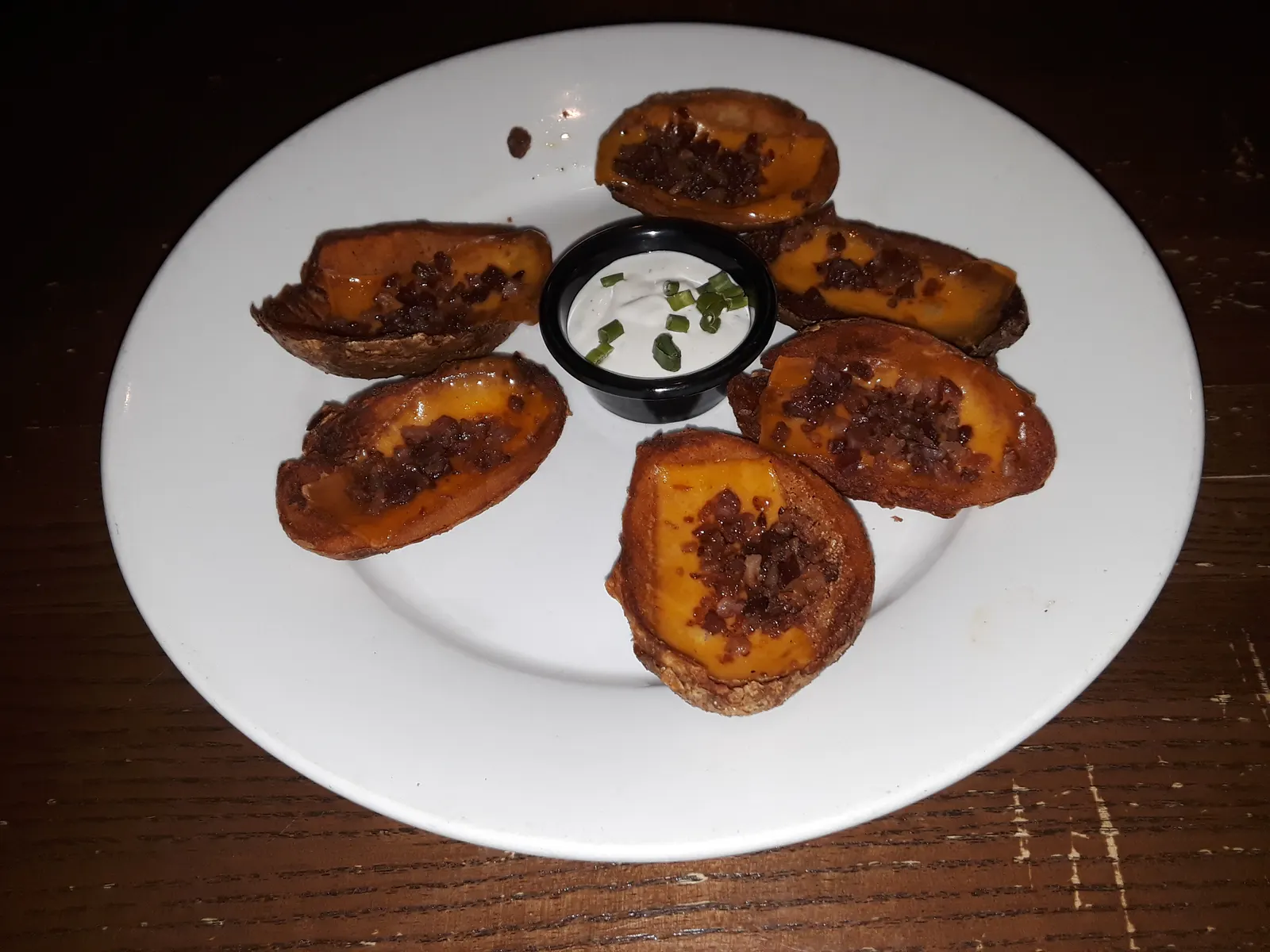
This public-domain TGI Friday’s plate mirrors the recipe’s restaurant-style target. The photographed dip is ranch; Lauren finishes her skins with sour cream and chives or green onion.Photo by Ser Amantio di Nicolao / Wikimedia Commons · CC0 1.0
Makes
12 skins
Potatoes
6 russets
Heat
Bake + broil
Total
1 hr 30 min
A potato becomes an appetizer by subtraction. Lauren Allen bakes six russets whole, removes just enough center to make twelve sturdy boats, and gives the exposed potato its own buttered broil before any topping arrives. That empty-shell interval is the hinge: it turns a soft baked potato into a crisp vehicle rather than a miniature twice-baked potato.
The load stays classic and deliberately short—cheddar, cooked bacon, sour cream, and one fresh green finish. There is no spice cabinet detour and no second filling mixed from the scooped flesh. The contrast does the writing: hot shell, bubbling cheese, brittle bacon, cold cream, sharp chive.
“These loaded potato skins are spot-on restaurant quality, and super easy to make from home!”
Bake the structure
The whole russet must be tender before it becomes a boat. Check the largest with a thin knife at the one-hour mark.
Leave a sturdy rim
Scoop only the center. A thick attached layer keeps the skin intact while the broiler dries and crisps its surface.
Butter both faces
Lauren brushes inside and outside before seasoning, giving the shell an even route to browning.
Never leave the broiler
Seven to eight minutes crisp the empty boats; three to four more melt the loaded cheddar. Watch color, not only time.
The bar-snack blueprintStarch · butter · melt · smoke
Four loads, each with one clear job
The source formula stays exactly where Lauren put it. Crispness comes from sequencing and restraint, not extra ingredients.
A thin coat inside and outside seasons the shell and carries heat across the newly exposed potato surface.
Brush rather than pour; puddled butter softens the boat instead of coating it.03
Eight ounces cheddar
The full source measure divides into a generous molten layer across twelve compact skins.
Shred before the broiler stage so the hot shells spend no time waiting.04
Eight cooked bacon slices
Crisp crumbles sit above the cheese, keeping smoke and crunch legible in every piece.
Drain and cool the cooked bacon before crumbling so excess fat does not pool in the boats.
Smoke + meltThe two toppings that meet the broiler
Cheddar softens into the boat while bacon keeps the edge
Eight cooked, crumbled slices supply the smoky crunch. Keep the pieces dry and crisp before they meet the cheese.Photo by Didriks / Wikimedia Commons · CC BY 2.0
Do not bury the shell
Eight ounces of cheese and eight slices of bacon are generous across twelve skins. Divide them evenly and let the crisp potato remain part of the bite.
Eight ounces of shredded cheddar become the molten center. The photograph is an illustrative grating demonstration rather than a labeled cheddar block.Photo by Didriks / Wikimedia Commons · CC BY 2.0
6 small to medium russet potatoes, rinsed clean and patted dry
1/4 cup unsalted butter (1/2 stick), melted
Salt, to taste
Freshly ground black pepper, to taste
Load and finish
8 ounces cheddar cheese, shredded
8 slices bacon, cooked and crumbled
Sour cream, for topping
Chopped chives or green onion, for topping
Directions
Heat the oven to 400°F / 205°C. Poke each clean, dry russet several times with a fork and set the potatoes on a large baking sheet.
Bake for about 1 hour, preserving the source clock. Begin checking the largest potato at that point: it should offer little resistance to a thin knife and feel tender through the center. Continue in short increments if needed.
Move the potatoes off the hot sheet and let them cool for about 15 minutes, just until they can be handled safely. Keep the baking sheet ready for the shells.
For small potatoes, cut each one in half lengthwise. For large potatoes, cut each lengthwise into three long slabs; reserve the skinless middle slab for another dish. Either route yields two skin-on boats per potato.
Use a small spoon to hollow each skin slightly, keeping a sturdy layer of potato attached all around. A roughly 1/4-inch border is a useful independent guide, but leave more wherever a thin skin needs support. Save the removed flesh for another use.
Switch the oven to high broil. Brush the hollowed and skin sides with the melted butter, arrange the boats hollow side up on the baking sheet, and season with salt and pepper.
Broil for 7–8 minutes, watching continuously, until the buttered interiors look dry at the surface and the rims are lightly crisp. Broiler intensity varies; pull the sheet sooner if an edge darkens rapidly.
Divide the cheddar generously among the hot boats and scatter the cooked, crumbled bacon over it. Return the sheet to the broiler for about 3–4 minutes, watching continuously, until the cheese is melted and bubbling.
Top with sour cream and chopped chives or green onion. Serve warm while the shells are crisp. Refrigerate any leftovers within 2 hours.
Source and research references: the January 7, 2015 My Recipe Magic card for the queued legacy identity, title, Lauren Allen byline, original deck, eight ingredient lines, opening method, and unusable historical nutrition; Lauren’s maintained Tastes Better From Scratch article and recipe card for her January 2015 first-publication note, complete matching formula, twelve-skin yield, 20/70/90-minute clock, large-versus-small cutting method, thick shell, butter brush, 7–8-minute empty-shell broil, 3–4-minute cheese broil, current automatic nutrition, refrigerator storage, and hollow-shell freezing plan; Dax Phillips’s Simple Comfort Food recipe, which Lauren credits as her adaptation base, for independent preservation of the same six-potato, eight-ounce-cheddar, eight-bacon-slice, quarter-cup-butter structure; The Kitchn’s test-kitchen loaded potato skins for the serrated-knife option, one-quarter-inch shell guide, and reserved-flesh use; Food Network Kitchen’s tested potato skins for a low-resistance knife cue, the same one-quarter-inch border, bubbling-cheese cue, and immediate service; America’s Test Kitchen via The Splendid Table for russets’ high-starch, low-water baking behavior and the importance of venting and crisping; and FoodSafety.gov’s game-day guidance for 40°F cold holding, the two-hour/one-hour limit, 3–4-day refrigerated storage, and 165°F reheating. The recipe’s ratios, cutting logic, oven settings, broiler timings, topping order, and identity remain unchanged; doneness, border, broiler-watch, storage, reheating, and allergen guidance are explicitly separated research.