
Butcher-counter supperChicken · cheese · bacon

Four rolls · one hot broiler

Bacon-Wrapped Cream Cheese Stuffed Chicken Breast

Thin chicken cutlets rolled around cream cheese, pepper Jack, and green onion, wrapped in bacon, baked, and broiled crisp.

Roll the chicken
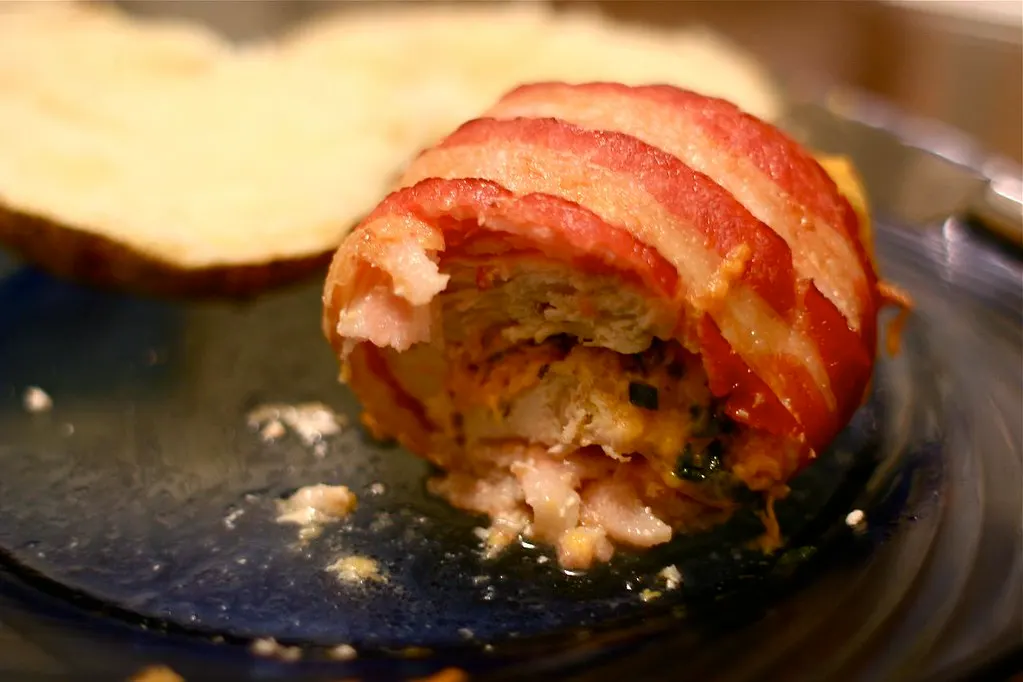
A bacon-wrapped chicken roulade cut open to reveal a seasoned cheese filling.
An illustrative bacon-wrapped, cheese-filled chicken roulade. Catherine Daugherty’s exact filling uses cream cheese, pepper Jack, and green onion.Photo by bovinity · CC BY-SA 2.0
Prep
15 min
Bake
30 min
Finish
Broil 5–8 min
Serves
4

This is a five-ingredient lesson in layers. Catherine Daugherty’s 2013 recipe turns one pound of chicken into four thin sheets, spreads each with cream cheese, pepper Jack, and green onion, then uses a bacon spiral to hold the roll together. The oven cooks the center; the broiler makes the outside worth cutting into.

The formula does not need embellishment. It needs a clean sequence: pound evenly, leave a border around the filling, place the seam down, and probe the center before chasing crisp bacon. That order preserves the original supper while resolving the one thing a clock cannot tell you—whether a filled roll is safely cooked through.

“An easy but elegant main dish with moist chicken, a creamy center, and a crisp bacon wrapping.”

Thin on purpose

Four-ounce chicken pieces pounded to an even 1/4 inch roll around the filling without leaving a thick, slow-cooking center.

The seam has a job

Filling stays away from the rim, the chicken rolls snugly, and the seam lands underneath before bacon locks the shape.

Brown after safe

The oven cooks chicken and filling to 165°F; only then does a closely watched broil crisp the bacon.

Filling studyCream heat smoke

Three ingredients build the center and shell

The quantities are restrained; how each ingredient is distributed decides whether every slice tastes complete.

01

Cream cheese

Four softened tablespoons make the filling cohesive and creamy without overwhelming four small chicken rolls.

Soften only until easy to mix; warm, loose cream cheese is more likely to escape at the seams.Read the ingredient story
02

Pepper Jack

A quarter cup brings a firmer melt and little pockets of chile to the mild cream-cheese base.

Shred it finely so the small amount distributes through every portion of filling.
03

Bacon

One or two slices per roll make the outer spiral, supply smoky fat, and brown under the final broil.

Overlap the wrap just enough to cover the chicken; heavy stacking can leave soft bands while exposed ends overbrown.

Mise en placePortion filling picks probe

Count, divide, and stage before raw chicken

A tidy setup keeps cheese portions even and creates a one-way route from raw board to clean platter.

Spiral + centerCrisp outside, quiet heat within

The cut reveals whether the roll held

A bacon-wrapped chicken breast sliced across the middle on a patterned plate.
A finished bacon-wrapped chicken breast shows the spiral wrap and the thin, even chicken layer that surrounds the filling.Photo by Michele Frazier · CC BY 2.0
Leave a narrow bare edge

Cheese needs room to move as it heats. A clean border gives the chicken surfaces a chance to meet before bacon and toothpicks secure the roll.

A pale block of pepper Jack cheese dotted with red and green pepper pieces.
Pepper Jack gives the four-tablespoon cream-cheese filling a firmer melt and a mild pepper edge.Photo by Daniel Olsen · CC BY 1.0

Fifty-minute clockPound fill bake probe broil

Fifteen minutes to roll, then stay near the oven

The source publishes a 50-minute total; its written underside broil can add up to 3 minutes beyond that stated clock.

  1. 0:00

    Heat and line

    Set the oven to 375°F and prepare a rimmed pan to contain bacon fat and any escaped cheese.

  2. 0:03

    Pound evenly

    Work from the thick center outward until all four chicken pieces are about 1/4 inch thick.

  3. 0:08

    Mix and portion

    Combine the two cheeses with green onion and divide the filling into four equal mounds.

  4. 0:11

    Roll, wrap, secure

    Leave the edges clear, roll the chicken, set the seam down, spiral with bacon, and pin loose ends.

  5. 0:15

    Bake

    Bake for 30 minutes, then probe each roll from the side and continue only until the coolest center reaches 165°F.

  6. 0:45+

    Broil and rest

    Crisp the top for about 5 minutes, turn for up to 3 more if needed, then rest 5 minutes and remove toothpicks.

Doneness cues165 bronze opaque creamy

Four signs the roll is ready to rest

Temperature answers safety. Bacon color, chicken texture, and the settled filling answer the rest.

01

Center reaches 165°F

Probe from the side through chicken and filling. Check more than one roll because the shapes and bacon coverage vary.

02

Bacon is bronzed, not black

The wrap should look crisp at its raised edges after broiling without scorched ends or smoking fat.

03

Chicken looks evenly opaque

A test slice after resting should show no translucent seam; temperature remains the safety decision, not color alone.

04

Filling holds a soft center

The cheese will be hot and creamy. A little leakage is normal, but most should remain inside a snug, rested roll.

Keeping planCook cool cover reheat

Treat the filled center as the slow lane

Stuffed poultry needs disciplined timing before the oven and deliberate cooling and reheating afterward.

Cook after assembly

USDA guidance for stuffed poultry favors filling just before cooking. Keep ingredients cold and move assembled rolls straight to the oven.

Cool promptly

Refrigerate within 2 hours in a shallow covered container so dense filled centers shed heat efficiently.

Use within four days

USDA gives cooked stuffed poultry a 3-to-4-day refrigerator window; freeze sooner if dinner plans change.

Reheat to the center

Warm only the portions needed and verify 165°F in the filling, where a bacon-wrapped roll heats slowest.

Bacon-wrapped cream cheese stuffed chicken breast

Four thin chicken rolls filled with cream cheese, pepper Jack, and green onion, wrapped in bacon, baked, and broiled crisp.

Chicken BreastBaconCream CheesePepper JackStuffed ChickenBaked Chicken

Ingredients

Chicken and filling

  • 1 pound boneless, skinless chicken breast, cut into four 4-ounce pieces
  • 4 tablespoons cream cheese, softened
  • 1/4 cup pepper Jack cheese, shredded
  • 2 tablespoons green onion, finely chopped

Wrap

  • 4 to 8 slices bacon

Directions

  1. Heat the oven to 375°F (190°C). Line a rimmed baking sheet or choose a baking dish. Keep a clean platter separate for the cooked chicken.
  2. Place each 4-ounce chicken piece inside a sturdy food-safe bag or between sheets of parchment. Pound from the thicker center outward until the meat is an even 1/4 inch thick, taking care not to tear holes.
  3. Mix the softened cream cheese, pepper Jack, and green onion until evenly combined. Divide the filling into four portions.
  4. Set one portion of filling across the center of each chicken piece, leaving a narrow bare border. Starting at a long edge, roll the chicken snugly around the filling with the seam underneath.
  5. Spiral 1 or 2 bacon slices around each roll, overlapping enough to cover the chicken. Secure loose ends and the seam with toothpicks, then arrange the rolls seam-side down in the prepared pan with space between them.
  6. Bake for 30 minutes. Check the center of each roll with an instant-read thermometer inserted from the side so the sensing area reaches the chicken and filling without resting against the pan. Continue baking if needed until every roll reaches 165°F (74°C) at its coolest point.
  7. Broil the tops for about 5 minutes, watching continuously, until the bacon browns and crisps. The source then turns each roll and broils the underside for about 3 minutes; do this only if needed for crispness, and keep watching closely.
  8. Transfer the rolls to the clean platter, rest for 5 minutes, remove every toothpick, and serve hot.

Source and research references: Catherine Daugherty’s primary Pray Cook Blog recipe, its first-day archived page, the queued My Recipe Magic card, the USDA guides to stuffed-poultry safety, thermometer placement, and leftover storage, plus FoodSafety.gov’s safe-temperature chart.

Image credits

Photography is used under open licenses with attribution: bovinity, Michele Frazier, and Daniel Olsen.