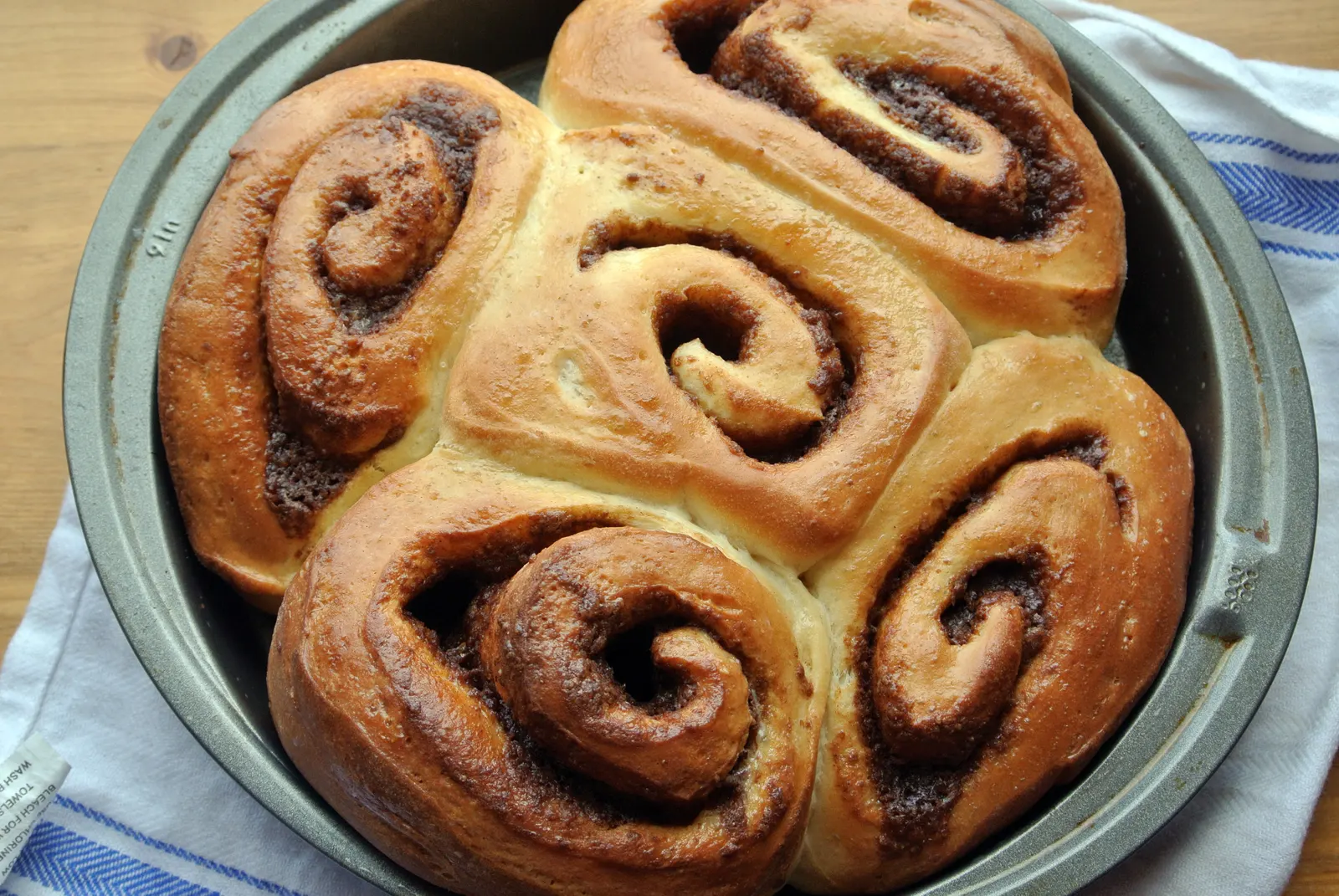
These open-license cinnamon rolls are an illustrative unglazed pan. Jocelyn’s recipe makes nine no-yeast square-pan rolls, each finished with an apple-butter cream-cheese glaze.Photo by Karen and Brad Emerson / Wikimedia Commons · CC BY 2.0
Makes
9 rolls
Method
No yeast
Oven
425°F
Total
40 min
The orchard runs through every layer. Jocelyn does not simply smear apple butter into an ordinary cinnamon roll. A quarter-cup joins buttermilk in the dough, six tablespoons draw the dark spiral, and the final two tint a cream-cheese glaze. The repetition makes a concentrated fruit spread read as structure, filling, and finish.
The surprise is speed. Baking powder and soda replace yeast, and a soft biscuit-style dough goes from bowl to oven without a rise. That trade demands a light hand: accept the stickiness, use flour beneath rather than inside, and free the sheet with a scraper as it rolls. Twenty oven minutes later, the center—not the browned edge—is the final judge.
“These soft Apple Butter Cinnamon Rolls are a delicious and sweet breakfast for fall mornings.”
Trust the stickiness
Jocelyn confirms the 2½-cup flour measure. Flour the bench and hands without kneading a new cup of flour into the dough.
Keep it moving
Baking soda and powder replace the proof. Once the buttermilk lands, mix briefly, shape directly, and bake in the hot oven.
Release, do not tug
A scraper or broad knife separates the soft rectangle from the bench as the short side rolls into a nine-piece log.
Read the center
Golden edges can arrive before the middle is set. Look between the center coils and use 190°F as an optional cross-check.
The dough mapTender · lift · spiral · glaze
One orchard note, three different jobs
The source proportions stay fixed. Success comes from keeping the handling flour outside the dough and each apple-butter measure in its own stage.
01
Two and one-half cups flour
The measured base supports nine quick rolls while keeping the chemically leavened crumb tender rather than bread-like.
Reserve bench flour for handling. Jocelyn explicitly confirms that the sticky 2½-cup dough is correct.02
One-quarter cup in the dough, six tablespoons inside the coil, two tablespoons in the glaze—each is distinct and unchanged.
Apple butter appears three times: one-quarter cup softens the dough, six tablespoons stripe the filling, and two tablespoons tint the glaze.Photo by Whitney / Wikimedia Commons · CC BY 2.0
The direct laneSift mix pat stripe roll cut bake glaze
Forty minutes with no proofing clock
Chemical leavening removes the rise, not the need for sequence. Prepare the pan first, shape promptly, and save the final decision for the center roll.
0:00
Heat and butter the pan
Set 425°F and brush the 10-inch square pan with the fifth tablespoon of melted butter.
+3
Sift the dry map
Distribute flour, sugar, baking powder, baking soda, and salt before any liquid arrives.
+6
Make one sticky dough
Add buttermilk, the first apple butter, and four tablespoons butter; stop as soon as the bowl is cohesive.
+9
Flour, turn, pat
Knead only a few turns, then keep the bench dusted while forming the even 10-by-14-inch rectangle.
+13
Stripe the apple center
Spread six tablespoons apple butter inside a clean border and cover it with the cinnamon-sugar blend.
+16
Roll short side, cut nine
Release the sheet from underneath as it rolls; trim lightly, mark thirds, and divide each third into three.
+20
Bake the center through
Give the pan about 20 minutes, then judge the middle coils for set crumb, golden color, and optional 190°F.
40:00
Glaze while warm
Beat cream cheese, powdered sugar, and the final apple butter, then spread over the slightly cooled rolls.
Four tactile cuesSticky · even · bordered · set
Read the dough before you read the timer
Jocelyn’s formula is intentionally soft. These cues distinguish useful stickiness from a glued bench, and a moist apple spiral from raw center dough.
01
Soft and insistently sticky
The dough clings before the counter is floured but gathers as one mass. Dry, stiff dough means too much handling flour moved inside.
02
An even, supported rectangle
Ten by fourteen inches gives nine comparable coils. Keep checking underneath so the filling stage does not cement it to the bench.
03
A narrow clean border
The apple butter stops just shy of the edge. That small dry margin limits squeeze-out and gives the last turn somewhere to seal.
04
Golden outside, set inside
The center roll should not show a glossy raw seam. Its dough may reach about 190°F even while the apple-butter spiral stays moist.
The next-day planGlaze serve cover chill reheat
Serve warm, then move the glazed pan cold
Cream cheese turns a countertop pastry into a refrigerated leftover. Keep the first service generous and the remaining clock short.
Glaze for immediate service
Spread the three-ingredient glaze over rolls that have cooled only slightly so it relaxes across the warm ridges.
Refrigerate every leftover
Cover the glazed pan and move it to a refrigerator at 40°F / 4°C or below within two hours of baking and service.
Use within 3–4 days
The source specifically keeps leftovers cold and reheats the next day; the shorter general leftover window protects the dairy glaze.
Warm one roll at a time
Jocelyn gives 30–40 seconds in the microwave for a next-day roll. Heat only the portion you plan to eat.
Apple Butter Cinnamon Rolls
Jocelyn’s nine no-yeast buttermilk rolls with apple butter in the dough, cinnamon filling, and cream-cheese glaze.
2 1/2 cups all-purpose flour, plus flour for the work surface and hands
2 tablespoons granulated sugar
1 1/2 teaspoons baking powder
1/2 teaspoon baking soda
1/2 teaspoon salt
1 cup buttermilk
1/4 cup apple butter
4 tablespoons unsalted butter, melted
Pan and filling
1 tablespoon unsalted butter, melted, for the pan
6 tablespoons apple butter
1/3 cup packed brown sugar
2 tablespoons granulated sugar
1 teaspoon ground cinnamon
Apple-butter glaze
4 ounces cream cheese, softened
1 cup powdered sugar
2 tablespoons apple butter
Directions
Heat the oven to 425°F / 220°C. Brush a 10-inch square baking pan with the reserved 1 tablespoon melted butter, reaching the corners and lower sides.
Sift the 2 1/2 cups flour, 2 tablespoons granulated sugar, baking powder, baking soda, and salt into a large bowl. Stir once so the two leaveners are distributed evenly.
Make a well in the dry ingredients. Add the buttermilk, 1/4 cup apple butter, and 4 tablespoons melted butter. Mix on low speed or with a fork only until a soft, cohesive dough forms. It will be very sticky; do not taste the raw dough.
Flour the work surface and your hands generously. Turn out the dough and knead it only a few times—just enough to make it manageable—using a scraper to lift it and adding flour beneath it as needed. Keep the measured 2 1/2-cup formula intact rather than working extra flour through the whole dough.
Pat or gently roll the dough into an even 10-by-14-inch rectangle. Check underneath as you work and dust the surface again wherever it begins to cling.
Spread 6 tablespoons apple butter across the rectangle, leaving a narrow clean border at every edge. Mix the brown sugar, remaining 2 tablespoons granulated sugar, and cinnamon in a small bowl, then scatter the mixture evenly over the apple butter.
Starting at a short side, roll the dough slowly into a log. Slide a bench scraper, broad spatula, or butter knife underneath whenever the dough sticks instead of pulling at the soft sheet. Trim only a thin piece from each end to square the log.
Mark the log into thirds, then divide each third into three equal pieces. Cut nine rolls with a sharp knife or unflavored dental floss and set them cut side down in the buttered pan.
Bake for about 20 minutes. Begin checking at that point: the outer coils should be golden, the center rolls should look set rather than wet, and an instant-read thermometer inserted into the dough of a center roll may read about 190°F / 88°C. If the center is still raw, continue in short increments instead of judging only by the browned edge rolls.
Let the pan cool slightly while making the glaze. Beat the softened cream cheese, powdered sugar, and remaining 2 tablespoons apple butter until smooth and creamy. Spread over the warm rolls and serve. Refrigerate uneaten glazed rolls promptly.
Source and research references: the queued legacy path /apple-butter-cinnamon-rolls-2500872388.html for the title and ID; Jocelyn’s maintained Inside BruCrew Life article and full recipe card for the October 4, 2013 publication, author, nine-roll yield, 20/20/40-minute clock, complete formula, 10-by-14-inch shape, short-side roll, current 10-inch-square pan, 425°F bake, glaze, refrigeration, and 30–40-second next-day reheat, plus her direct comment confirming the 2½-cup flour amount; the matching Musselman’s grower-cooperative card for independent preservation of the same ingredients and method and its disclosed 8-inch-pan variant; King Arthur Baking’s test-kitchen biscuit-dough cinnamon buns for a soft dough, heavily floured work surface, scraper-assisted rolling, light-golden cue, immediate baking, and covered storage; King Arthur’s small-batch cinnamon rolls for an independently tested 190°F center cue; University of Minnesota Extension’s cream-cheese frosting safety discussion for the importance of verified sugar concentration and water activity rather than assuming every dairy frosting is shelf stable; FoodSafety.gov’s 40°F cold holding and two-hour rule; and FDA raw flour and baking-mix guidance. The source ratios, triple apple-butter structure, shaping direction, yield, and clock remain unchanged; scraper technique, center-doneness language, cold-holding limits, raw-flour caution, and allergen context are explicitly separated guidance.