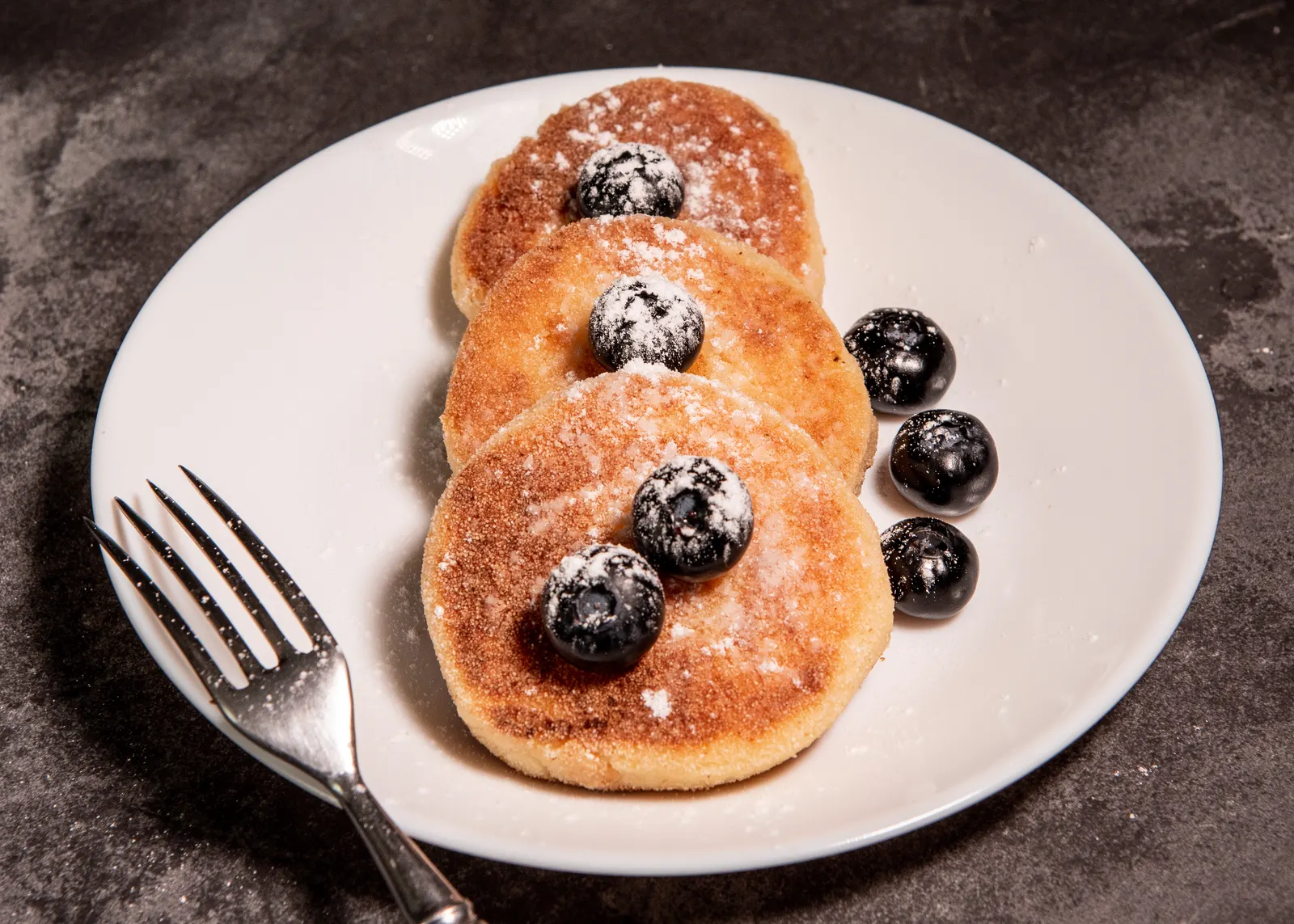
The open-license plate shows Ukrainian syrnyky, the same wider Eastern European family of curd cakes. Blueberries and powdered sugar are illustrative; The Wild Birch serves this formula with sour cream and berry preserves.Photo by Evil linnka / Wikimedia Commons · CC BY-SA 4.0
Serves
3
Prep
5 min
Skillet
14 min
Center
Curd-forward
These are cheese cakes in the literal sense. Farmer cheese supplies nearly all the mass, while two eggs and six tablespoons of flour persuade the curds to hold a thick pancake shape. The source title uses “Sirniki”; “syrniki” is the familiar alternate transliteration.
Their success lives in restraint. Do not dry the mixture with fistfuls of flour, do not flatten the cakes into crepes, and do not race medium heat. Wet hands make the sticky dough cooperative; a thin dredge and a patient skillet turn its outside gold while the middle stays gently tangy.
“Traditional Russian breakfast full of everything you’ll love.”
Fifteen ounces curd
Two 7.5-ounce farmer-cheese packages stay the dominant ingredient; flour is binder and coating, not the body.
One wet-hand bowl
Room-temperature water manages the deliberately sticky mixture without forcing more flour into it.
One light dusting
Coating flour gives each face a dry surface for browning while the interior remains tender and cheese-led.
Two patient sides
Six to seven minutes per face on medium heat lets a thick cake firm before its golden crust gets too dark.
The ingredient mapCurd bind coat finish
One dry curd, three supporting moves
The formula is short enough that every ingredient has a visible job. Keep the flour measured and let farmer cheese remain the headline.
01
Dry farmer cheese
Fifteen ounces of compact curd supply the tang, tenderness, and structure promised by the dish.
Look for a dry, crumbly package rather than loose cottage cheese suspended in whey.02
Two eggs
Egg binds the curds into a sticky mixture that can be rounded and flattened.
Mix them completely into the cheese before adding flour so no wet pockets remain.03
Six tablespoons flour
A restrained amount holds the center together without turning sirniki into ordinary pancakes.
Keep extra flour outside as a thin dredge; do not chase a dry dough.04
Sour cream + dark jam
Cool tang and tart fruit sharpen the warm, lightly sweet cheese cakes at the table.
Blackcurrant preserves are the source author’s especially traditional choice.
The breakfast clockWet shape dust fry
A five-minute mix and one patient turn
The source gives 14 skillet minutes after a five-minute preparation. Shape beside the pan, leave an inch between cakes, and follow the crust rather than the urge to flip.
0:00
Warm a filmed skillet
Set vegetable or coconut oil over medium heat while the short dough comes together.
0:01
Season the curds
Work farmer cheese, eggs, salt, and one teaspoon sugar into an even sticky base.
0:03
Add only six spoons
Mix in the measured flour just until dry streaks disappear; stop before the curd texture gets buried.
0:05
Wet, round, flatten, dust
Use damp hands for small thick cakes, then coat both faces lightly in extra flour.
0:06
Leave space and fry
Give each cake about an inch of room and let the first side build a golden set crust.
0:13
Turn once
Flip only when the first face releases, then give the second face the same patient 6–7 minutes.
0:20
Serve warm
Move firm, browned sirniki to the plate and add sour cream and berry preserves at the table.
Curd + berryThe center and its sharp finish
Dry tvorog builds the cake; dark fruit wakes it up
Forest-berry kissel supplies the same tart-fruit logic as the source author’s jam suggestion. Her preferred table is sour cream plus a whole-berry preserve, especially blackcurrant.Photo by Kunetskiy / Wikimedia Commons · CC BY-SA 3.0
Keep the center cheesy
Extra flour belongs on the outside. Inside, the measured six tablespoons should bind fifteen ounces of curd without erasing its tender grain.
A dry, crumbly curd is the useful visual target. This homemade tvorog is illustrative; the source specifies two packaged 7.5-ounce farmer cheeses.Photo by Ist2607 / Wikimedia Commons · CC BY-SA 4.0
Four physical cuesCling thickness crust firmness
Read the stick, shape, release, and center
The clock matters, but these are the signals that tell you whether your cheese moisture, shaping, and pan heat agree with it.
01
Sticky before shaping
The source warns you to expect cling. Wet hands solve it without diluting the curd or loading the middle with flour.
02
Thick, not domed
Flatten each ball into a small substantial pancake so the center can cook on the same clock as both faces.
03
Release before the turn
A properly set flour coat loosens more readily. If it tears or smears, give that side another quiet minute.
04
Golden and firm
Saveur uses the same paired cues. The crust should brown while the center loses its wet, unset feel.
The holding planBatch warm chill reheat
Fry fresh, hold briefly, chill promptly
Sirniki are best warm from the pan. A short batch hold and a careful leftover plan preserve more of their browned outside and tender middle.
Mix just before frying
The source needs only five prep minutes. Shape beside the heated pan rather than holding a sticky batch for hours.
Hold between batches
Keep finished cakes on a rack or warm plate in a low oven while the remaining sirniki fry without crowding.
Chill within two hours
Cool leftovers promptly and seal them before refrigeration; do not leave the dairy-and-egg cakes on the breakfast table all morning.
Keep 3–4 days
USDA’s cooked-leftover window applies. Reheat to 165°F, using low skillet heat or a moderate oven to protect the crust.
Traditional Russian Breakfast (Sirniki)
Small, thick farmer-cheese cakes with a light flour coat, fried until golden and served warm with sour cream and berry preserves.
SirnikiSyrnikiFarmer CheeseRussian BreakfastSkilletVegetarianBlackcurrant Jam
Ingredients
Sirniki
2 (7.5-ounce) packages farmer cheese, 15 ounces total
2 large eggs
1/2 teaspoon salt
1 teaspoon granulated sugar
6 tablespoons all-purpose flour, plus more for coating
Vegetable or coconut oil, enough to lightly coat the skillet
For serving, optional
Sour cream, the source author’s traditional accompaniment
Berry jam or whole-berry preserves, preferably blackcurrant
Directions
Set a large skillet over medium heat and add enough vegetable or coconut oil to make a thin, continuous film. Let the pan warm while you mix the curds.
Put the farmer cheese, eggs, salt, and sugar in a medium bowl. Mix with a spatula or clean hands until the eggs are fully incorporated and the curds are evenly seasoned.
Add the measured 6 tablespoons flour and mix only until no dry streaks remain. The mixture will be very sticky; that is the source’s intended texture, not a signal to bury it in extra flour.
Put a small bowl of room-temperature water beside the work area and some additional flour in a shallow bowl. Dip your hands in the water, scoop up a portion of cheese mixture, and roll it into a ball.
Flatten the ball gently between your palms into a small, thick pancake. Coat both faces lightly in the additional flour and shake away loose excess. Repeat, wetting your hands between pieces as needed.
Arrange the shaped cakes in the hot skillet with about 1 inch between them. Work in batches rather than letting the sides touch or crowding the pan.
Fry for 6–7 minutes on the first side. Turn when the underside is evenly golden and the cake releases without tearing, then cook the second side for another 6–7 minutes.
The sirniki are ready when both faces are browned and the cakes feel firm rather than wet at the center. Transfer to a plate or rack and serve warm with sour cream and berry preserves if desired.
Source and technique references: the queued legacy path and exact title match, plus The Wild Birch’s maintained post and public recipe card for the 2021 date, author identity, three servings, 5/14-minute clock, six-item formula, sticky-mixture note, equipment, shaping, spacing, frying, and sour-cream-and-jam service; Saveur’s Yelena Bachko syrniki for the independently tested wet-hand shaping, light flour dredge, medium skillet, and golden-and-firm finish cues; Victoria Drey’s Russia Beyond technique guide for dry curd, restrained flour, low-to-medium heat, and the warning that high heat can brown a thick cake before its center sets; and USDA FSIS for two-hour chilling, 3–4-day refrigerated storage, and 165°F leftover reheating. No source ratio or defining skillet step was changed.