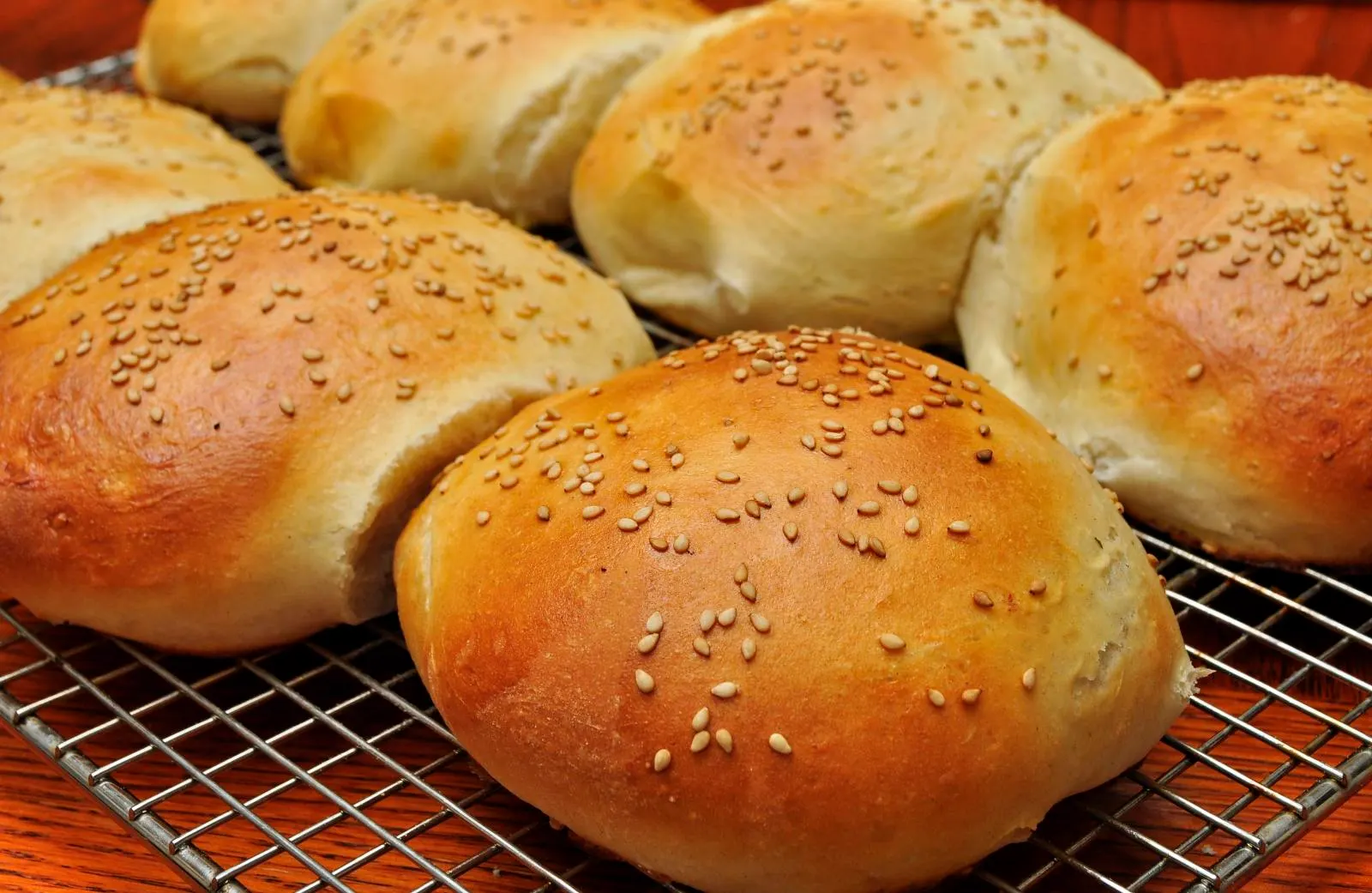
Fresh sesame buns as an illustrative starting point. Kari’s technique begins with four ready-made hamburger buns and adds no butter or other fat.Photo by jeffreyw · CC BY 2.0
Makes
4 buns
Setting
Bagel
Shade
Medium–dark
Added fat
None
The smallest kitchen discoveries often hide in plain sight. Kari Shifflett had four hamburger buns, two teenagers headed in opposite directions, and no interest in melting butter or washing another pan. Her twelve-year-old toaster already had the solution printed on its face: Bagel.
On a true one-sided setting, the cut crumb faces active heat while the domed crust receives less or none. The result is exactly what a burger bun wants—structure where juices land and softness where fingers hold it. The recipe needs no embellishment, but it does need one modern qualification: the button behaves differently from model to model, so the appliance manual is an ingredient in everything but name.
“Kari Shifflett wanted warm, toasted buns for two teenagers without adding butter, dirtying a pan, or slowing down a quick meal. The overlooked bagel button was the whole answer.”
The button is the technique
A compatible Bagel mode reduces or disables heat on one side so the cut crumb browns while the rounded crust stays comparatively soft.
The manual is part of the mise en place
Slot direction, cycle order, and even whether Bagel mode is truly one-sided differ by toaster model. Check before loading.
Dry means dry
No butter, oil, cheese, sauce, or spread enters a pop-up toaster. Dress the warm buns only after they eject.
Compatibility firstManual fit dry heat
Four gates before a bun enters the slot
The shortcut works only when the toaster, bun, and setting agree. Each check has a clean fallback.
The manual names buns or round breads
Use the Bagel cycle
Load the halves exactly as the model diagram shows; several manufacturers direct cut faces toward the inside elements.
The manual says Bagel still heats both sides
Expect an all-over toast
Kari’s soft-outside result is not guaranteed. Stop at a lighter shade or use a cut-side-only skillet or grill instead.
A bun half rubs, protrudes, or wedges
Do not force it
A jammed carriage defeats the safety shutoff. Move that bun to a toaster oven, broiler, dry skillet, or grill.
The bun is already buttered or dressed
Keep it out of the slot
Manufacturer warnings are explicit: toppings can drip, ignite, or contact live components. Use a pan or toaster oven.
No stopwatch promisedRead split set select pop
From factory seam to toasted face in one watched cycle
Kari gives a shade range, not a minute count. Let the machine run its own cycle while you watch color, aroma, and fit.
READ
Confirm model and orientation
Find the Bagel instructions, slot-width limit, and cut-face direction before the toaster is hot.
SPLIT
Make four dry buns into eight halves
Use the factory seam or a serrated knife. Similar thickness gives the most even batch.
SET
Choose medium to medium-dark
That is Kari’s source range. Start lower for sweet, dry, very soft, or unfamiliar buns.
BAGEL
Lower, select, and stay beside it
Follow the model’s button order and watch the full cycle. Cancel is the correction for fast browning.
POP
Read the cut face, then assemble
Golden crumb and a soft rounded shell are the target. Fill while the buns are still warm.
Heat + landingThe red coil and the soft shell
One side meets the element; one side holds the meal
A pop-up toaster in operation. Bagel modes vary by model, so the manufacturer’s slot orientation and one-sided-heating instructions outrank any universal rule.Photo by Photokid261 · CC BY-SA 4.0
Bagel does not mean the same thing everywhere
Some models disable the outer elements; some merely rebalance heat; at least one GE family still browns both sides. Read the diagram, then point the cut faces where your manufacturer says.
4 hamburger buns, plain and completely free of butter, oil, sauce, cheese, or other toppings
Directions
Read the toaster’s own manual before beginning. Confirm that its slots are wide enough for split buns without forcing or protruding, that a Bagel function is provided, and which direction the cut faces should point. Do not use this method if the manual excludes buns or the halves can jam.
Split the four buns evenly if they are not already cut. Leave every surface dry: do not butter, oil, season, fill, or top the buns before they enter a pop-up toaster.
Set the shade control to medium or medium-dark, the range Kari specifies. Load the halves in the orientation required by the manufacturer; on many one-sided Bagel settings, the cut faces point toward the inside elements. Keep like-size halves together so they brown at a similar rate.
Lower the lever and activate the Bagel function in the order specified for the toaster. Stay beside the appliance for the full cycle. Use Cancel and eject the buns early if the cut faces smell deeply toasted or look golden enough before the cycle ends.
When the buns rise, remove them by their cool edges without touching the slots. The cut faces should be lightly to deeply golden while the rounded exteriors remain soft. Serve immediately around burgers or sandwich fillings.
After serving, switch off and unplug the toaster. Let it cool completely, then empty the crumb tray according to the manufacturer’s directions; never insert a metal utensil into the slots.