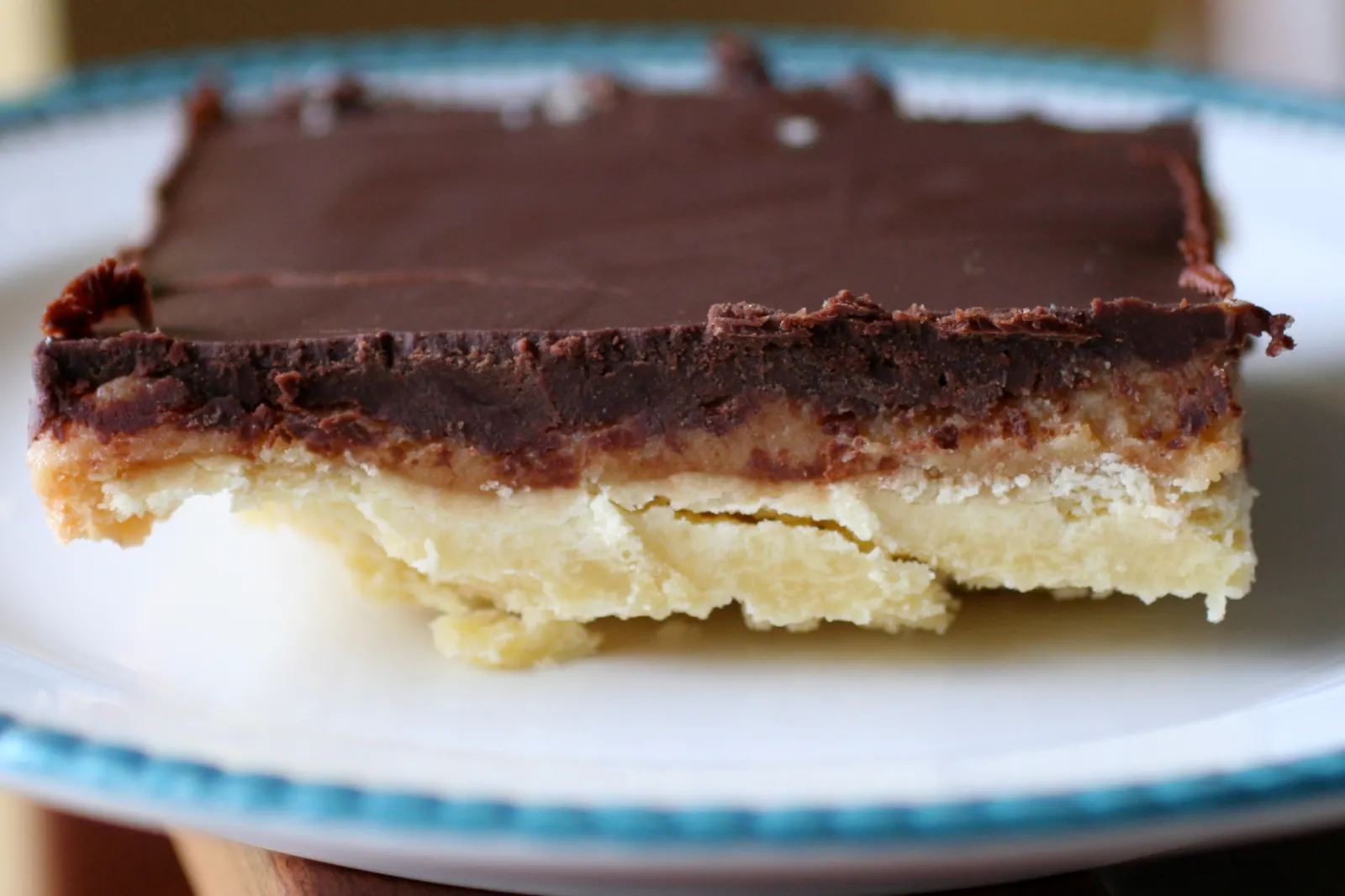
The three-layer architecture is the point: a fully cooled shortbread base, a set caramel center, and chocolate spread edge to edge. This open-license millionaire’s shortbread is an illustrative close relative.Photo by Whitney / Wikimedia Commons · CC BY 2.0
Yield
16 bars
Pan
9 × 13 in
Caramel
Soft ball
Keep
1 week cold
The pleasure is architectural. A pale, tender cookie carries a deep amber caramel; a broad milk-chocolate cap closes the slab. Lauren Allen’s original version is not a dipped candy-bar replica. It is a pan of bold, square-cut layers with the same biscuit-caramel-chocolate rhythm and a homemade caramel at its center.
That center is the only narrow finish line. Under-cook it and the layer runs; push beyond soft ball and it turns hard on the teeth. The recipe gives both instruments—a thermometer if you own one, ice water if you do not—then asks patience between every layer. Cool, set, spread, set again.
“The most amazing Homemade Twix Bars with an easy shortbread crust, a layer of homemade caramel, and melted chocolate on top.”
Cool
The shortbread must be fully cool before hot caramel arrives, and the caramel must set before chocolate follows.
Read
A thermometer gives the range; a very soft ball in ice water confirms the texture the original author intended.
Stir
Condensed milk brings solids that can catch. Sweep the base and corners constantly from boil to finish.
The construction ledgerCrumb · chew · snap
Three layers, eleven measured parts
The legacy formula stays intact. Each layer has a different structural job, and none needs an extra flavor to announce itself.
01
Salted-butter shortbread
Equal cups of butter and powdered sugar meet two cups flour for a tender, pale base with a lightly golden rim.
Work only until the crumbs cohere, then press gently and evenly so the base does not become compact.02
Brown-sugar caramel
Butter, brown sugar, corn syrup, and sweetened condensed milk cook into the thick middle layer.
The dash of salt belongs to the legacy formula. Do not omit it merely because a later edition did.03
Light corn syrup
Corn syrup supplies glucose that helps the non-crystalline caramel stay smooth while it concentrates.
Keep the source cup intact. This is structure, not a garnish or a sweetness adjustment.04
Milk chocolate
Three cups create a generous top layer; one tablespoon butter helps the chips spread smoothly.
Use a dry bowl and stop heating before every piece looks liquid. Stirring finishes the melt with less scorching risk.
The layer clockPress bake cool boil set melt cut
A relay of heat and waiting
Active work comes in short passages. The quiet intervals keep the boundaries sharp and the final slab sliceable.
0:00
Press the shortbread
Heat the oven to 300°F, prepare the pan, and bring four ingredients together with a pastry blender.
0:08
Bake the pale base
Give the pressed layer 28–33 minutes, stopping at a set center and lightly golden outside edge.
Cool
Wait for a cold foundation
The caramel is hot enough to soften a warm crust, so let the baked base lose all residual heat.
Boil
Stir to soft ball
Keep the caramel moving until it reaches a very soft ball in ice water—about 234–240°F at sea level.
1–2 hr
Set the middle
Spread immediately, let the surface settle, then refrigerate until the caramel is firm enough to support chocolate.
30 sec
Melt in pulses
Heat milk chocolate and butter briefly, stirring between every burst until residual heat makes the mixture smooth.
Firm
Finish cold, cut clean
Spread, refrigerate, then portion the slab into sixteen bars with a warm dry knife.
Amber + cocoaThe middle and the finish
Soft ball below, gentle melt above
This caramel sauce is pictured in a separate pastry preparation. For the bars, the source mixture is cooked to soft-ball stage so it sets into a sliceable layer rather than remaining a sauce.Photo by Rebecca Siegel / Wikimedia Commons · CC BY 2.0
The layers need different endpoints
Caramel is cooked until concentrated enough to set. Chocolate is heated only until fluid enough to spread. More heat helps neither one.
The 2015 formula calls for three cups of high-quality milk chocolate chips plus one tablespoon butter. Short microwave bursts and frequent stirring protect the finish from scorching.Photo by Jessica Merz / Wikimedia Commons · CC BY 2.0
The tactile proofGolden soft settled firm
Four readings from oven to knife
The clock narrows the range; the layers themselves tell you when to move to the next stage.
01
The crust edge barely colors
The outer rim is light gold and the center no longer looks damp; a dark crust would overpower the tender base.
02
The caramel gathers softly
In ice water, a cooled drop can just be pinched into a yielding ball. Fluid syrup is underdone; a firm chew has gone too far.
03
The middle stops flowing
After chilling, the caramel supports a spatula stroke and the chocolate can be spread without marbling through it.
04
The chocolate yields to the knife
It is set and matte-glossy, not liquid, yet a warmed blade passes through without shattering the entire top.
The cold planCool set cut cover
Make time do the delicate work
This is an accommodating make-ahead bar precisely because every pause improves definition.
Build the base first
Bake and cool the shortbread before starting the caramel. Once the syrup reaches soft ball, it needs a waiting crust immediately.
Set overnight if useful
The source calls for at least 1–2 hours cold; the maintained author notes that an overnight caramel rest is also workable before chocolate.
Cut from cold
Firm layers travel cleanly under a warm dry knife. Keep portions chilled, then let them soften briefly before serving if desired.
Cover for one week
Refrigerate airtight for the source’s full one-week window. Freeze well wrapped only for longer storage.
The Best Homemade Twix Bars
Lauren Allen’s exact 2015 formula: salted-butter shortbread, condensed-milk soft-ball caramel, and milk chocolate, cut into sixteen bars.
Heat the oven to 300°F / 150°C. Coat a 9-by-13-inch pan very well with nonstick spray. For easier lifting, the maintained source also permits a parchment-paper sling with the paper lightly greased.
In a large bowl, use a pastry blender to work the room-temperature salted butter, powdered sugar, flour, and vanilla together just until the mixture coheres. Press it gently and evenly across the bottom of the prepared pan.
Bake for 28–33 minutes, until the outside edge is lightly golden and the center looks set. Remove the pan from the oven and let the shortbread cool completely before adding caramel.
Combine the butter, brown sugar, light corn syrup, sweetened condensed milk, and dash of salt in a medium heavy-bottomed saucepan. Set over medium heat and stir across the bottom and into the corners as the butter melts and the mixture becomes smooth.
Bring the caramel to a rolling boil and continue cooking while stirring constantly until it reaches soft-ball stage. At sea level, a candy thermometer should read about 234–240°F / 112–116°C. For the source’s cold-water test, drop a little caramel into ice water; it should gather into a very soft ball that barely holds between your fingers.
Immediately remove the pan from the heat. Pour the hot caramel over the completely cooled shortbread and spread it into an even layer without scraping scorched or crystallized residue from the saucepan. Leave it undisturbed until it begins to set, then refrigerate for 1–2 hours.
Put the milk chocolate chips and tablespoon of butter in a clean, completely dry heatproof bowl. Melt over a double boiler, or microwave in 30-second bursts, stirring after each burst and stopping when the residual heat can smooth the last soft pieces.
Spread the melted chocolate evenly over the cold, set caramel. Refrigerate until the chocolate is firm.
Lift out the slab if using parchment and cut into 16 bars with a sharp knife. Warming and drying the blade between cuts can keep the layers cleaner. Store the bars covered in the refrigerator.
Source and technique references: Lauren Allen’s archived April 2015 Tastes Better From Scratch article for the exact 16-bar formula, 300°F oven, 28–33 minute bake, soft-ball and cold-water tests, 1–2 hour set, chocolate method, and one-week refrigerated storage; the maintained source article for author confirmation, complete clocks, parchment handling, overnight option, and its clearly separated later edits; King Arthur Baking’s chocolate caramel shortbread for independent confirmation of constant stirring, layer cooling, warm-knife cutting, and one-week cold storage; King Arthur Baking’s melted-chocolate test for short microwave bursts, stirring, milk-chocolate heat sensitivity, and moisture control; Colorado State University Extension for the 234–240°F sea-level soft-ball range, cold-water test, and 2°F-per-1,000-feet elevation adjustment; and Utah State University Extension for thermometer calibration and boiling-point adjustment. The legacy ingredients, ratios, yield, and method remain unchanged; numeric temperature, altitude, burn prevention, cutting, and storage context are separated editorial guidance.