Ginataang bilo-biloRound · chewy · coconut-rich

5-minute prep · 20-minute cook

Sticky Rice Balls in Coconut Milk

Filipino ginataang bilo-bilo with glutinous rice balls, sweet potato, plantain, tapioca pearls, and jackfruit in sweet coconut milk.

Roll the rice balls
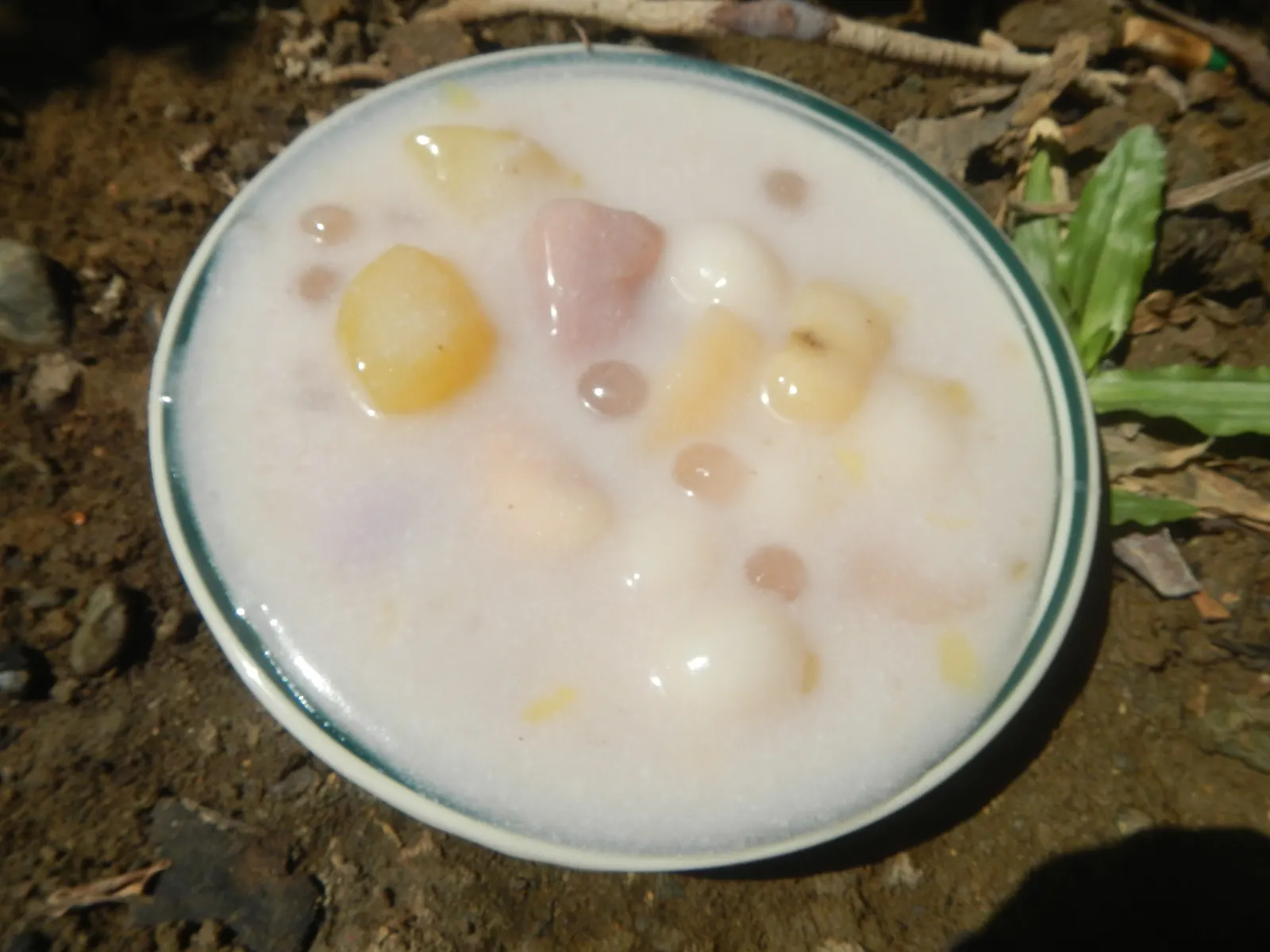
A bowl of ginataang bilo-bilo with colorful rice balls, coconut broth, fruit, and tapioca pearls.
Judgefloro’s bowl shows the exuberant mix that defines ginataang bilo-bilo: chewy rice balls, fruit, roots, pearls, and coconut milk sharing one spoon.Photo by Judgefloro / Wikimedia Commons · CC0 1.0
Prep
5 min
Cook
20 min
Makes
6 servings
Cue
Rice balls float

This is a dessert built from different kinds of soft. The bilo-bilo pull back against the teeth, tapioca pearls slip between them, sweet potato yields, plantain turns custardy, and jackfruit keeps a little fibrous snap. Sweet coconut milk joins the textures without erasing them.

Bebs’s archived Foxy Folksy formula remains the center of the pot: two cups glutinous rice flour, two cans of coconut milk or cream, tropical fruit, root, and pearls in a 25-minute recipe. The editorial additions are practical rather than transformative—how the dough should feel, why the ingredients enter in stages, and when to loosen a broth that will thicken twice.

“Ginataang Bilo-Bilo is a popular Filipino afternoon snack or dessert made with sticky rice balls, plantain bananas, sweet potatoes, tapioca pearls, and jackfruit cooked in sweet coconut milk.”

Roll them small

Half-tablespoon portions stay spoon-friendly and cook through on the source timetable.

Roots before rice balls

Sweet potato and plantain need a head start; cooked tapioca and jackfruit need only the finish.

Expect the second thickening

Rice starch continues to tighten the coconut broth after the pot leaves the heat.

Inside the bowlChew · cream · root · fruit

Four textures share the coconut broth

Each ingredient arrives on its own clock, so the finished spoon holds contrast rather than one undifferentiated pudding.

01

Glutinous rice flour

Two cups become the elastic dough for bilo-bilo, the small round dumplings at the center of the bowl.

Look for “glutinous” or “sweet rice” flour. Despite the name it contains no gluten, but ordinary rice flour is not a texture substitute.
02

Coconut milk or cream

Two 400-milliliter cans carry the fruit aromas and collect the starch released by the rice balls and sweet potato.

Use moderate heat and sweep the bottom as the sugar dissolves; the richer the product, the more water the finished pot may need.
03

Sweet potato and plantain

The root brings soft, earthy cubes while ripe plantain gives a distinct tender sweetness.

Cut both small and evenly. Add the firmer sweet potato first so the plantain can remain intact at the finish.
04

Tapioca and jackfruit

Cooked pearls echo the rice balls at a smaller scale; ripe jackfruit threads fragrance through the coconut broth.

Both go in late. Drain canned jackfruit and use fully cooked tapioca so neither disrupts the short source cook.

Shape and scaleHalf a tablespoon at a time

A small round dumpling makes a generous bowl

A close view of ginataang bilo-bilo in a white bowl with purple and white rice balls.
Bilo-bilo should be small enough for a spoon and pleasantly chewy at the center. Purple coloring is optional; the source treats it as decoration, not flavor.Photo by Televido / Wikimedia Commons · CC BY-SA 4.0
The float cue

Rising to the surface means a rice ball is nearly ready, but thickness matters. Taste one: the center should be chewy throughout, with no dry flour hidden inside.

Fine white glutinous rice flour in a clear measuring bowl.
Glutinous rice flour—not ordinary rice flour—forms the elastic, chewy dough. Add the measured water while watching for a smooth, rollable texture.Photo by Ocomejessian / Wikimedia Commons · CC BY-SA 3.0

Twenty-minute clockRoot fruit rice pearl

Build the pot from longest cook to shortest

The source sequence gives the firm sweet potato a head start and keeps the cooked tapioca and ripe jackfruit for the finish.

  1. 0:00

    Make the dough

    Combine two cups glutinous rice flour with one cup water until smooth, soft, and rollable.

  2. 0:03

    Roll the bilo-bilo

    Shape half-tablespoon portions into small balls and keep them apart in a single layer.

  3. 0:05

    Start the coconut pot

    Dissolve sugar in two cans coconut milk and two cups water at a gentle boil.

  4. 0:08

    Stagger the fruit

    Give sweet potato about five minutes, then plantain another three to five.

  5. 0:13

    Watch the balls rise

    Simmer the bilo-bilo gently for five to eight minutes, then taste one beyond the float cue.

  6. 0:20

    Finish and loosen

    Add cooked tapioca and jackfruit, simmer briefly, then adjust with the reserved water before resting.

Doneness cuesSmooth chewy tender coating

Read the dough, center, fruit, and broth

The clock is compact; these tactile checks keep every element distinct when ingredient size and flour absorption vary.

01

Dough smooth, not smeary

A rolled ball should hold a clean round shape without splitting around the edge or sticking heavily to the palm.

02

Bilo-bilo floating and chewy

Floating signals that the balls are close; a bitten center should be evenly translucent and pleasantly resilient, not floury.

03

Fruit tender but distinct

Sweet potato should yield to the spoon while the plantain and jackfruit still read as separate pieces.

04

Broth lightly coats a spoon

Stop before it resembles paste. The rice flour, tapioca, and root will continue thickening the coconut milk off heat.

Keeping planShallow cold covered loosened

The chilled bowl asks for more liquid

Ginataang bilo-bilo is welcome hot or cold, but its starches keep absorbing coconut broth after cooking.

Serve the first bowls warm

The coconut broth is loosest and the contrast between chewy balls, tender fruit, and tiny pearls is clearest just after the short rest.

Cool shallow and promptly

Transfer the deep pot into smaller covered containers and refrigerate within two hours rather than waiting for the whole batch to cool.

Keep for 3–4 days

The dessert is also served cold, but its starches firm each day. Stir before portioning and discard it after the safe leftover window.

Loosen over gentle heat

For a warm return, add water or coconut milk a splash at a time and stir over low heat until the broth is spoonable again.

Sticky Rice Balls in Coconut Milk

Filipino ginataang bilo-bilo with chewy rice dumplings, sweet potato, plantain, tapioca, and jackfruit in sweet coconut milk.

Ginataang Bilo-BiloCoconut MilkGlutinous RiceJackfruitPlantainMerienda

Ingredients

Sticky rice balls

  • 2 cups glutinous rice flour
  • 1 cup water
  • Food coloring, optional

Coconut milk and fruit

  • 2–3 cups water, divided as needed
  • 2 cans (400 milliliters each) coconut milk or coconut cream
  • 3/4 cup granulated sugar
  • 1 large sweet potato, peeled and cut into small cubes
  • 2 plantain bananas, peeled and cut into small cubes
  • 1 1/2 cups cooked tapioca pearls
  • 1 1/2 cups ripe jackfruit, cut into strips

Directions

  1. Put the glutinous rice flour in a large bowl. Add 1 cup water and mix with a fork until the flour gathers into a soft, smooth dough that holds together without crumbling. If using food coloring, divide and tint the dough now.
  2. Scoop roughly 1/2 tablespoon at a time and roll it between your palms into small balls. Keep the shaped bilo-bilo in a single layer while the coconut mixture heats.
  3. In a large heavy-bottomed pot, combine 2 cups of the water, both cans of coconut milk or cream, and the sugar. Bring just to a gentle boil over medium heat, stirring so the sugar dissolves and the coconut does not catch on the bottom.
  4. Add the sweet potato and cook for about 5 minutes, stirring occasionally. Add the plantain and cook for another 3–5 minutes, until both are nearly tender but still hold their shape.
  5. Lower the heat to maintain a steady simmer. Add the rice balls a few at a time, stirring gently between additions so they do not settle into a clump. Simmer for about 5–8 minutes, until the balls float and their centers are chewy rather than floury.
  6. Stir in the cooked tapioca pearls and jackfruit. Simmer for another 3–5 minutes, until the fruit is tender and the coconut broth lightly coats the spoon. Add some or all of the remaining 1 cup water if the pot becomes thicker than you like.
  7. Remove from the heat and let the bowl settle for 5 minutes. It will continue to thicken as it stands. Ladle into bowls and serve warm, at room temperature, or chilled.

Source and technique references: Bebs’s maintained Foxy Folksy recipe, the preserved Foxy Folksy recipe card, the Filipino Community Center formula published by Hawaiian Electric, Panlasang Pinoy’s sequence and stirring guidance, and USDA leftover guidance.

Image credits

Photography is used under open licenses with attribution: Judgefloro / Wikimedia Commons, Televido / Wikimedia Commons, and Ocomejessian / Wikimedia Commons.