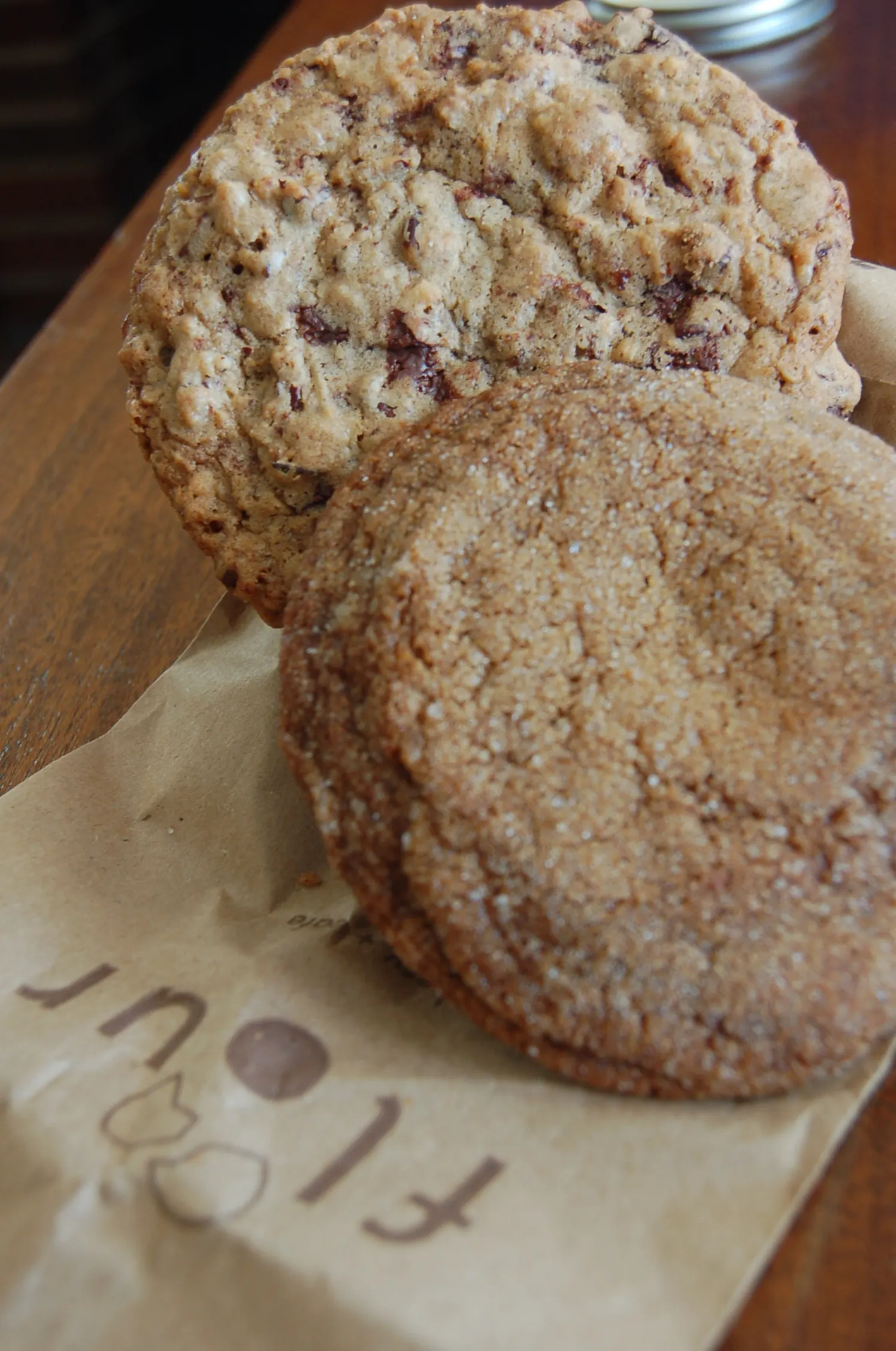
The sugar-crusted cookie in front is Flour Bakery’s ginger molasses cookie; the companion behind it is a Chunky Lola chocolate chip–pecan cookie. Becky’s home recipe uses cinnamon sugar and a shorter 8–10 minute bake.Photo by snowpea&bokchoi · CC BY 2.0
Active
About 25 min active
Chill
Several hr or overnight
Bake
8–10 min per batch
Yield
24–36 cookies
These cookies are built around restraint. Becky’s 2013 formula chills longer than impatience likes, bakes faster than color suggests, and asks for two quiet minutes on the sheet before anyone reaches for a spatula. That sequence keeps the middle soft while cinnamon sugar turns the outside into a delicate, crackled shell.
The spice cabinet is direct—equal teaspoons of cinnamon, ginger, and cloves—but the texture comes from less obvious choices. Shortening delays spread, molasses brings both acid and moisture, and fresh baking soda pushes the cold dough outward and upward. The result should be broad and tender, not crisp like a gingersnap and never dark at the edge.
“Molasses Cookies. The perfect holiday cookie!”
Cold controls spread
A long refrigerator rest firms the shortening and hydrates the flour before the small dough balls meet a hot oven.
Sugar writes the cracks
A full cinnamon-sugar coat becomes a quick-setting shell; the expanding center breaks it into fine fissures.
Pale means tender
The source is explicit: pull the cookies before browning, then let the hot sheet finish their fragile centers for two minutes.
The dough mechanicsSyrup fat lift shell
Four ingredients decide the crack and chew
The source ratio stays untouched. Better results come from choosing the intended molasses, keeping the original fat, and knowing what each part controls.
01
Unsulphured molasses
One quarter cup supplies dark caramel depth, moisture, and the slight bitterness that anchors all three spices.
Choose light or dark molasses. Blackstrap is far more bitter and is not the neutral default when a baking recipe says only “molasses.”02
Vegetable shortening
Three quarters of a cup gives the original cookie its tender bite and delays melting long enough for the dough to set.
Keep the source fat intact. Butter changes both water content and melting behavior, so it is not a drop-in version of this cookie.03
Baking soda
A precise 1 3/4 teaspoons reacts in the acidic molasses dough, lifting the center that splits the sugar shell.
Use fresh soda and whisk it through the flour before combining. Lumps or tired leavener work against an even crinkle.04
Cinnamon sugar
Three quarters of a cup coats every chilled ball, creating sparkle, a delicate crust, and a visible crack map.
Use one teaspoon cinnamon for a soft halo or two for a bolder finish; the source deliberately allows both.
The crinkle preflightChill test preheat cool
Prepare the cold before heating the oven
This dough rewards planning more than improvisation. Four checks prevent most flat, dark, or hard batches.
Dark syrup bright spiceOne dough · two cinnamon moments
Molasses carries the depth; cinnamon draws the edge
Cinnamon works twice: one teaspoon seasons the dough, while another one to two teaspoons scent the rolling sugar.Photo by formulatehealth · CC BY 2.0
The split teaspoon
One teaspoon cinnamon belongs inside the dough. Another one or two belongs in the rolling sugar, where aroma reaches the nose before the cookie breaks.
The source says simply molasses. Light or dark unsulphured molasses fits that instruction; blackstrap is substantially more bitter and is not substituted here.Photo by Surv1v4l1st · Public domain
The batch sequenceMix fold chill coat crack rest
The dough moves through six firm thresholds
The clock matters at both ends: hours in the refrigerator create control, while minutes in the oven preserve tenderness.
Mix
Cream, lighten, darken
Beat sugar with shortening, lift it with the egg, then mix in molasses until the color is completely even.
Fold
Stop when flour disappears
Whisk spices and soda through the flour first; low-speed mixing ends as soon as the dough has no dry pockets.
3+ hr
Chill until genuinely firm
Cover and refrigerate for several hours or overnight. The dough should scoop cleanly and hold a 1-inch ball.
2 in
Coat and give room
Roll lightly, cover every surface in cinnamon sugar, and space the balls two inches apart on cool parchment.
8–10
Read cracks, not color
Bake until the surface fissures and the edges set. Pull the sheet before either the tops or bottoms brown.
2 min
Let the sheet finish the set
The centers are delicate at first. Two minutes on the pan gives enough structure for a clean transfer to the rack.
The soft-center checksFirm sandy fissured bending
Read the cookie before it turns brown
Color is a late signal for this recipe. Texture at the scoop, shell, edge, and cooled center is more useful.
01
Cold, scoopable dough
The portion should release from the scoop and accept a quick roll without coating your palms or slumping.
02
A dry cinnamon shell
Every ball should look evenly sandy rather than wet in patches; uncovered spots will not draw the same crack pattern.
03
Fine top fissures
Small cracks and set edges say the cookie has expanded. Deep browning says its soft window has already started to close.
04
A center that bends
After cooling, the middle should flex before it snaps. Airtight storage protects that contrast with the sugary edge.
The baker’s switchboardMolasses coating sheet doneness
Make four choices without changing the formula
Each decision stays inside Becky’s original boundaries while making the outcome more predictable.
Molasses
Light or dark, not blackstrap
Light stays sweeter; dark tastes more robust. Either preserves the recipe far better than blackstrap’s concentrated bitterness.
Coating
One or two teaspoons cinnamon
The source range is useful: choose one for balance, two when the rolling sugar should carry a distinct cinnamon note.
Batch rhythm
One cool sheet at a time
Center-rack baking and a cold pan make spread easier to read. Alternate sheets instead of loading warm metal.
Doneness
Cracked and pale
Do not chase a browned edge. Residual heat during the source’s two-minute pan rest completes the center.
Soft & Chewy Molasses Crinkles
Becky’s cinnamon-sugar molasses cookies: chilled until firm, baked just to the first cracks, and rested on the sheet for a soft center.
MolassesCookiesCinnamonGingerClovesHoliday Baking
Ingredients
Molasses cookie dough
1 cup granulated sugar
3/4 cup vegetable shortening
1 large egg
1/4 cup light or dark unsulphured molasses, not blackstrap
2 cups all-purpose flour
1 3/4 teaspoons baking soda
1 teaspoon ground cinnamon
1 teaspoon ground ginger
1 teaspoon ground cloves
1/2 teaspoon fine salt
Cinnamon-sugar coating
3/4 cup granulated sugar
1–2 teaspoons ground cinnamon
Directions
Beat the 1 cup sugar and shortening with an electric mixer until evenly creamed. Add the egg and beat until the mixture looks lighter and fluffy. Pour in the molasses and mix until the color is uniform, scraping the bowl as needed.
In a separate bowl, whisk together the flour, baking soda, cinnamon, ginger, cloves, and salt so the leavener and spices are distributed without pockets.
Mix the dry ingredients into the creamed mixture on low speed just until no dry flour remains. Cover the dough and refrigerate for several hours or overnight; allow at least 3 hours for the shortening to firm and the flour to hydrate.
When ready to bake, set a rack in the center of the oven and preheat to 375°F (190°C). Line a cool, ungreased baking sheet with parchment. Stir 3/4 cup sugar with 1 teaspoon cinnamon for a gentler coating or 2 teaspoons for a stronger one.
Scoop the cold dough and roll it lightly into 1-inch balls. Coat each ball completely in the cinnamon sugar, then arrange the balls 2 inches apart on the prepared sheet because they will spread.
Bake one sheet at a time for 8–10 minutes. Remove the cookies when their tops have opened into fine cracks and their edges look set, but before the surfaces or bottoms visibly brown; the centers should still look soft.
Leave the cookies on the hot sheet for exactly 2 minutes so the fragile centers can settle. Slide a thin metal spatula underneath each cookie and transfer it to a wire rack to cool.
Cool the baking sheet completely before loading the next batch, or alternate between two cool sheets. Once the cookies are fully cool, store them airtight to protect their soft texture.