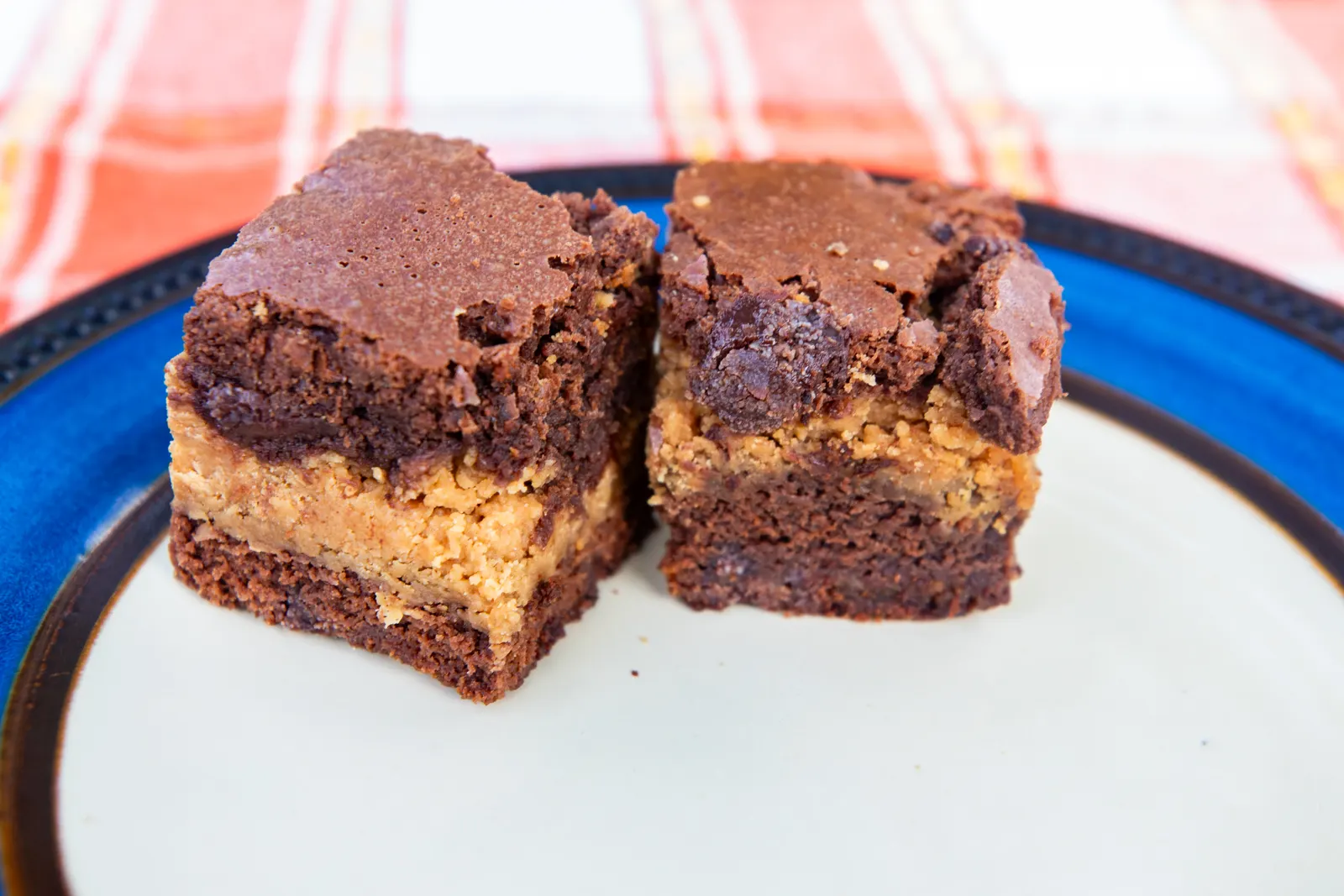
Wheeler Cowperthwaite’s peanut-butter brownies are an illustrative layered cousin, not the source batch; Steph Loaiza’s bites add marshmallow, caramel, roasted peanuts, and a chocolate-dipped top.Photo by Wheeler Cowperthwaite / Wikimedia Commons · CC BY 2.0
Makes
24 brownie bites
Prep
25 minutes
Bake
25 minutes
Total
1 hour 20 minutes
A birthday cake idea got compressed into two inches. Steph Loaiza began with the chocolate, caramel, and peanut combination she already loved, then found Hayley Parker’s candy-bar brownie and gave it a Six Sisters turn. The result is less a brownie with toppings than a stack of distinct textures built on one familiar boxed base.
Every layer has one job. Brownie brings chew. Marshmallow and peanut butter suggest nougat. Caramel provides pull, roasted peanuts break it with salt, and a dipped chocolate top draws the whole bite back into candy territory. The recipe is generous but deliberately uncomplicated: package directions handle the bake; cooling and chilling handle the architecture.
“A brownie base layered with marshmallow-peanut-butter nougat, caramel, roasted peanuts, and chocolate became Steph Loaiza’s new birthday tradition.”
The foundation
A boxed 13-by-9-inch brownie keeps the project focused on the four candy-bar layers above it.
The faux nougat
Marshmallow fluff and smooth peanut butter turn into a soft, pale layer with no sugar thermometer.
The clean finish
Warm caramel catches the peanuts; a cold rest steadies the slab; only the cut tops meet chocolate.
Layer ledgerFoundation spread veil crunch shell
Four decisions above the brownie line
The source quantities remain package-based where the source left them that way. Technique, not brand conversion, keeps the stack intact.
01
Brownie mix
One box makes the sturdy chocolate base and determines its own eggs, oil, water, bake time, and final doneness cue.
Use a mix intended for a 13-by-9-inch pan and follow that package rather than forcing one brand’s additions onto another.02
Marshmallow + peanut butter
The one-jar-to-one-cup pairing creates the recipe’s soft nougat impression without boiling syrup or whipping egg whites.
Blend until no white streaks remain, then spread only over a completely cool brownie so the layer stays distinct.03
Caramels + cream
A package of unwrapped caramels loosens with one tablespoon of cream into a thin veil that will hold the peanuts.
Stir after the first minute before adding more heat; the pieces may be soft enough to become smooth even while holding their shape.04
Peanuts + almond bark
Dry-roasted peanuts bring the salt and crunch, while the dipped chocolate top completes the candy-bar silhouette.
Press the nuts in while the caramel is warm, but melt and dip the coating only after the layered slab has chilled.
One hour twentyBake cool blend melt chill dip
The clock alternates heat with restraint
The active moves are short. The stable layers come from respecting the two rests between them.
350°F
Bake the brownie base
Use the box additions, pan timing, and doneness cue for the mix in hand.
COOL
Wait for a firm foundation
The brownie should lose every trace of warmth before the soft nougat layer arrives.
MIX
Blend fluff with peanut butter
Work until the spread is uniform, then level it from edge to edge.
1:30
Melt the caramels gently
Microwave for one minute, stir, and give the bowl another 30 seconds only if needed.
30M
Press in peanuts and chill
Warm caramel anchors the nuts; refrigeration makes the four layers sliceable.
DIP
Cut 24, coat the tops, set
A lightly sprayed knife moves through the slab; excess chocolate drips back into the bowl.
Dark crumb, bright crunchCaramel warmth + roasted salt
The brownie stays soft; the peanuts make the cut audible
Stephanie Clifford’s salted-caramel brownies are an illustrative base. The source recipe builds its caramel and peanut layers above a boxed 13-by-9-inch brownie rather than baking them into the crumb.Photo by Stephanie Clifford / Wikimedia Commons · CC BY 2.0
Press, do not bury
The peanuts need enough contact to adhere to the warm caramel while staying exposed enough to keep their crunch.
The source presses 1 1/4 cups dry-roasted peanuts into warm caramel, creating the crisp, salty layer between soft nougat and chocolate.Photo by Vis M / Wikimedia Commons · CC BY-SA 4.0
Read the stackSet cool smooth fluid firm dry
Five checkpoints hold five layers in place
The source gives a timer where it matters and leaves package variables to the products themselves. These visible cues close the gaps.
01
A brownie that is set, not hot
The package’s tester cue decides the bake; complete cooling decides when the next layer may begin.
02
Nougat with no white streaks
The marshmallow and peanut butter should read as one smooth spread rather than two swirled ingredients.
03
Caramel that flows from the spatula
It should spread in a thin sheet without unmelted corners, yet remain thick enough to hold the peanuts.
04
A slab that cuts without skating
After the cold rest, the caramel and nougat stay above the brownie instead of sliding ahead of the knife.
05
Chocolate that loses its wet shine
The dipped tops are set when they look dry and can be moved without leaving a print or a chocolate tail.
Party sequenceBake ahead chill once cut then dip
Build the waiting time into the plan
A calm schedule protects the layers and still preserves the original two-day room-temperature hold.
Make the brownie first
Bake and cool the base several hours ahead if useful; leave it in its lined pan, covered once fully cool.
Chill after caramel
The source’s 30-minute rest is the clean-cut window. Do not skip it or move it ahead of the warm caramel layer.
Cut, then dip
The recipe coats only the tops of individual bites. Dipping the slab first would crack the shell when the knife enters.
Hold for two days
Store airtight at cool room temperature as the source directs; refrigerate in a warm kitchen to protect the layers and coating.
Snickers brownie bites
Twenty-four small brownie squares layered with peanut-butter nougat, caramel, roasted peanuts, and a chocolate-dipped top.
1 box brownie mix, plus the ingredients called for on the box
Nougat, caramel, and peanut layers
1 jar marshmallow fluff
1 cup smooth peanut butter
1 package Kraft caramels, unwrapped
1 tablespoon heavy cream
1 1/4 cups dry-roasted peanuts
Chocolate finish
1/2 package chocolate almond bark
Directions
Heat the oven to 350°F. Line a 13-by-9-inch baking pan with foil, leaving enough overhang to lift the brownies later, and coat the foil lightly with nonstick cooking spray.
Prepare the brownie mix with the ingredients and method printed on its box. Spread the batter evenly in the prepared pan and bake according to the package directions, about 25 minutes in the source timing, until the center is set and a tester meets the package’s doneness cue.
Set the pan on a rack and cool the brownie completely. Do not add the marshmallow layer while the base is warm; heat will soften it and make the layers slide.
Combine the marshmallow fluff and smooth peanut butter in a medium bowl. Stir with a rubber spatula or beat briefly with a hand mixer until the mixture is uniform, then spread it over the cooled brownie in an even layer.
Put the unwrapped caramels and heavy cream in a microwave-safe bowl. Microwave for 1 minute, stir thoroughly, then heat for another 30 seconds only if needed. Stir until the caramel is completely smooth.
Spread the warm caramel evenly over the marshmallow-peanut-butter layer. Immediately scatter the dry-roasted peanuts over the top and press them gently into the caramel so they adhere.
Refrigerate the layered brownie for about 30 minutes, until the caramel is set enough to cut without dragging the soft layers.
Melt the chocolate almond bark according to its package directions until smooth. Use the foil overhang to lift the slab from the pan. Lightly spray a sharp knife and cut the brownie into 24 squares, roughly 1 to 2 inches each, wiping and respraying the blade as needed.
Dip the top of each square into the melted almond bark, let the excess drip back into the bowl, and place the bite chocolate-side up on the lined sheet pan. Leave the coating undisturbed until firm, then store the bites airtight at room temperature for up to 2 days as the source directs.
Source and technique references: the saved My Recipe Magic card for legacy ID 2500828018, its 24-piece yield, exact seven-item formula, summary, and Six Sisters attribution; Steph Loaiza’s August 27, 2013 primary post for the full method, structured timing, birthday-story context, and author signature; Hayley Parker’s Domestic Rebel original for the credited antecedent, layer logic, and two-day storage direction; the maintained Lil’ Luna adaptation for independent confirmation of the same marshmallow-peanut-butter, caramel-peanut, chill, cut, and dip sequence; King Arthur Baking’s brownie guidance for a set center, moist-crumb tester cue, and complete cooling before cutting; and Ghirardelli’s melting-wafer method for half-power heating, thorough stirring, short finishing bursts, and avoiding scorched coating. The source formula, package-based measures, 24-piece yield, and five-layer identity are unchanged.