The summer flanSponge · berries · ruby jelly

Marie Roffey · June 2017

Simple Strawberry Flan

Marie Roffey’s nostalgic fruit flan builds a shallow whole-egg sponge, fresh strawberries, and just-setting strawberry jelly into a bright chilled dessert.

Catch the ribbon
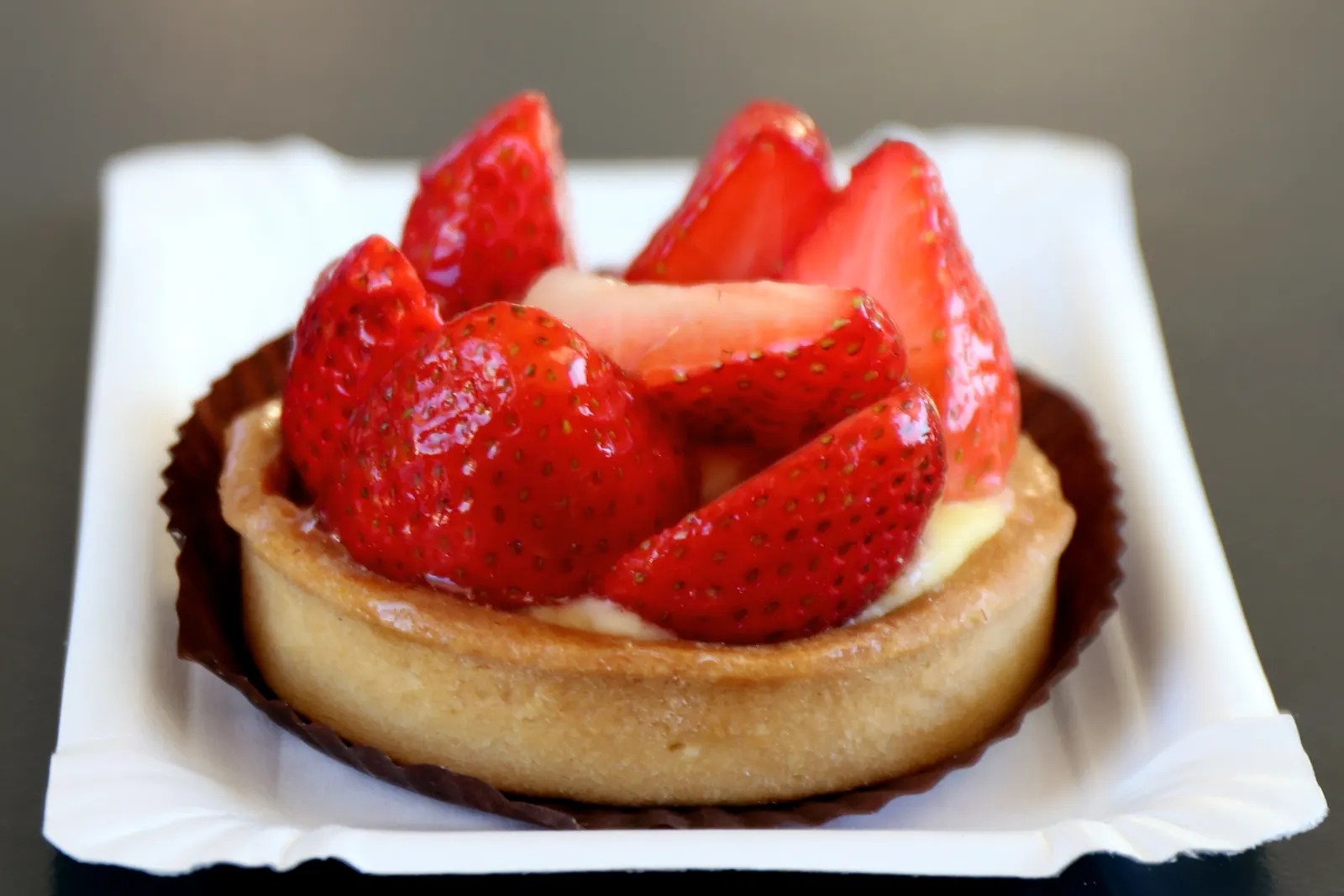
A glossy strawberry tartlet filled with halved fresh strawberries.
Prayitno’s illustrative tartlet uses a pastry shell and cream beneath its glazed berries. Marie Roffey’s flan instead rests the fruit and jelly in a shallow, airy sponge case.Photo by Prayitno / Wikimedia Commons · CC BY 2.0
Yield
6 servings
Sponge
8–10 minutes
Strawberries
500 g / 1.1 lb
Set
3–4 hours

This flan is a cake wearing the silhouette of a tart. Marie Roffey’s family formula has no pastry, custard, or butter. A whole-egg sponge rises into a shallow edible plate; strawberries fill its well; cold jelly turns the loose pile into one glossy summer slice. The old shorthand is compact enough to remember: two eggs, two ounces each of sugar and flour, one spoon of water.

Its ease depends on three moments of restraint. Stop beating only when the egg foam leaves a ribbon. Stop folding as soon as the sifted flour disappears. Stop chilling the jelly while it still pours. Get those transitions right and the dessert stays airy below, fresh in the middle, and jewel-clear above.

“Super simple to make, from scratch, Strawberry Flan. This tart has a light, fluffy sponge base covered in fresh strawberries.”

Whip to a ribbon

Eggs and sugar should double in volume and leave a pale trail that sits briefly before sinking.

Fold, then stop

Sift the flour over the foam and lift it through completely with the fewest deliberate turns.

Cool both layers

The sponge must be cool and the jelly cold before they meet; warmth sends the topping into the crumb.

Pour in two passes

A first thin layer anchors the berries. The remaining jelly fills the spaces without floating the fruit.

The small formulaAir · fruit · gel

Nine lines, three distinct states

The sponge must remain aerated, the berries dry, and the jelly fluid enough to find every gap without soaking the base.

01

The 2–2–2–1 sponge

Two eggs, 2 ounces sugar, 2 ounces self-raising flour, and one Australian tablespoon water make the shallow case.

Measure the water as 20 ml. The familiar US tablespoon is smaller.
02

Whole-egg foam

The whipped eggs carry the airy texture; the self-raising flour supplies a small reserve of lift.

Wait for a visible ribbon, then change from beating to folding as soon as the flour arrives.
03

Fresh strawberries

A full 500 grams fills the sponge well and gives the jelly something to hold in a generous crown.

Rinse only before assembly, dry thoroughly, then hull and halve. Frozen fruit releases too much water here.
04

Just-setting jelly

The cold jelly seals the sponge and catches the berries in a translucent red layer.

Use it while it still pours. Fully liquid runs away; fully set will not settle into the gaps.

The ruby handoffDry fruit · cool jelly · cold plate

Build the crown only when every layer is ready

A wicker basket filled with ripe red garden strawberries on grass.
Fresh, firm berries are the structure as well as the flavor. Rinse them only when the jelly and cooled sponge are ready, then dry them before halving.Photo by George Chernilevsky / Wikimedia Commons · Public domain
Water belongs in the jelly

Fresh strawberries should arrive dry. Surface water dilutes the set exactly where jelly needs to grip the fruit and sponge.

Clear red strawberry jelly with whole and sliced strawberries in glass dessert bowls.
Chloe Lim’s strawberry jelly makes the setting stage visible. For the flan, cool the dissolved jelly until it is cold and just beginning to thicken before it meets the sponge.Photo by Chloe Lim / Wikimedia Commons · CC BY 2.0

The flan clockWhip · fold · bake · cool · crown

Twenty-three active minutes, then the chill

The source card’s active clock is quick, but the dessert is not ready in 23 minutes. The 3–4-hour set belongs in the plan.

  1. 0:00

    Heat and coat the tin

    Set the oven to 350°F and grease every groove of the flan tin before dusting it with flour.

  2. 0:05

    Whip the pale ribbon

    Beat eggs and sugar until doubled, thick, and able to leave a brief trail from the whisk.

  3. 0:10

    Fold the shallow case

    Add water and vanilla, sift over the flour, and fold only until no dry pocket remains.

  4. 0:13

    Bake fast and light

    Spread gently and bake 8–10 minutes, until just golden with a clean center tester.

  5. 0:23

    Dissolve and cool the jelly

    Stir crystals into boiling water, add cold water, then chill until cold and barely thickened.

  6. assemble

    Anchor, arrange, and fill

    Lay down one-third of the jelly, arrange dry berry halves, then pour into the spaces.

  7. 3–4 hr

    Wait for a clean set

    Chill until the jelly holds a cut edge and the berries stay fixed when the plate moves.

The transition testRibboned · airy · golden · thickened

Four reads that matter more than the timer

Each phase ends at a texture, not merely at a minute mark. Read the bowl and the flan stays light instead of wet or rubbery.

01

Ribboned, not merely frothy

The egg foam is pale and thick enough that batter falling from the whisk remains visible for a moment.

02

Thin batter, intact air

The layer looks slight in the tin. That is expected; repeated smoothing is more damaging than an imperfect surface.

03

Just golden, clean center

At 8 minutes, look for a faint gold cast and test the middle. Wet batter needs another minute or two.

04

Cold jelly with a soft drag

It pours in a ribbon and briefly mounds before leveling. Water-thin jelly is too early; spoonable jelly is too late.

The short holdWrap bare · wash late · chill filled

Keep the sponge dry and the crown cold

The unfilled case waits well; the assembled dessert is deliberately brief. Moisture begins moving as soon as fruit, jelly, and sponge meet.

Make the sponge 2 days ahead

Cool it completely, wrap airtight, and keep it chilled until the topping is ready.

Wash berries at the last moment

Keep them refrigerated and unwashed, then rinse, dry, hull, and halve immediately before assembly.

Serve within 1–2 days

Keep the finished flan refrigerated. Time softens the sponge as moisture migrates from fruit and jelly.

Do not freeze the crown

Frozen strawberries and gelatin thaw watery, so freezing trades the clean set for a soggy surface.

Simple Strawberry Flan

Marie Roffey’s airy sponge flan case filled with fresh strawberries and cold-set strawberry jelly.

Strawberry FlanSponge CakeFresh StrawberriesJellySummer DessertAfternoon Tea

Ingredients

Sponge flan case

  • 2 large eggs
  • 55 g / 2 oz caster or superfine sugar, about a scant 1/4 cup
  • 20 ml / 1 Australian tablespoon water
  • 1/2 teaspoon vanilla paste or extract, optional
  • 55 g / 2 oz self-raising flour

Strawberry jelly crown

  • 500 g / 1.1 lb fresh strawberries, hulled and halved
  • 85 g / 3 oz packet strawberry jelly crystals or strawberry gelatin dessert mix
  • 250 ml / 1 cup boiling water
  • 200 ml / 7 fl oz cold water

Directions

  1. Heat the oven to 350°F / 180°C / 160°C fan. Grease a 9- to 10-inch round sponge flan tin thoroughly, reaching every groove, then flour it and tap out the excess.
  2. Beat the eggs and caster sugar with an electric mixer until very pale, thick, and at least doubled in volume. The mixture is ready when a ribbon falling from the whisk remains visible briefly on the surface.
  3. Beat in the 20 ml water and optional vanilla only until combined. Sift the self-raising flour over the foam, then fold gently and completely, turning the bowl and lifting from the bottom so no dry pocket remains without knocking out the air.
  4. Pour the thin batter into the prepared tin and ease it to the edges with the fewest strokes. Bake for 8–10 minutes, until the surface is just golden and a tester through the center comes out clean. Cool, then invert onto a rimmed cake plate so the shallow well faces upward.
  5. Put the jelly crystals in a wide glass bowl. Add the boiling water and stir until every crystal dissolves, then stir in the cold water. Refrigerate until the jelly is cold and just beginning to thicken; it should still pour.
  6. Rinse the strawberries under cool running water just before assembly, hull them, dry them thoroughly, and halve them. Whisk the cold, slightly thickened jelly briefly until smooth.
  7. Spread about one-third of the jelly across the sponge well. Arrange the strawberries over it, then pour the remaining jelly slowly into the spaces between the berries. Stop when the flan is full; the tin depth may mean a little jelly remains.
  8. Refrigerate for 3–4 hours, until the jelly is fully set. Keep the flan chilled until serving and cut with a clean, sharp knife.

Source and research references: the queued legacy path and matching June 13, 2017 My Recipe Magic card for the original identity, description, yield, and formula; Marie Roffey’s maintained Sugar Salt Magic article for the complete method, equipment, fresh-fruit rule, 3–4-hour set, make-ahead window, storage, and approximate current nutrition; the King Arthur Baking test kitchen’s ribbon-stage guide and genoise method for visible foam and gentle folding cues; Australian Eggs’ traditional sponge guidance for sifting, egg volume, and preserving air; University of Minnesota Extension’s strawberry guidance for last-minute cool-water rinsing without soaking; and the FDA’s raw-flour guidance for the no-tasting and cleanup note. The source proportions and method remain intact; only timing clarity, sensory cues, produce handling, and safety are added as separately researched guidance.

Image credits

Photography is used under open licenses with attribution: Prayitno / Wikimedia Commons, George Chernilevsky / Wikimedia Commons, and Chloe Lim / Wikimedia Commons.