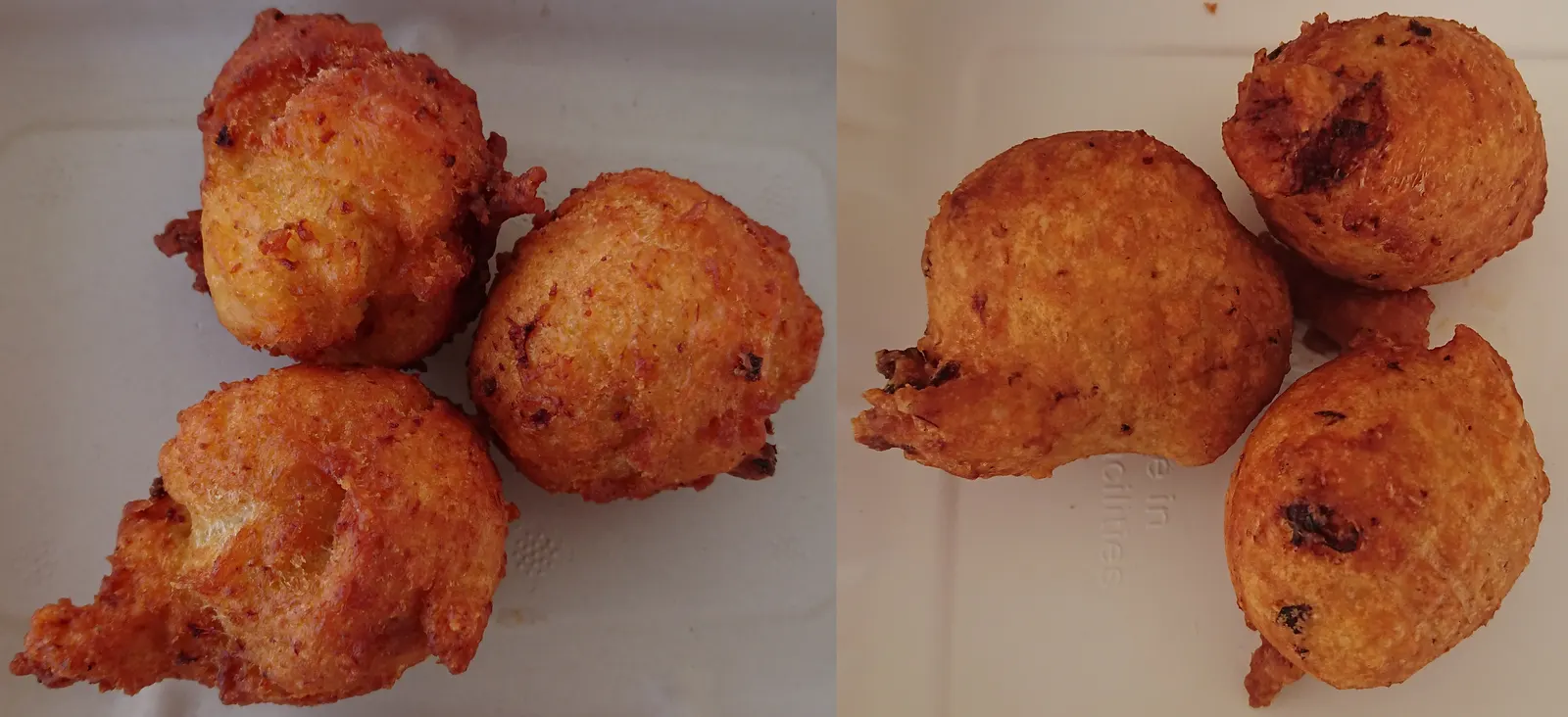
Clam cakes from Warren, Rhode Island, and nearby Rehoboth show the regional range in shape. The Rocky Point copycat drops smaller teaspoonfuls.Photo by Waz8 / Wikimedia Commons · CC0 1.0
Yield
12 servings
Chowder
Simmer until tender
Fry
375°F
Cakes
2–3 min
At Rocky Point, chowder and clam cakes were one order. The amusement park is gone, but the logic of its shore dinner survives: a tomato-red bowl rich with salt pork and clam liquor beside little fried cakes made for dipping. The Hungry Hoarder’s 2011 copycat captures that partnership as one twelve-serving recipe.
This is not a generic New England cream chowder and the cakes are not crab-cake patties. The soup is smooth, red, potato-studded, and cracker-thickened; the cakes are spoon-dropped fritters, crisp outside and steamy within. One pot waits while the fryer works, then both arrive hot.
“A nostalgic chowder-and-clam-cake dinner adapted from the food served at Rocky Point Amusement Park in Rhode Island.”
The red bowl
Salt pork, two onions, clam juice, potatoes, two condensed tomato soups, herbs, crackers, and baby clams make the source’s nostalgic chowder.
The small cake
A teaspoon—not a tennis-ball scoop—sets this copycat’s scale. The batter carries minced clams, onion, milk, eggs, and clam liquor.
The pairing
The cakes leave the oil crisp and hot; the chowder waits at a quiet simmer. Their shared finish line is the bowl, ready for dipping.
The formula mapRender red briny crisp
Four levers of the shore-dinner bowl
The copycat’s identity sits in ordinary pantry ingredients used in a strict sequence. Keep the measures, then control the heat around them.
01
Salt pork + butter
Rendered salt pork builds the savory foundation; butter carries the diced onion into the stockpot and rounds the condensed tomato base.
Render gently before adding butter. High heat can scorch the butter while the pork is still giving up its fat.02
Two tomato soups
Three cans of tomato bisque and one can of tomato soup create the copycat’s smooth red identity rather than a clear or cream chowder.
The 2011 source never recorded can sizes. Preserve its can count and choose one brand consistently instead of inventing ounces.03
Clams + clam juice
Bottled juice seasons the potatoes, baby clams finish the chowder, and minced clams with measured liquor perfume the fritter batter.
Keep the clam solids cold until needed. Add the baby clams only after the potatoes soften, then heat gently.04
Oyster crackers
Crushed near the end, they supply the source’s modest thickening without turning this into a flour-roux chowder.
Add some, stir, and pause before deciding on more. The crackers continue absorbing liquid as the pot stands.
The service rhythmReserve render simmer finish fry dip
One pot hands off to one fryer
The chowder earns its waiting time first. The batter is mixed only when the oil and serving bowls are ready.
Mise
Separate the two clam jobs
Reserve the baby-clam and minced-clam juices independently; keep the solids cold while the potatoes cook.
Render
Build the pork-and-onion base
Melt the salt-pork fat gently, add butter, and soften two diced onions without darkening the dairy.
Tender
Simmer the red pot
Combine clam juice, potatoes, soups, pork, onions, herbs, and a little water; cook until every potato cube yields.
Finish
Add clams, then crackers
Warm the baby clams through, season only after tasting, and crush some oyster crackers into the chowder.
375°F
Mix only when the oil is ready
Bring the deep oil to temperature, then fold wet and dry batter components just until hydrated.
2–3 min
Fry small and serve fast
Lower teaspoonfuls in uncrowded batches, drain the golden cakes, and carry them straight to the hot chowder.
The memory spreadTomato bowl · midway lights · Narragansett Bay
A red bowl carries the park home
This Manhattan-style tomato chowder is an illustrative visual reference. The source copycat builds its red bowl from tomato bisque, tomato soup, clam juice, potatoes, salt pork, herbs, and clams.Photo by stu_spivack / Wikimedia Commons · CC BY-SA 2.0
The picture is a guide, not the source batch
The photographed tomato chowder is labeled honestly as illustrative. The ledger—not the image—defines this copycat’s condensed soups, potatoes, salt pork, herbs, clams, and crackers.
3 cans tomato bisque soup (source does not specify can size)
1 can tomato soup (source does not specify can size)
1 tablespoon dried oregano
1 tablespoon dried parsley
5 large potatoes, diced
Fine salt and ground black pepper, to taste
2 cups oyster crackers
Clam cakes
1 can minced clams, drained with juice reserved (source does not specify can size)
2 cups all-purpose flour
2 teaspoons baking powder
1/4 cup finely chopped onion
1/2 teaspoon fine salt
1 cup milk
1/2 cup clam juice, using the reserved minced-clam juice first and bottled juice as needed
2 large eggs
Vegetable oil, for deep-frying
Directions
Prepare both parts before heating the frying oil: cut the salt pork, dice the onions and potatoes, drain the baby clams and minced clams into separate containers, and reserve their juices. Keep the clams refrigerated while the chowder base cooks.
Put the salt pork in a large skillet over medium-low heat and cook until its fat renders. Add the butter, then the 2 diced onions. Sauté gently until the onion softens without scorching the milk solids.
In a large stockpot, combine the 32 ounces bottled clam juice, diced potatoes, tomato bisque, tomato soup, and the rendered salt-pork-and-onion mixture. Add the reserved baby-clam juice and a small splash of water, just as the source directs.
Stir in the oregano and parsley. Bring to a gentle simmer and cook until the potatoes are completely tender when pierced; stir along the bottom often enough to prevent the condensed soups from catching.
Add the baby clams only after the potatoes are soft. Warm them through gently, then taste and add salt, pepper, and a little more water only if needed. The canned soups, clam juice, salt pork, and crackers all contribute salt, so season at the end.
Crush some of the oyster crackers and stir them into the chowder near the end of cooking to thicken it, preserving the source method. Keep the chowder hot over very low heat while the clam cakes fry; do not let it boil hard after the clams enter.
Pour vegetable oil into a deep heavy pot or deep skillet, leaving generous headroom, and fit a deep-fry thermometer. Heat to the source’s 375°F (191°C). Keep the draining tray, scoop, and slotted spoon beside the stove before mixing the batter.
Whisk the flour, baking powder, and 1/2 teaspoon salt together. In a second bowl, combine the minced clams, 1/4 cup chopped onion, milk, 1/2 cup measured clam juice, and eggs. Fold the wet mixture into the dry just until no dry flour remains; do not beat the batter smooth.
Working in small batches so the oil temperature can recover, lower teaspoonfuls of batter close to the oil surface. Fry for 2–3 minutes, as the source specifies, turning as needed, until the clam cakes are evenly golden and their centers show no wet batter.
Lift the cakes out with a slotted spoon and drain on paper towels or a wire rack. Let the oil return to 375°F between batches. Serve the clam cakes immediately with bowls of hot chowder for dipping.
Source and technique references: The Hungry Hoarder’s archived December 13, 2011 post for the original date, twelve-serving yield, complete formula, directions, and author description; the intact My Recipe Magic card for legacy ID 2500547825 for the syndicated title, ingredients, source link, and nutrition panel; Saveur’s test-kitchen clam cakes for independent oil-temperature, thermometer, close-to-oil dropping, gentle-mixing, and uncrowded-batch guidance; National Geographic’s Rhode Island clam-cake history for Rocky Point’s notably small fritters and chowder pairing; Rhode Island State Parks for the property’s 150-plus-year public history; and FoodSafety.gov for shallow-container cooling, two-hour refrigeration, four-day storage, and 165°F reheating. No source ingredient or ratio was changed; mixing, batch control, observable doneness, hot-oil safety, and storage are explicitly researched guidance.