The covered panPrawn · egg · tomato

Four eggs · fifteen curry leaves

Prawn and Egg Curry

Prawns and softly poached eggs in a tomato curry with ghee, garlic, ginger, cardamom, garam masala, curry leaves, and coriander.

Cook the curry
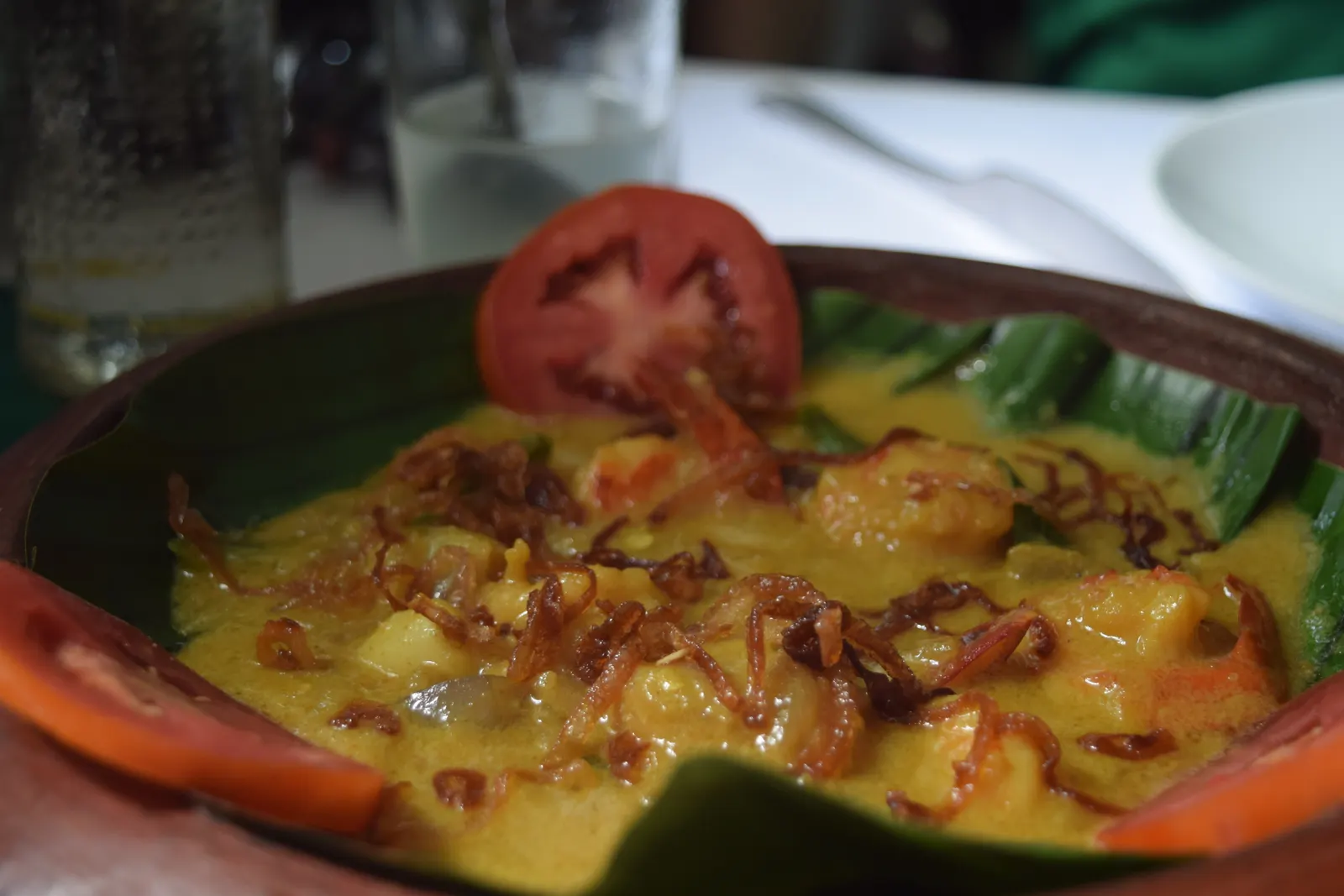
Orange prawn curry in a white bowl with several whole prawns visible on top.
An illustrative Kochi-style prawn curry, not Karen Chin’s exact dish: the source curry also poaches four eggs in a ghee, tomato, curry-leaf, and coriander sauce.Photo by Ravirajdayal · CC BY-SA 4.0
Makes
4 servings
Sauce
20 min
Prawns
5–8 min
Eggs
4, poached

The cleverness arrives after the sauce is already complete. Onion and garlic-ginger soften in ghee; seven measured spices, tomato, curry leaves, and a remarkable cup of fresh coriander settle together under a lid. Only then do the prawns go in, followed by four eggs cracked directly into the red sauce.

Karen Chin described the dish as a meeting point between her son’s love of prawns and the egg curry her mother made after school. The recipe is mild, warming, and personal. Its proportions need no redesign; what it benefits from is a sharper set of signals for the moment seafood turns opaque, the eggs set, and the heat should stop.

“Karen Chin adapted the egg curry her mother made after school, adding prawns for a warming, mild family supper served with basmati rice.”

Build the sauce first

The onion, paste, seven ground spices, tomato, curry leaves, and coriander get a full covered simmer before seafood enters the pan.

Read the prawn flesh

The source says pink; the safer, clearer cue is pearly white and opaque through the thickest piece.

Poach without stirring

Make four spaces, crack in the eggs, then cover. Once they enter, move the sauce around them rather than through them.

The curry mapPearly set tomato leaf

Two proteins carried by one red-green sauce

Prawns stay late, eggs stay whole, and the sauce earns its depth before either one begins to cook.

01

Prawns

A compact 235 grams turns a family egg curry into a seafood supper without changing the tomato-spice foundation.

Keep them cold until the sauce has finished its 20-minute simmer, then cook only until the flesh is opaque.
02

Four eggs

They are cracked directly into the sauce, giving each serving a poached egg rather than chopped or hard-boiled pieces.

Use a wide pan and make distinct hollows so the whites can set without the eggs crowding one another.
03

Tomato + ghee

One tin, a spoon of purée, and two tablespoons ghee create the source’s rich red base without coconut milk or cream.

Keep the covered simmer gentle and stir once or twice; concentrated tomato can catch under a tight lid.
04

Curry leaves + coriander

Fifteen aromatic leaves simmer in the sauce while one full cup of chopped coriander brings a greener, fresher register.

Reserve a small handful from the measured cup for the finish, satisfying both source instructions with one quantity.

Order protects textureSoften bloom simmer opaque firm

A long sauce, a short prawn window, a quiet egg finish

The source gives only two firm clocks. Everything else is a visible transition, and those transitions matter more than inventing a total time.

  1. SOFTEN

    Melt ghee around onion and paste

    Cook until the slices are translucent and soft; the source does not give a minute count.

  2. BLOOM

    Loosen seven spices with water

    Use a little from the measured half-cup and stir the paste only until fragrant, never scorched.

  3. 20 MIN

    Cover the tomato base

    Add tomato, purée, remaining water, curry leaves, most coriander, salt, and pepper; simmer gently.

  4. 5–8 MIN

    Add prawns at the end

    Cover and check early. Their flesh should be pearly white and opaque, not merely pink on the surface.

  5. 4 EGGS

    Crack directly into four hollows

    Treat the sauce as poaching liquid and keep each yolk intact while the pan stays covered.

  6. FIRM

    Stop when whites and yolks set

    Remove the pan from heat immediately, scatter the reserved coriander, and serve with rice.

Poach + perfumeThe set center and the green edge

The egg enters whole; the curry leaf stays in the sauce

Halved boiled eggs in a red-brown Indian curry sauce with herbs.
An egg-curry analogue, not the source method: Karen cracks raw eggs into the prawn sauce and covers the pan so they set like poached eggs rather than adding hard-boiled halves.Photo by Nayan j Nath · CC BY-SA 4.0
The photograph shows a different egg method

Karen does not boil or halve her eggs. She cracks them into four spaces after the prawns turn opaque, then covers the pan until they set.

Fresh green curry leaves arranged on a white plate.
Fifteen fresh curry leaves simmer in the tomato base. They are an aromatic leaf, not interchangeable with curry powder or a generic curry spice blend.Photo by Abithavelu · CC0 1.0

Watch the transitionsCatch thin opaque spread

Four corrections while the pan is still recoverable

The sauce is forgiving; prawns and eggs are not. These small moves preserve the original order without rewriting the dish.

If the spice paste catches

Add one teaspoon measured water

Lower the heat and scrape cleanly before tomato goes in. Do not add more ghee or invent a larger liquid measure.

If the tomato sauce is watery after 20 minutes

Uncover briefly before the prawns

Let excess steam escape for a minute or two; adding seafood to a vigorous reduction makes it harder to protect.

If prawns are opaque before the eggs go in

Lower the heat at once

Make the egg hollows quickly and cover. The source order stays intact, but the sauce should barely simmer while eggs set.

If an egg spreads across the pan

Leave it alone

Cover and let the white set where it landed. Stirring now breaks the yolk and shreds raw egg through the sauce.

Serve + storeCoordinate cool cover warm

Let the sauce wait for rice, never the prawns

The curry is built for immediate serving. A little planning protects its two most delicate ingredients from unnecessary heat.

Cook the rice alongside the sauce

The source serves basmati but does not count it in the method. Time it so the finished curry does not wait on the stove.

Serve the same day for best texture

Prawns and poached eggs are most tender immediately after cooking; every reheat firms both.

Cool within two hours

Transfer leftovers to shallow covered containers rather than leaving the lidded pan to cool slowly.

Keep 3–4 days, reheat to 165°F

Warm gently and only once. A splash of water can loosen the tomato sauce, but it cannot restore overcooked seafood.

Prawn and egg curry

Prawns and four eggs in a mild tomato curry with ghee, onion, garlic, ginger, cardamom, garam masala, curry leaves, and coriander.

PrawnsEgg CurryIndian-InspiredTomato CurryOne-PanBasmati Rice

Ingredients

Prawn, egg, and tomato curry

  • 235 g raw peeled prawns
  • 4 eggs
  • 1 medium onion, sliced
  • 2 tablespoons ghee
  • 1 tin tomatoes, size and style not specified
  • 1 tablespoon tomato purée
  • 1/2 cup water
  • 1 tablespoon garlic and ginger paste
  • 1 teaspoon ground coriander
  • 1 teaspoon ground cumin
  • 1 teaspoon ground cardamom
  • 1 teaspoon garam masala
  • 1 teaspoon ground ginger
  • 1 teaspoon mild chilli powder
  • 1 teaspoon ground turmeric
  • 15 curry leaves
  • 1 cup fresh coriander, chopped, with a little reserved for serving
  • Salt and black pepper, to taste

To serve

  • Basmati rice, cooked, amount not specified

Directions

  1. Have the basmati rice cooked or nearly ready before the curry finishes; the source recommends it but gives no quantity or rice method. Slice the onion and chop the fresh coriander, reserving a small amount of the measured cup for the finish. Keep the prawns refrigerated until needed.
  2. Set a large wide pan over medium heat and melt the ghee. Add the sliced onion and garlic-and-ginger paste. Cook, stirring often, until the onion is translucent and fully softened without taking on dark color; the source gives no exact time.
  3. In a small bowl, mix the ground coriander, cumin, cardamom, garam masala, ground ginger, mild chilli powder, and turmeric with just enough of the measured 1/2 cup water to make a loose paste. Add it to the onions and stir over medium-low heat for about 1 minute, only until fragrant; do not let the paste catch.
  4. Add the tin of tomatoes, tomato purée, remaining measured water, curry leaves, most of the chopped fresh coriander, and a modest amount of salt and black pepper. Stir well, bring to a gentle simmer, then cover and cook over medium to medium-low heat for about 20 minutes. Stir once or twice and lower the heat if the sauce catches.
  5. Add the raw peeled prawns and stir so each one is coated and submerged as far as the sauce allows. Cover and simmer gently, checking early, until the flesh turns pearly white and opaque; the source allows about 5–8 minutes.
  6. As soon as the prawns have turned opaque, make four shallow spaces in the sauce. Crack one egg into each space as though poaching it, taking care not to break the yolks. Cover the pan, reduce the heat to low or medium-low, and cook until both whites and yolks are firm. The source does not specify an egg-setting time.
  7. Remove the pan from the heat as soon as the eggs are set so the prawns do not cook longer than necessary. Scatter over the reserved fresh coriander, taste the sauce around—not through—the eggs, and adjust salt or black pepper only if needed. Serve immediately with basmati rice.

Source and research references: Karen Chin’s February 7, 2014 primary post for the family story, exact ingredient list, four-serving yield, 20-minute sauce, 5–8 minute prawn window, in-sauce egg method, and basmati service; the queued My Recipe Magic card for legacy ID 2501287382, Karen’s byline, and its direct link back to the primary post; two Food Network Kitchen comparisons, Shrimp Curry and Spicy Shrimp Curry, for independent convergence on building onion, garlic-ginger, spice, and tomato before briefly cooking shrimp; and FoodSafety.gov guidance on opaque shrimp, firm egg whites and yolks, and 165°F leftovers, cold storage and shellfish handling, and egg handling and prompt refrigeration. No source proportion was changed.

Image credits

Photography is used under open licenses with attribution: Ravirajdayal, Nayan j Nath, and Abithavelu.