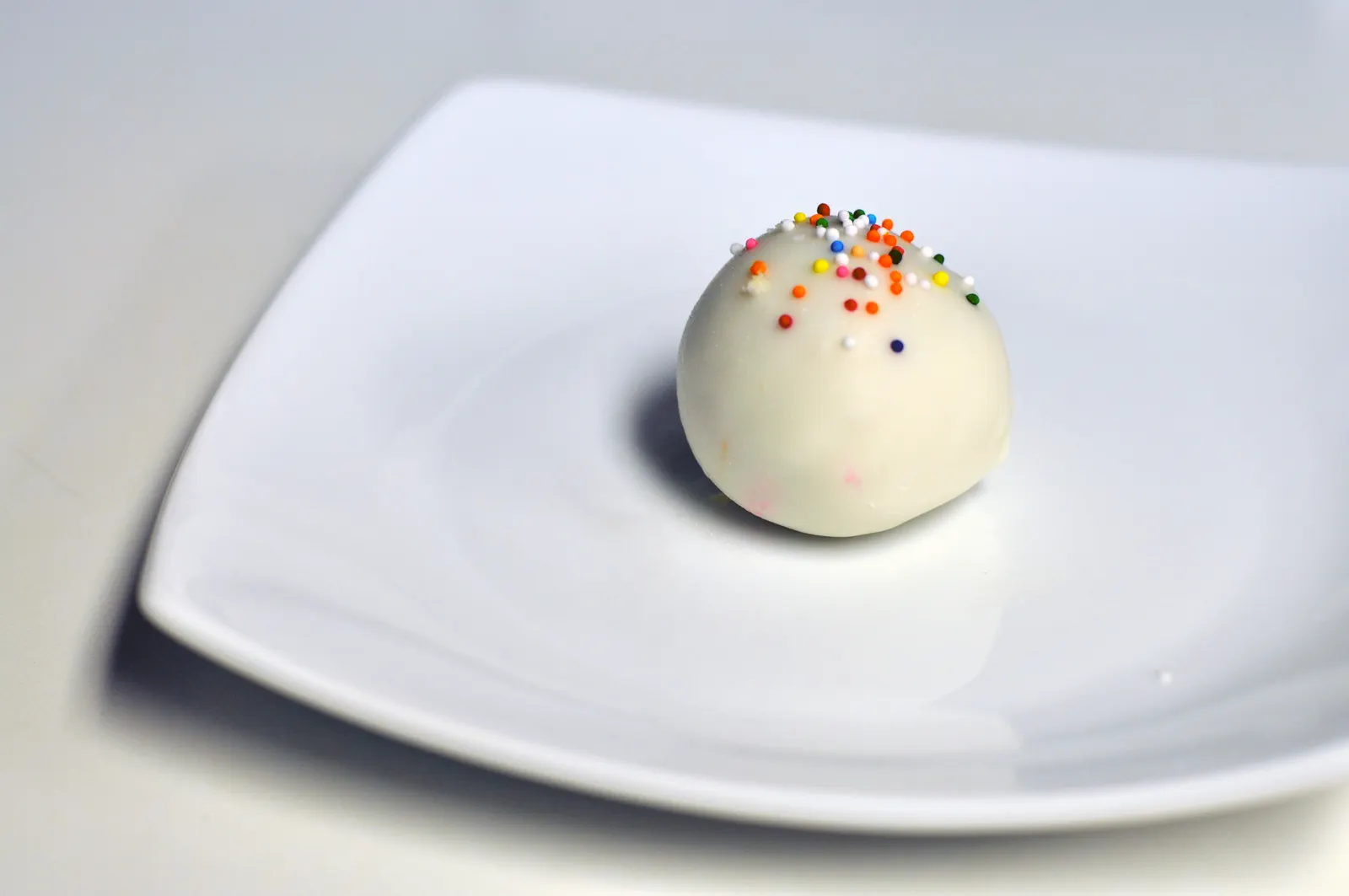
Sasha Wolff’s sprinkle-coated cake ball shows the smooth, fully covered shell to seek; it is illustrative, not Marissa’s yellow pineapple-cherry version.Photo by Sasha Wolff / Wikimedia Commons · CC BY 2.0
Source yield
8 servings
Pineapple
About 1 cup
Chill
10–15 minutes
Center
1 cherry each
The clever part is not turning cake into a ball. It is finding a place for the sticky, buttery brown-sugar layer that makes pineapple upside-down cake itself. Marissa’s answer is to pour that warm caramel mixture into the cooled crumbs, where it becomes both flavor and structure.
The rest reads like a party reveal: pineapple juice runs through the yellow cake, crushed fruit stays in its crumb, and a whole red cherry waits at the center. A yellow shell keeps the bite neat. Frosting is deliberately optional, because the cake, fruit, butter, and sugar may already bind without it.
“Marissa made these for her daughter’s Lilo & Stitch luau after deciding that the cake-ball versions she had seen needed the buttery brown-sugar glaze of a traditional pineapple upside-down cake.”
The cake
Use the box directions, replacing its water with reserved pineapple juice and folding in drained fruit.
The caramel
Warm melted butter and brown sugar go into the crumbs before any optional frosting.
The surprise
Seal one drained cherry inside each ball, then dip it in yellow candy coating.
Before the batterBox sieve tray bowl
Set up the luau assembly line
This recipe moves from cake pan to crumb bowl to cold tray to coating bowl. Four small preparations keep the handoff clean.
Inside the shellJuice fruit caramel cherry
Classic cake signals, compressed
Each familiar upside-down-cake cue lands in a different layer, so the bite reads clearly even without the iconic ring pattern.
01
Yellow cake + pineapple juice
The box supplies the crumb structure while reserved can juice replaces plain water and drives pineapple flavor through the whole center.
Use the package’s water measure; the source does not authorize changing its eggs, oil, pan, or temperature.02
Crushed pineapple
About one cup puts visible strands and soft fruit into the cake without abandoning the familiar boxed-cake crumb.
Press out free juice. Wet fruit is the source’s own warning sign for a longer, less predictable bake.03
Butter + brown sugar
This warm mixture is Marissa’s central idea: the caramel glaze of upside-down cake becomes the binder inside the ball.
Mix it in before reaching for frosting; the crumbs may already hold together without another sweet binder.04
Maraschino cherry + yellow shell
A whole cherry makes the hidden red center; the candy coating seals the moist cake and gives the party bite a clean finish.
Blot the cherry, seal every seam, and keep half the tray cold while the other half is dipped.
Gold + cherry redThe cake that inspired the center
Caramel warmth outside the old cake pan
The source’s quarter-cup butter and full cup of brown sugar carry the caramel signature of the classic cake into the crumbled center.Photo by Kimberly Vardeman · CC BY 2.0
Caramel before frosting
The butter-brown sugar mixture is not decoration. It is the recipe’s defining binder, so mix it through every crumb before deciding whether frosting is needed.
Drain the 10-ounce jar thoroughly, then either hide one cherry inside each ball or chop the cherries into the cake mixture as Marissa suggests.Photo by WindyWinters · CC BY 2.0
The party sequencePackage time + source chill
Bake, cool, bind, hide, dip
The box owns the oven clock; Marissa owns the flavor architecture. Keep those responsibilities separate and the recipe stays both faithful and workable.
Bake
Follow the package
Replace its water with reserved pineapple juice, fold in about one cup drained pineapple, and bake until its stated doneness cue is met.
Cool
Lose every trace of warmth
Let the cake cool completely before crumbling; warm steam and added fat can make the center pasty.
Crumb
Add caramel first
Work warm butter and brown sugar through fine crumbs, then test whether the mixture squeezes together.
Bind
Use frosting by teaspoons
Add vanilla frosting only if the glazed crumbs still fall apart, stopping before the mixture turns sticky.
Shape
Close around the cherry
Flatten each scoop, add one drained cherry, wrap the edges over it, and roll until no seam remains.
10–15m
Firm, do not freeze
Chill the lined tray until the balls hold their shape; keep the waiting batch cold during dipping.
Dip
Submerge and tap
Cover each ball in smooth yellow coating, tap away excess, and slide it onto the lined sheet to set.
Hands and eyesBaked cohesive sealed fluid
Four checks for a clean shell
Cake-ball success is mostly moisture control. Read the crumb and coating instead of solving every wobble with more frosting or more heat.
01
Cake is baked through
The center follows the package doneness test; extra pineapple liquid must not leave a gummy raw streak.
02
Crumbs squeeze cleanly
A palmful should hold without coating your fingers. If it smears, more frosting will only make it worse.
03
Cherry is fully sealed
No red syrup or fruit should show through the rolled surface before the chill.
04
Coating falls in a thin ribbon
Smooth candy should cover in one pass and drain from the fork; thick ridges signal cooling or overheating.
Pineapple upside-down cake balls
Pineapple-juice yellow cake and crushed fruit bound with warm butter and brown sugar, wrapped around maraschino cherries, and dipped in yellow candy coating.
1 can crushed pineapple, drained very well with the juice reserved
1/4 cup butter, melted
1 cup packed brown sugar
Vanilla frosting, only as needed to bind
Cherry center and shell
1 jar (10 ounces) maraschino cherries, drained
Yellow candy melts, enough to coat the formed balls
Directions
Drain the crushed pineapple very thoroughly, pressing gently in a sieve, and reserve the juice. Drain the maraschino cherries separately and blot away clinging syrup. Prepare the cake pan called for by the cake-mix package.
Make the yellow cake batter according to the package, using the reserved pineapple juice in place of the water it calls for. Fold in about 1 cup of the well-drained crushed pineapple; this is the amount Marissa recorded using.
Bake in the package-specified pan, oven temperature, and time range. The source warns that excess pineapple liquid can lengthen the bake, so use the package doneness cue and continue only until the center is baked through.
Cool the cake completely. Crumble it finely into a large bowl with clean hands or pulse pieces in a food processor until no large chunks remain.
Stir the melted butter and brown sugar together; it is fine if the sugar does not fully dissolve. Drizzle the mixture over the crumbs while still warm and mix until evenly distributed.
Squeeze a little mixture in your palm. If it does not hold together easily, work in vanilla frosting a small spoonful at a time. Stop as soon as the crumbs form a cohesive ball without feeling sticky.
Scoop a portion, roll it, then flatten it into a small disk. Put one drained cherry in the center and wrap the cake mixture firmly around it, rolling again to seal. Alternatively, use Marissa’s source option: chop the cherries and mix them into the crumbs before shaping.
Arrange the balls on a wax-paper- or parchment-lined baking sheet and refrigerate for 10–15 minutes, just until firm enough to dip. Keep the undipped balls chilled while you work in batches.
Melt the yellow candy coating according to its package in a completely dry, deep bowl. Stir until smooth; avoid water, steam, and overheating, which can make candy melts seize or thicken.
Lower one cake ball into the coating with a fork, submerge it completely, then lift and tap the fork gently against the bowl so the excess falls away. Slide the coated ball back onto the lined sheet. Repeat with the remaining balls.
Let the shells set completely. If the coating begins to thicken, rewarm it gently rather than adding water or milk. Refrigerate the finished cake balls in a covered container.
Source and technique references: Marissa’s complete March 26, 2014 Life Is Fantasmic recipe for the ingredient formula, pineapple-juice substitution, approximately one-cup fruit note, warm butter-brown sugar binder, optional frosting, cherry center, 10–15 minute chill, fork-dipping method, and wet-pineapple warning; the queued My Recipe Magic card for legacy ID 2501462154, its May 22 syndication date, eight-serving record, and unverifiable nutrition panel; King Arthur Baking’s test-kitchen cake-pop recipe for fine crumbs, a squeeze-to-hold binder cue, two-tablespoon portions, batch chilling, deep-bowl coating consistency, gentle tapping, and refrigerated storage; Wilton’s candy-melt guide for keeping water and steam away, avoiding overheating, and preventing a seized coating; the FDA on raw flour and batter safety; and Food Network’s pineapple upside-down cupcakes as independent corroboration that butter, brown sugar, pineapple, and cherries form the dessert’s classic flavor line. No source ingredient proportion was changed.