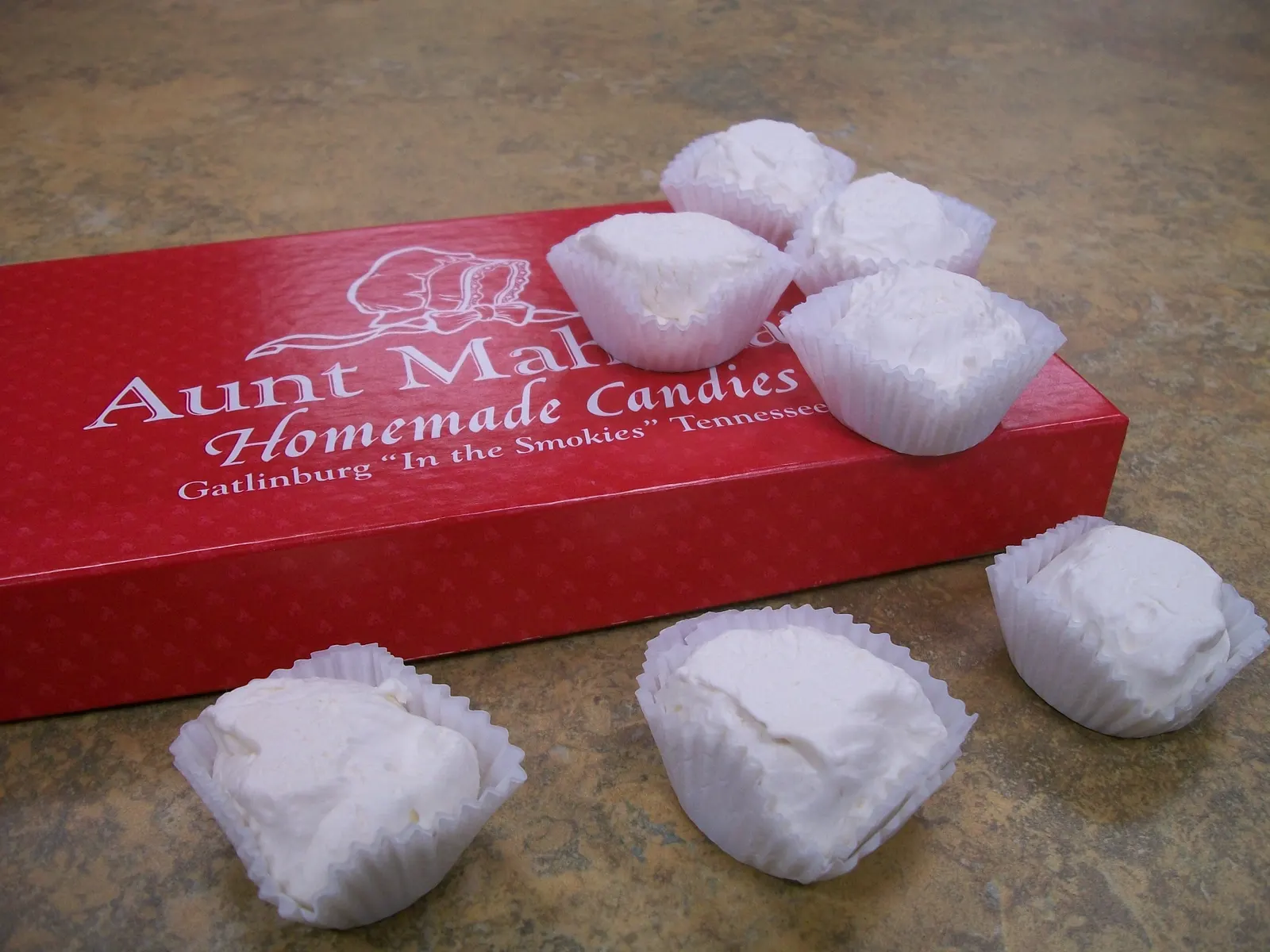
This photographed Tennessee divinity shows the irregular, matte, spoon-dropped finish to look for. Trish’s gelatin version can be pastel rather than white.Photo by Ejm225 / Wikimedia Commons · CC BY-SA 3.0
Active
35 min
Syrup
250°F
Set
4 hr or overnight
Yield
36 candies
Divinity turns a thermometer reading into a cloud. Trish Rosenquist’s variation starts with the classic American candy architecture—hot concentrated syrup folded into egg-white foam—then lets dry fruit gelatin carry the color and flavor. The result is soft and nougat-like inside, matte and delicately set outside.
“No-fail” still has a narrow finish line. The syrup must reach 250°F, the pour must stay thin enough for the moving whisk to absorb it, and the final beat must stop when a spoonful stands. Those are observable controls, not kitchen folklore, and they make the cheerful pastel candy repeatable.
“An easy pastel Jell-O divinity made for Easter tables and baby showers, with the gelatin helping the candy set more quickly.”
The syrup
Sugar, corn syrup, water, and salt cook without stirring until the thermometer reaches the source’s 250°F hard-ball target.
The foam
Very stiff egg whites take three tablespoons of dry gelatin before the hot syrup arrives in a thin, deliberate stream.
The finish
The mixer stops by evidence: the shine fades, the mass turns sticky, and a test spoonful stands instead of spreading.
The formula mapSyrup foam fruit crunch
Four parts of a pastel cloud
The ingredient list is short, but each part arrives at a precise stage. Preserve the measures and organize the counter before heat enters the process.
01
Light corn syrup
It joins granulated sugar in the cooked base, bringing body while helping the concentrated syrup resist uncontrolled crystallization.
Keep the source’s three-quarter cup. Dark corn syrup changes both the pale color and the clean fruit-flavor canvas.02
Egg whites
Two stiffly beaten whites hold the syrup as a fine foam, giving divinity its soft, cloudlike interior rather than a hard-candy snap.
A perfectly clean, grease-free bowl matters. For the conservative safety choice, use whites separated from pasteurized shell eggs.03
Fruit gelatin
Three dry tablespoons add flavor, a pastel tint, and gelatin to the whipped candy without introducing liquid coloring.
Cherry makes the brightest pink; strawberry is paler, while lime, berry blue, and lemon follow Trish’s photographed variations.04
Pecans, optional
A full cup breaks up the sweetness with toasted-looking ridges and a firm bite, but the divinity can remain completely smooth.
Have the nuts chopped before the syrup boils. Fold them in only after the candy holds a mound, then start dropping immediately.
The candy rhythmPrepare dissolve boil pour beat drop
The thermometer-to-spoon relay
Once the syrup reaches hard ball, every remaining ingredient, tool, and papered tray should already be waiting.
0:00
Build the landing zone
Paper two sheets, butter two spoons, measure every finish, and place the mixer beside the saucepan.
Boil
Dissolve, then stop
Stir until the syrup boils and the sugar disappears; from that point onward, leave the pan undisturbed.
250°F
Hit hard-ball concentration
Read the thermometer in the syrup, not against the pan. Adjust the target downward when cooking well above sea level.
2 min
Thread syrup into the foam
With the colored whites moving, pour a thin stream between the whisk and bowl wall for a full two minutes.
4–6 min
Beat to a matte mound
Add vanilla and watch gloss give way to a sticky mixture whose test spoonful keeps a distinct silhouette.
4 hr+
Drop and leave it alone
Portion quickly, then let the candies dry undisturbed until they lift cleanly; overnight is even better.
The precision spreadRead the number · trust the mound
One temperature, then a texture test
A candy thermometer is the recipe’s central control. The display pictured is illustrative; the syrup target here is 250°F at sea level.Photo by Veganbaking.net / Wikimedia Commons · CC BY-SA 2.0
The two endpoints do different jobs
The thermometer controls syrup concentration. The dropped-spoon test controls aeration and crystallization. Neither one replaces the other.
2 large egg whites, at room temperature; pasteurized shell eggs preferred
3 tablespoons fruit-flavored Jell-O powder, any flavor
1 teaspoon vanilla extract or another complementary extract; clear vanilla keeps pale colors bright
1 cup chopped nuts, optional; Trish usually uses pecans
Directions
Line two large baking sheets with waxed paper. Lightly butter two large spoons and set them beside the sheets. Measure the gelatin, vanilla, and optional nuts before the syrup starts; the finished candy firms quickly.
Combine the granulated sugar, corn syrup, water, and salt in a heavy 3-quart saucepan. Bring to a boil over medium to medium-high heat, stirring frequently only until the sugar is dissolved and the boil is established.
Stop stirring once the syrup boils. Clip on the candy thermometer without letting its tip touch the pan bottom. Continue boiling undisturbed to 250°F (121°C), the source’s hard-ball target. At high elevation, use the adjusted finish temperature in the notes rather than 250°F unchanged.
While the syrup heats, put the room-temperature egg whites in the clean, grease-free mixer bowl. Beat on high until they stand in very stiff peaks. Add the dry Jell-O powder and whisk until the color is even and no powder pockets remain.
As soon as the syrup reaches the correct temperature, remove it from the heat. Run the mixer at medium-high and pour the syrup in a very thin, steady stream between the whisk and bowl—not directly onto either. Take about 2 full minutes, as Trish specifies, and keep hands clear of the steam and syrup.
Add the vanilla. Continue beating for 4–6 minutes, stopping briefly to test as needed, until the candy becomes sticky, loses its wet gloss, and a spoonful dropped on the prepared paper holds a mound instead of spreading into a puddle.
Fold in the optional chopped nuts only after the candy passes the mound test. Work promptly so the mixture does not set in the bowl.
Use one buttered spoon to lift a heaping teaspoon or tablespoon of candy and the second to push it onto the waxed paper. Keep portions similar so the 36 pieces set at the same rate; the spoons should not need to be buttered again.
Leave the dropped candies undisturbed at room temperature for at least 4 hours, preferably overnight, until their surfaces are dry and they lift cleanly from the paper.
Store fully set divinity in a tightly sealed container at cool room temperature, separating layers with waxed or parchment paper. Keep it away from heat, sunlight, and humidity.
Source and technique references: Trish Rosenquist’s maintained Mom On Timeout article for the February 28, 2016 identity, exact formula, 36-piece yield, flavor variations, 250°F endpoint, two-minute syrup pour, 4–6-minute beat, spoon test, setting time, and two-week dry storage; Utah State University Extension’s divinity method for independent confirmation that very stiff whites, gradual hot-syrup incorporation, a loss of gloss, and spoon-dropping define the confection; Colorado State University Extension’s candy guide for the 250–260°F hard-ball range, thermometer use, crystallization control, and the approximate 2°F-per-1,000-feet elevation adjustment; and the FDA egg-safety guide for clean handling and pasteurized eggs when a finished food’s egg cook is uncertain. The recipe’s ingredient ratios and sea-level endpoint were not changed; altitude, burn prevention, pasteurized-egg preference, humidity, and doneness cues are clearly separated researched guidance.