The dark-roux potLouisiana · chicken · kielbasa · rice
Thirty to forty-five minutes at the spoon
New Orleans Gumbo
Lauren Allen’s 2014 chicken-and-sausage gumbo builds six generous bowls from a patient chocolate-dark roux, the Louisiana trinity, rotisserie chicken, and Polska kielbasa.
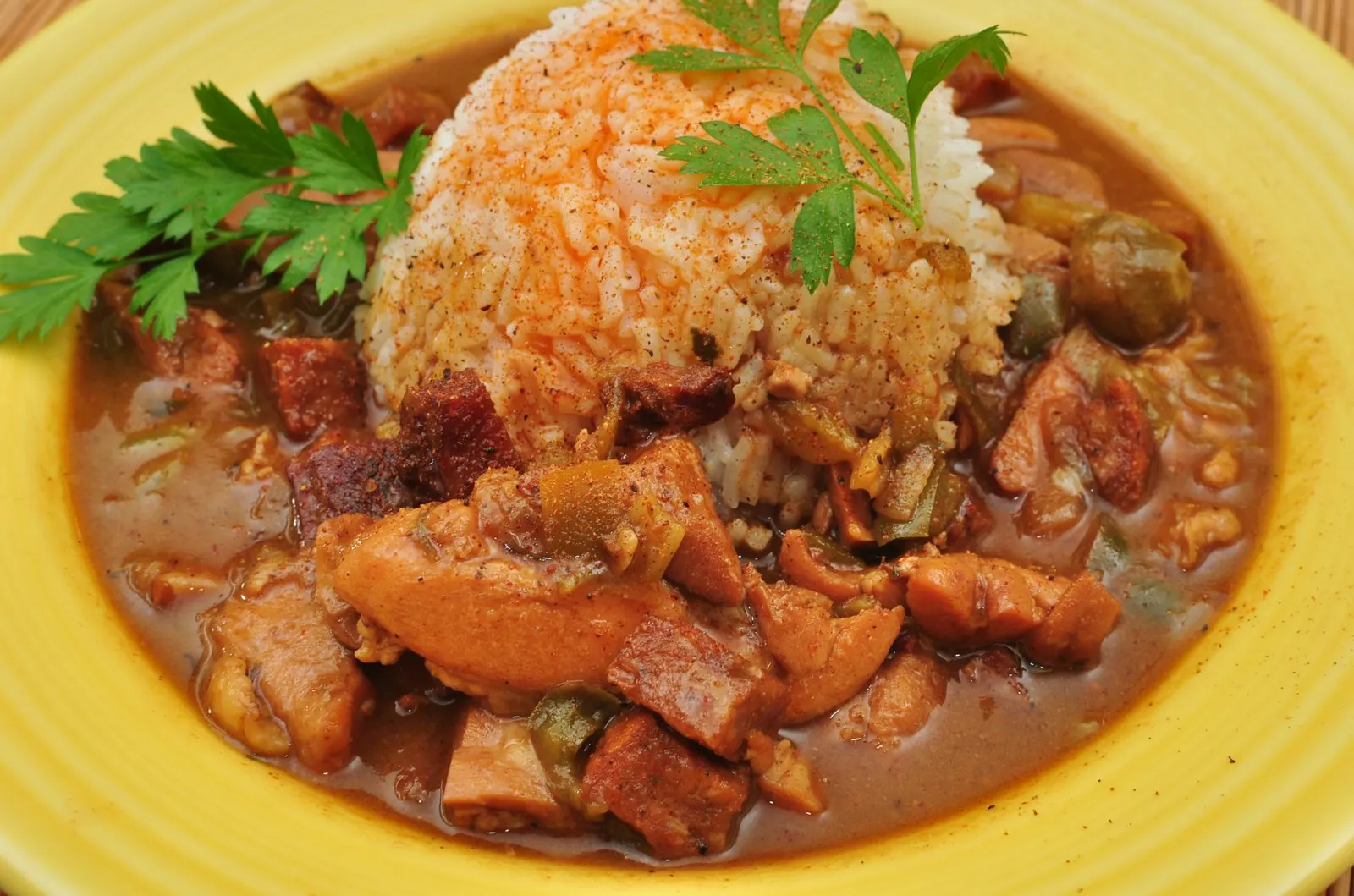
Chicken, smoked sausage, rice, and a dark gravy make this a close visual relation to the queued gumbo. The photographed bowl also contains tasso and uses andouille rather than the source card’s Polska kielbasa.Photo by jeffreyw / Wikimedia Commons · CC BY 2.0
Serves
6 bowls
Prep
20 minutes
Total
1 hour 20 minutes
Center
Dark roux · chicken · kielbasa
The first ingredient is attention. For half an hour or more, flour and oil move around a heavy pot until their pale beginning becomes the color of dark chocolate. That patient roux gives Lauren Allen’s 2014 gumbo its gravity; everything after it—the green vegetable basket, smoky sausage, pulled chicken, and white rice—has somewhere deep to land.
This is the compact six-serving edition preserved by the queued card: Polska kielbasa rather than a measured andouille package, five to six cups of stock, and no shrimp. It is a practical family pot with a serious Louisiana technique at its center, and its best safeguard is simple mise en place: chop first, then stir without interruption.
“Authentic New Orlean's Style Gumbo”
The edition
The queued 2014 card serves six with Polska kielbasa and no shrimp; later author-page additions remain outside this formula.
The commitment
A chocolate-dark roux takes 30–45 minutes of steady stirring. All chopping happens before the oil meets flour.
The last taste
Stock, sausage, chicken, and seasoning arrive with their own salt. The pot is adjusted only after they have met.
The pot mapToast · green · smoke · tenderness
Four layers, one dark foundation
The ingredient list is generous, but the roles are clean: roux carries the broth, the trinity perfumes it, sausage leaves fond, and cooked chicken enters late.
01
Flour and neutral oil
A heaping cup of flour and two-thirds cup oil become the dark, nutty backbone that thickens without cream.
Use a heavy pot and a flat-edged spoon or whisk that reaches the corners. Never step away once browning begins.02
The trinity and its green edge
Celery, bell pepper, and onion establish the Louisiana base; green onion, parsley, and garlic make this particular pot unusually aromatic.
Dice everything before starting the roux. A whole celery bunch includes its leaves, which carry useful herbal flavor.03
Polska kielbasa
The 2014 card chooses one smoky sausage rope and leaves its weight open rather than specifying later-revision andouille.
Cut even coins and brown both faces. Deglaze the skillet with stock so the fond follows the sausage into the gumbo.04
Rotisserie chicken
One cooked bird turns the gumbo into a practical supper while keeping the meat and stock decisions separate.
Pull bite-size pieces and add them late. The goal is to heat through, not simmer the chicken until it shreds into threads.
The eighty-minute clockChop · brown · open · simmer · ladle
The long stir makes room for a short finish
Nearly all active risk sits in the roux. Once its color is right, the gumbo comes together through measured stock, a brief vegetable boil, and a final heat-through.
0:00
Finish every knife cut
Dice the six aromatics, slice the kielbasa, pull the chicken, and measure flour, oil, and stock before the burner comes on.
0:20
Begin the roux
Combine flour and oil over medium-low heat and move the mixture slowly through the center, edges, and corners without stopping.
0:35
Read the color
The roux passes tan and peanut butter on its way to dark chocolate. Lower the heat if the color runs ahead of your spoon.
0:50
Brown the coins
As the roux nears its final shade, sear the kielbasa in one layer in a separate skillet, turning every piece once.
0:55
Capture the fond
Deglaze the sausage skillet with half a cup of stock and stir those browned bits into the roux pot.
1:00
Open the roux with stock
Stir in another four and a half cups gradually, then add every chopped vegetable, parsley, and garlic.
1:08
Bring in the meats
After a brief boil softens the vegetables, add seasoning, sausage, and chicken; return the pot to a gentle simmer.
1:17
Taste, loosen, ladle
Adjust spice and stock only now, then serve the hot gumbo around white rice in six bowls.
From copper to chocolateThe color decides the depth
A roux is ready when the pot smells toasted
The source’s decisive stage is visual rather than numerical: keep the flour and oil moving until the roux is chocolate-dark, smooth, and nutty, with no black specks or acrid smell.Photo by Megs / Wikimedia Commons · CC BY-SA 4.0
Dark does not mean rushed
Medium-low heat gives the spoon time to keep pace with browning. If the roux runs toward black, move the pot—not the clock.
Celery, green bell pepper, and yellow onion are the Louisiana trinity. Allen’s card uses a whole bunch of celery and adds garlic, green onions, and parsley for a notably green, aromatic pot.Photo by Herb Roe / Wikimedia Commons · CC BY-SA 3.0
The sensory readSmooth · brown · seared · tender · ladleable
Five proofs that the pot is on course
Clock time is only the frame. Color, aroma, the wake of the spoon, and the way the finished gumbo settles tell the truth.
01
The spoon leaves a clean wake
A finished roux briefly exposes the pot before flowing back, with a smooth sheen and no floury lumps.
02
The color is dark chocolate, not black
Deep brown brings toast and nuttiness. Black flecks or an acrid edge mean the flour has burned.
03
The sausage owns two browned faces
Even coins carry seared edges into the broth instead of tasting merely warmed and rubbery.
04
The vegetables yield but remain visible
Celery, pepper, and onion soften in the brief boil without dissolving into a uniform paste.
05
The ladle pours, then settles
Five cups makes the fuller-bodied starting point; the sixth cup is available only if the pot needs loosening.
Gumbo rewards advance work and careful cooling. Rice stays separate, and the deep stockpot gives way to shallow containers before refrigeration.
Make the roux ahead
The maintained author guidance allows a cooled roux to rest covered in the refrigerator for 3–5 days.
Prep the basket first
Chop the vegetables and pull the chicken before cooking; refrigerate them separately until the pot begins.
Hold the rice apart
Cook rice near service and keep it separate from gumbo so each grain stays distinct and leftovers do not swell.
Cool in shallow containers
Divide the pot rather than refrigerating one deep stockpot. Chill within two hours and use within 3–4 days.
Reheat with a boil
Bring the gumbo to a rolling boil, confirm 165°F throughout, and warm only the rice you intend to serve.
New Orleans Gumbo
Lauren Allen’s six-serving 2014 gumbo: a chocolate-dark flour-and-oil roux, celery and peppers, browned Polska kielbasa, rotisserie chicken, and hot white rice.
1–2 tablespoons Joe's Stuff Cajun Seasoning, or another Cajun seasoning to taste
5–6 cups chicken stock, divided
1 Polska kielbasa sausage, sliced into coins
Meat from 1 rotisserie chicken, shredded or pulled into bite-size pieces
Hot cooked white rice, for serving
Directions
Before heating the oil, dice the celery, bell pepper, yellow onion, green onions, parsley, and garlic; slice the kielbasa and pull the rotisserie chicken. Once the roux begins, it needs uninterrupted attention.
Combine the flour and oil in a large heavy-bottomed stockpot. Cook over medium-low heat for 30–45 minutes, stirring slowly and constantly into every edge of the pot, until the roux is dark chocolate brown, smells nutty, and has a soft cookie-dough-like body. If it develops black flecks or smells acrid, discard it and begin again.
While the roux is nearing its final color, arrange the kielbasa coins in one layer in a separate skillet over medium-high heat. Brown for 2–3 minutes on the first side, turn, and brown the second side. Transfer the sausage to a plate.
Take 1/2 cup from the measured chicken stock and pour it into the hot sausage skillet. Scrape up the browned bits, then carefully stir that liquid into the roux pot.
Gradually stir in another 4 1/2 cups chicken stock until the roux is smoothly dispersed. Add the celery, bell pepper, yellow onion, green onions, parsley, and garlic. Bring to a boil over medium heat and cook for 5–7 minutes, stirring and skimming any foam, until the vegetables are slightly tender.
Stir in 1 tablespoon Cajun seasoning, the browned kielbasa, and the pulled rotisserie chicken. Return the pot to a gentle simmer and cook just until the meats are hot and the vegetables are tender without disappearing into the broth.
Taste. Add more Cajun seasoning as needed and enough of the remaining chicken stock to reach the consistency you prefer. Keep salt decisions until this point because both kielbasa and prepared seasoning can carry substantial sodium.
Spoon hot cooked white rice into six deep bowls and ladle the gumbo around it. Serve immediately.