Blair Lonergan’s one-pan supper gives cubed sweet potatoes and broccoli a head start, then broils four salmon fillets beneath a glossy maple-Dijon glaze.
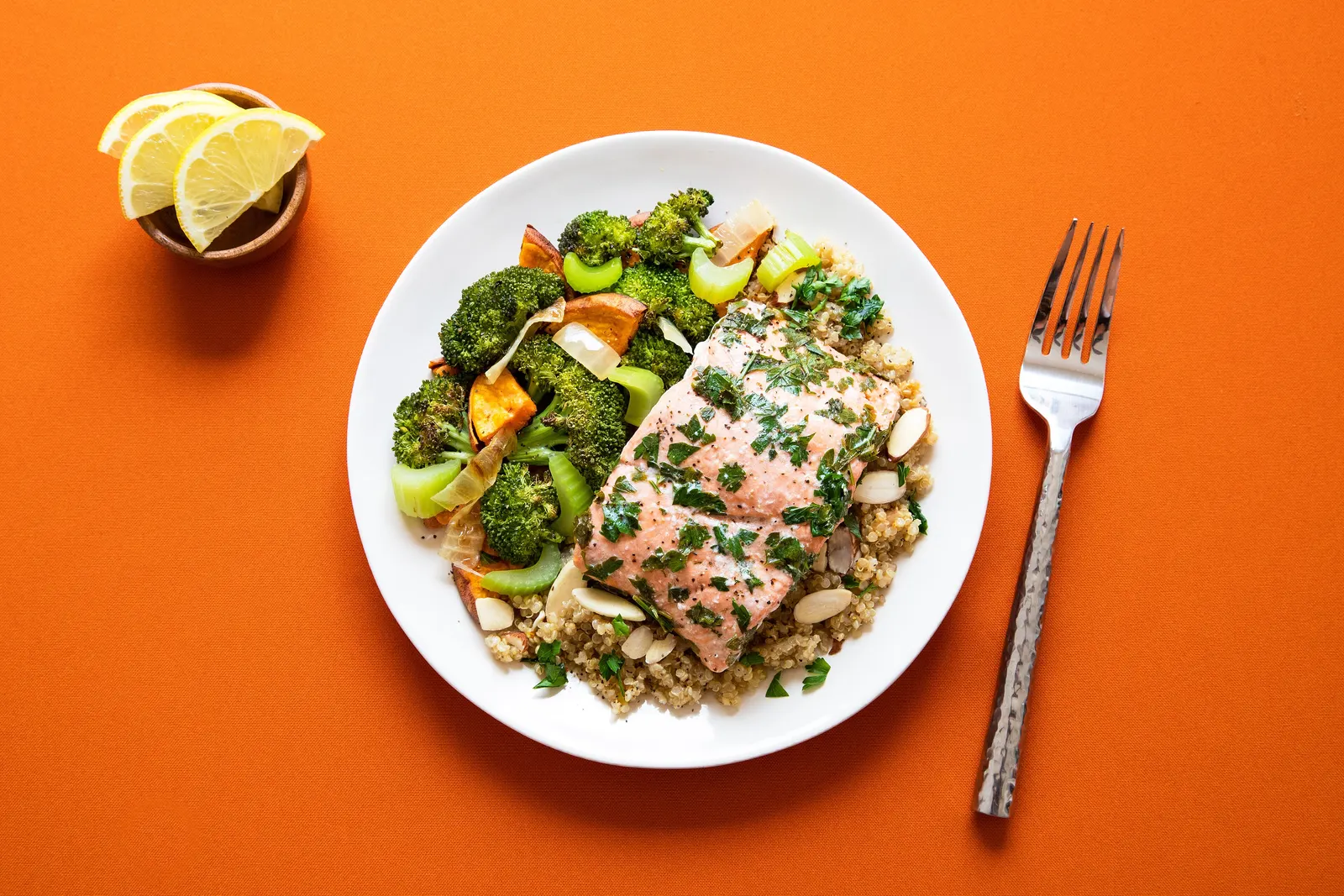
Ella Olsson’s open-license plate brings together the source recipe’s salmon, broccoli, and sweet potato. The photographed serving also includes quinoa, celery, almonds, lemon, and herbs, which are not part of Blair Lonergan’s seven-item 2015 formula.Photo by Ella Olsson / Wikimedia Commons · CC BY 2.0
Serves
4
Prep
10 min
Cook
20 min
Pan
One rimmed tray
One pan works only when every ingredient gets its own clock. Blair Lonergan’s 2015 supper does not ask salmon, broccoli, and sweet potato to pretend they cook at the same speed. The vegetables begin alone; the fish arrives for the final blast of heat.
That small piece of scheduling is the whole recipe. The sweet potatoes soften in a 400°F oven, the broccoli starts to bronze, and only then does the oven switch to high broil. Maple syrup and Dijon turn glossy over the salmon while the vegetables finish around the perimeter.
“This Sheet Pan Supper is an easy way to get to get a healthy dinner on the table FAST!”
The head start
One-inch sweet potato cubes and broccoli roast until almost tender before the faster-cooking salmon reaches the tray.
The center lane
Vegetables move to the perimeter; four spaced fillets take the hotter center without crowding or steaming.
The hot finish
Maple and Dijon meet only for the broil, where five to ten watched minutes can brown the glaze without drying the fish.
The tray mapSlow fast sweet sharp
Four ingredients, four clocks
The source formula is already spare. Accuracy comes from size, spacing, and order rather than adding more to the bowl.
01
Salmon fillets
Four pieces, each 4–6 ounces, turn the tray into four complete portions without changing the vegetable clock.
Choose fillets of similar thickness. A thin tail piece will finish before a thick center cut and should leave the pan first.02
Sweet potatoes
Two potatoes provide the tray’s slowest element and its caramelized, earthy sweetness.
Cut true 1-inch cubes. Larger pieces miss the source timing; smaller ones can soften before the broil ends.03
Broccoli
Twelve ounces roast beside the potatoes, their edges taking on color while the stems turn tender.
Keep florets broadly even. If the crowns darken early, lift the broccoli off before the salmon finishes.04
Maple + Dijon
A two-to-one blend brings sweetness, acidity, heat, and enough body to cling to the fish.
Pat the salmon dry and mix the glaze while the vegetables roast. The source needs no marinade and no extra sugar.
Oven clockRoast then broil
Thirty minutes, split into two heats
The first heat builds tenderness; the second browns the glaze. Keep those jobs separate and the whole tray lands together.
0:00
Heat and line
Set the pan several inches below the broiler, heat to 400°F, and line the metal tray with sprayed foil.
0:05
Build one layer
Coat the sweet potato cubes and broccoli with olive oil, salt, and pepper; spread them without piling.
0:10
Start the slow clock
Roast the vegetables for 10–15 minutes while maple, Dijon, salt, and pepper become one glaze.
0:22
Open the center lane
Switch to high broil, move vegetables outward, and space the salmon down the middle.
0:24
Brush and watch
Coat the fish generously; stay close while the maple bubbles and the surface browns.
0:30
Read the thickest point
Stop at 145°F, opaque flesh, and an easy fork separation; rest two minutes before plating.
Root + sharpThe supporting pair
Sweet potato takes the lead; Dijon cuts the glaze
Sweet potato owns the first clock. One-inch cubes roast until almost fork-tender before the faster salmon reaches the tray.Photo by Silentpilot / Wikimedia Commons · CC0 1.0
The tray is a timing diagram
Slow vegetables start first, fast fish enters last, and anything already deeply browned can leave before the final minute.
Two tablespoons of Dijon sharpen a quarter-cup of maple syrup and help the glaze hold to each fillet beneath the broiler.Photo by Jon Pallbo / Wikimedia Commons · Public domain
Four finish cuesTender cling bubble flake
Read the tray, not only the timer
A broiler can compress several minutes into one. These visual and temperature cues matter more than an exact second.
01
Nearly tender cubes
Before the salmon arrives, a fork enters the sweet potato with a little resistance and the corners remain intact.
02
Dry, coated fish
The glaze sits in an even amber layer instead of sliding into a watery moat around the fillet.
03
Active caramelization
Maple bubbles across the top and darkens at the ridges without turning black at the edges.
04
145°F at the center
The thickest section is opaque and separates in moist flakes; thinner pieces may reach that point first.
The holding planCut thaw broil chill
Stage early, glaze late
Vegetables and glaze can wait separately. The salmon should meet both only when the hot pan is ready.
Earlier in the day
Cut the vegetables and keep them covered and chilled. Whisk the glaze separately; do not coat the salmon yet.
Frozen fish
Thaw overnight in the refrigerator, then unwrap and pat dry. Cold-water thawing requires a sealed bag and immediate cooking.
At the table
Serve straight from the tray after a two-minute stand. The glaze is brightest and the broccoli edges crispest now.
Leftovers
Chill within two hours, keep 3–4 days, and reheat covered to 165°F in a low oven so the salmon loses less moisture.
Maple-glazed sheet pan salmon
Salmon fillets brushed with maple and Dijon, broiled beside roasted sweet potatoes and broccoli on one foil-lined tray.
2 sweet potatoes, peeled and cut into 1-inch cubes
2 tablespoons olive oil, plus more as needed for drizzling
12 ounces broccoli florets
Kosher salt and ground black pepper, to taste
4 salmon fillets, about 4–6 ounces each
Maple-Dijon glaze and pan
1/4 cup pure maple syrup
2 tablespoons Dijon mustard
Nonstick cooking spray, for the foil-lined pan
Directions
Set an oven rack so the rimmed sheet pan will sit several inches below the broiler element. Heat the oven to 400°F. Line the pan completely with aluminum foil and coat the foil lightly with nonstick cooking spray.
Spread the 1-inch sweet potato cubes and broccoli florets over the prepared pan in one uncrowded layer. Drizzle with 2 tablespoons olive oil, adding only enough extra to coat dry spots, toss well, and season with salt and pepper.
Roast for 10–15 minutes, turning the vegetables once if their undersides color quickly, until the sweet potatoes are nearly fork-tender. They should still hold their shape because they will cook again beneath the broiler.
While the vegetables roast, whisk the maple syrup, Dijon mustard, 1/4 teaspoon salt, and 1/4 teaspoon black pepper in a small bowl. Pat the salmon dry so the glaze adheres.
Remove the pan from the oven and switch the oven to BROIL on high. Push the vegetables toward the outer edges, leaving room at the center. If the broccoli is already deeply browned, transfer it to a plate and return it for serving.
Set the salmon in the center of the tray, leaving at least 1/2 inch between fillets. If using skin-on salmon, place it skin-side down. Brush or spoon the maple-Dijon mixture generously over the flesh.
Broil for 5–10 minutes, watching closely as the maple glaze bubbles and browns. The salmon is ready when the thickest part reaches 145°F (63°C), looks opaque, and separates easily with a fork; timing depends on fillet thickness and distance from the element.
Remove the pan as soon as the fish is done. Let the salmon stand for 2 minutes, then divide the fillets, roasted sweet potatoes, and broccoli among four plates and serve hot.
Source and technique references: the same-day September 4, 2015 The Seasoned Mom snapshot for the headline, description, publication date, author identity, seven food ingredients, four-serving yield, 10/20/30-minute timing, 400°F vegetable roast, and 5–10-minute high-broil finish; the maintained author page for the transparent later 425°F/35-minute revision, foil guidance, fillet-thickness troubleshooting, and current nutrition estimate; Food Network Kitchen for independent confirmation that maple, Dijon, a foil-lined rimmed sheet pan, and similarly sized salmon portions form a sound quick-roast method; FoodSafety.gov and the FDA seafood guide for 145°F doneness, fork-separation, refrigerated thawing, and the two-hour serving limit; and USDA FSIS for the 3–4 day refrigerated window for cooked fish. No source food ingredient, proportion, or 2015 cook setting was replaced.