The bright bakeBerry · buttermilk · zest · glaze

Liz Fourez · March 2013

Lemon Raspberry Muffins

Liz Fourez’s oil-based buttermilk muffins fold raspberries and lemon zest into a tender crumb, then finish with a sharp two-ingredient lemon glaze.

Fold lightly
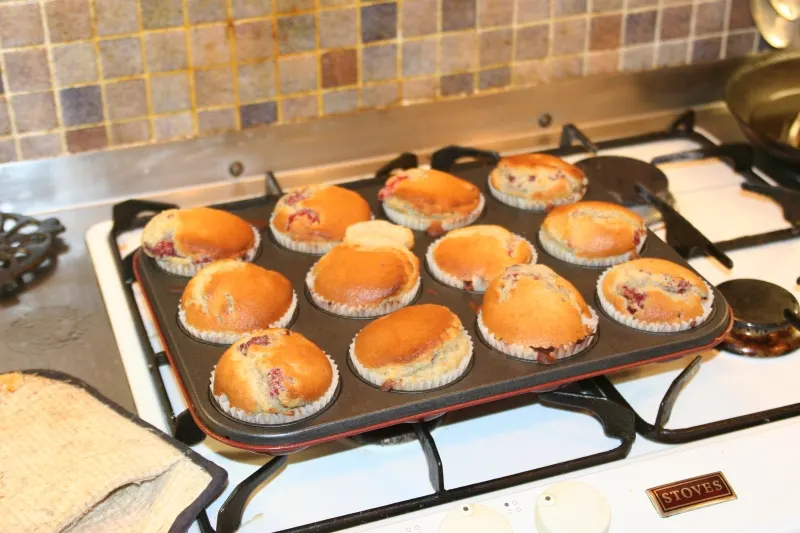
Twelve golden raspberry muffins cooling in paper liners inside a dark muffin pan.
Andrew Fogg’s raspberry muffins show the berry-marked crumb and modest domes that define this quick bread. Liz Fourez’s version yields eighteen and receives a fresh lemon glaze after cooling.Photo by Andy / Andrew Fogg / Wikimedia Commons · CC BY 2.0
Yield
18 muffins
Oven
400°F
Bake
18–20 minutes
Finish
Fresh lemon glaze

This is an eighteen-muffin recipe hiding inside a familiar twelve-cup silhouette. Liz Fourez keeps each portion modest, bakes it at one direct 400°F heat, and relies on buttermilk, canola oil, and a full tablespoon of baking powder for lift. The reward is not an oversized bakery cap. It is a light, practical brunch muffin with enough structure to hold a raspberry without turning rubbery around it.

Lemon works in two rooms. Zest stays in the batter, where its oil scents the crumb without adding extra liquid. Fresh juice waits for confectioners’ sugar, where acidity can remain vivid. Between those rooms sits the critical pause: mix only until moistened, distribute the berries with a few broad folds, and let the muffins cool before the glaze draws its pale line.

“Fresh raspberries and lemon zest give the muffins a bright burst of tart flavor, and a lemon glaze adds the final sweetness.”

Whisk dry first

Distribute the full tablespoon of baking powder through the flour before liquid enters the bowl.

Stop at moist

The batter needs no polishing. Fold only until the dry flour is nearly gone, then let the berries finish the mixing.

Give berries room

Eighteen wells keep the source portion modest. Overfilling twelve cups changes both the bake time and the crumb around the fruit.

Cool before the ribbon

Glaze belongs on the surface. A hot muffin absorbs it; a cooled muffin catches the lemon line.

The bowl planLift · tenderize · punctuate · finish

Eleven lines, four jobs

The maintained formula is short and deliberately divided. Each ingredient stays in the stage Liz assigned to it.

01

Buttermilk + canola oil

The liquid pair supplies tang and a crumb that stays supple after cooling without a butter-creaming step.

Whisk with the eggs and zest until the oil is evenly suspended before the wet bowl meets the flour.
02

One tablespoon baking powder

The source uses a generous measure to lift eighteen small portions at one steady 400°F temperature.

Whisk it through the flour and sugar thoroughly; a concentrated pocket tastes bitter and rises unevenly.
03

Raspberries

One and one-quarter cups punctuate the crumb rather than turning the batter into a berry puree.

Keep fresh berries dry and cold. Fold with a broad spatula and stop as soon as they are distributed.
04

Zest below, juice above

A teaspoon of fragrant zest perfumes the muffin, while three tablespoons of juice sharpen the white glaze.

Zest before juicing. Add any fourth tablespoon to the glaze by drops, only if the first mixture will not drizzle.

Fruit and acidCold berries below · lemon ribbon above

Keep the berry whole; keep the lemon bright

Fresh red raspberries packed into turquoise paper berry baskets.
Raspberries are the fragile fold-in. Keep them dry and cool until the batter is ready, then use the fewest strokes that distribute them.Photo by Igor Ovsyannykov / Wikimedia Commons · CC0 1.0
The fold is the edit

Every extra pass breaks more fruit and works more gluten. Stop while the batter still looks handmade; the oven, not the bowl, finishes the structure.

Lemons, oranges, orange blossoms, and a rose arranged on a dark table in a 1633 still life.
Francisco de Zurbarán’s still life supplies the article’s lemon-dark contrast. In the recipe, zest perfumes the crumb while juice is reserved for the glaze.Photo by Francisco de Zurbarán / Wikimedia Commons · Public domain

The steady-heat laneLine · whisk · fold · portion · test

Twelve minutes of mixing, twenty in the oven

There is no temperature change and no mixer. The only fast work is preparing the pans before the baking powder meets buttermilk.

  1. 0:00

    Heat and line eighteen wells

    Set the oven to 400°F and prepare at least eighteen wells across two standard muffin pans.

  2. 0:04

    Build the dry map

    Whisk flour, sugar, baking powder, and salt until the leavener is evenly dispersed.

  3. 0:07

    Whisk the bright bowl

    Combine eggs, buttermilk, canola oil, and lemon zest into one uniform emulsion.

  4. 0:09

    Fold only to moist

    Bring wet and dry together with a few deliberate strokes, then fold in the raspberries gently.

  5. 0:12

    Portion at two-thirds

    Share the batter among all eighteen wells so each muffin follows the source geometry.

  6. 0:30

    Read the center crumb

    At 18 minutes, test through cake rather than fruit. Continue to 20 minutes when wet batter remains.

  7. cool

    Rack, glaze, and set

    Move muffins out of the pans, cool them, then drizzle the lemon glaze and give it about 5 minutes to firm.

The crumb checkLumpy · whole · set · ribboned

Four reads from bowl to glaze

A clock narrows the window; texture decides when to stop mixing, when to pull the pan, and when the glaze is ready.

01

Lumpy batter, not a smooth pour

The flour is just moistened. Small unevenness is a sign to stop; continued stirring tightens the quick-bread crumb.

02

Whole berry pockets

Raspberries remain recognizable instead of streaking every inch of batter pink. A few broken berries are normal.

03

Set dome, clean crumb

The top springs back lightly and a tester through the muffin—not a berry—shows no paste-like raw batter.

04

Opaque glaze ribbon

The glaze falls slowly from the whisk and rests on the cooled crown. Watery icing vanishes; stiff icing tears the top.

The brunch holdChill dry · cool open · pack airtight

Protect the fruit first, the glaze last

Raspberries dislike water before baking and muffins dislike trapped steam afterward. The storage plan respects both.

Prep the pans before mixing

Baking powder begins working once the bowls meet. Line all eighteen wells first so finished batter never waits for paper.

Hold berries cold and dry

Refrigerate fresh raspberries unwashed in a shallow container. Rinse just before baking and blot gently.

Keep two days airtight

Cool completely before closing the container; trapped steam softens the glaze and makes the muffin surface tacky.

Freeze for 2–3 months

Freeze cooled muffins until firm, then pack airtight. Thaw at room temperature with space around the glaze.

Lemon Raspberry Muffins

Liz Fourez’s buttermilk-and-canola muffins with raspberries, lemon zest, and a fresh lemon glaze.

Raspberry MuffinsLemon GlazeButtermilkBrunchQuick BreadSpring Baking

Ingredients

Muffins

  • 2 cups all-purpose flour
  • 1 cup granulated sugar
  • 1 tablespoon baking powder
  • 1/2 teaspoon fine salt
  • 2 large eggs, lightly beaten
  • 1 cup buttermilk
  • 1/2 cup canola oil
  • 1 teaspoon finely grated lemon zest
  • 1 1/4 cups raspberries

Lemon glaze

  • 1 cup confectioners’ sugar
  • 3 tablespoons fresh lemon juice, plus up to 1 tablespoon more only if needed to loosen the glaze

Directions

  1. Heat the oven to 400°F / 205°C. Line 18 wells across two standard muffin pans with paper liners, or lightly grease them.
  2. In a large bowl, whisk the flour, granulated sugar, baking powder, and salt until the leavener is evenly dispersed and no compact pockets remain.
  3. In a medium bowl, whisk the lightly beaten eggs, buttermilk, canola oil, and lemon zest until uniform.
  4. Pour the wet mixture into the dry ingredients. Fold with a flexible spatula only until the flour is moistened; a few small flour streaks can remain before the fruit goes in. Add the raspberries and fold gently just until they are distributed.
  5. Divide the batter among 18 prepared wells, filling each about two-thirds full. Bake for 18–20 minutes, until the tops are set and a tester inserted through the crumb rather than a berry comes out clean or with only a few moist crumbs.
  6. Let the muffins settle briefly in the pans, then transfer them carefully to a wire rack. Allow them to cool so the glaze stays on the surface instead of soaking into the hot crumb.
  7. Whisk the confectioners’ sugar with 3 tablespoons lemon juice until smooth. If it is too thick to drizzle, add more juice a few drops at a time, using no more than the additional tablespoon the source allows. Drizzle over the cooled muffins and let the glaze harden slightly, about 5 minutes.

Source and research references: the queued legacy path and its matching MyRecipeMagic syndication identity; Liz Fourez’s maintained Love Grows Wild article for the March 24, 2013 date, authorship, brunch context, current eighteen-muffin formula, 400°F oven, 18–20-minute bake, two-bowl method, lemon glaze, and author clarification to cool before glazing; Susan Reid and the King Arthur Baking test kitchen’s berry-muffin method for hand-folding, frozen-berry handling, center-tester doneness, prompt rack cooling, and short room-temperature storage; Montana State University Extension’s raspberry guidance for shallow refrigerated storage and washing only before use; the FDA’s raw-flour guidance for the no-tasting warning and baking kill step; and Illinois Extension’s freezer chart for the 2–3-month quality window for baked muffins. Liz’s proportions, yield, oven setting, and glaze remain intact; pan logistics, doneness, frozen-fruit, safety, and storage notes are separated researched guidance.

Image credits

Photography is used under open licenses with attribution: Andy / Andrew Fogg / Wikimedia Commons, Igor Ovsyannykov / Wikimedia Commons, and Francisco de Zurbarán / Wikimedia Commons.