The chopstick scrambleEgg · sugar · soy · salt

No oil · four ingredients

Iri Tamago: Japanese Scrambled Eggs

Sweet-savory Japanese egg soboro stirred into tiny, separate grains for rice bowls, bento, fried rice, and sushi.

Make the egg grains
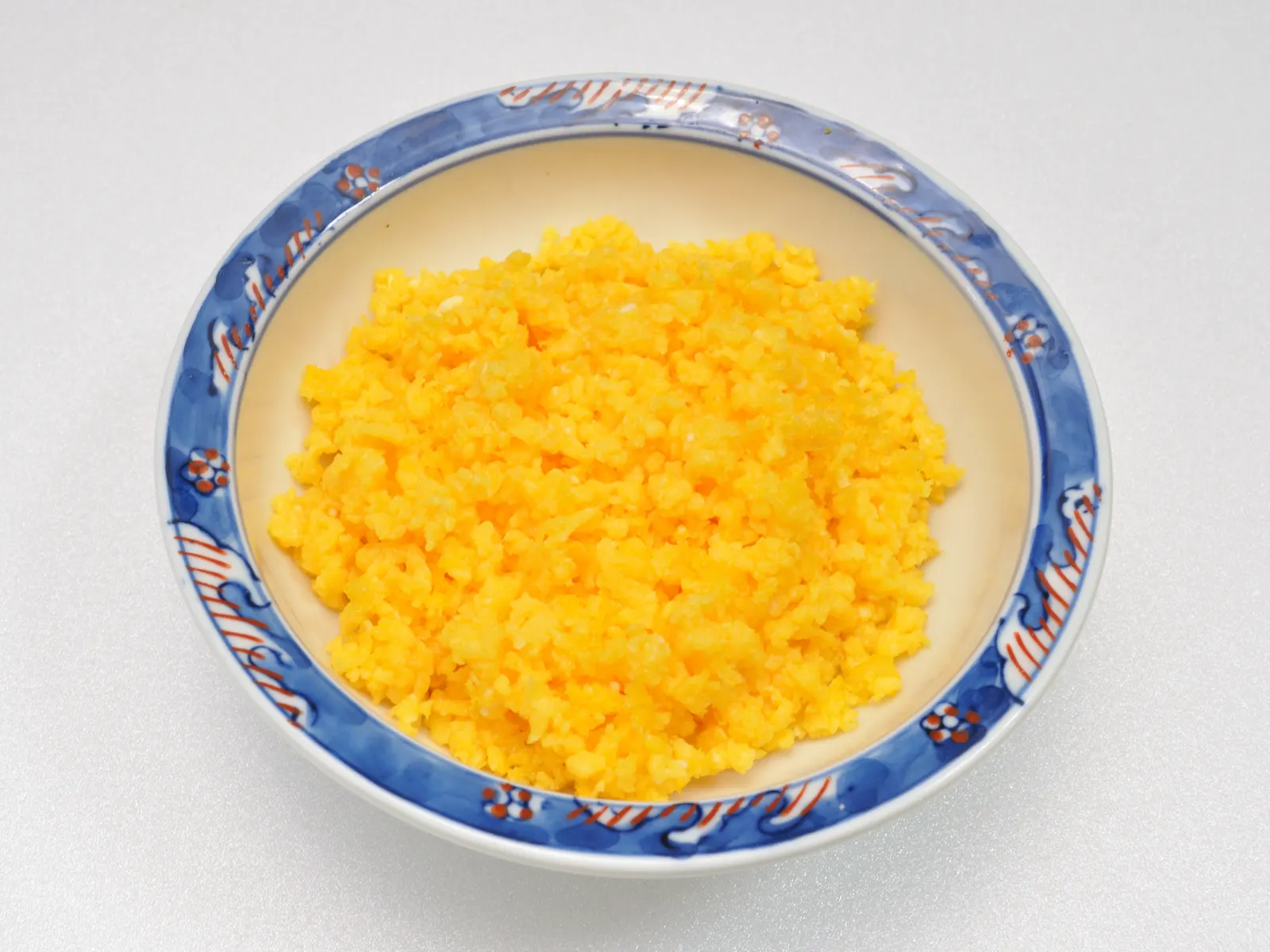
Fine yellow grains of Japanese iri tamago spread across a white plate.
Iri tamago is deliberately fine and fully set: a field of separate egg grains rather than the soft folds of Western breakfast scramble.Photo by Ocdp · CC0 1.0
Makes
2–3 servings
Ingredients
4
Fat in pan
None
Finish
Fine grains

Iri tamago begins like scrambled eggs and then takes the opposite road. There is no butter to soften broad folds, no cream to slow the set, and no moist finish to spoon onto toast. Sugar, soy sauce, and salt season two eggs for a deliberately dry, finely divided topping that can scatter across rice.

The tool explains the texture. Hold three or four cooking chopsticks together and every pass through the pan makes several cuts at once. Keep them moving while the heat goes briefly off, return the pan only to finish setting the last shine, and the egg lands as small golden grains ready for donburi, bento, fried rice, or sushi.

“Iri-tamago is a Japanese scrambled egg, also called soboro.”

Begin stirring at once

The first setting egg determines the curd size; break it before a sheet can form.

Bundle the chopsticks

Three or four points divide the mixture more quickly than a single utensil.

Pulse the heat

A brief off-heat stir keeps the outside from racing ahead before the center becomes granular.

The tiny formulaBody sweet savory salt

Four ingredients, one exact balance

With only two eggs in the bowl, a teaspoon is a real structural measure—not a casual dash.

01

Two eggs

The entire body of the dish, beaten smooth so white and yolk set into grains of the same color and size.

Break up every rope of white before the bowl reaches the stove.
02

One teaspoon sugar

A restrained sweetness that marks the egg as a Japanese rice and bento topping rather than a plain breakfast scramble.

Beat until no crystals collect at the bottom of the bowl.
03

One teaspoon soy sauce

A small savory measure deepens the egg without turning its bright yellow field brown or wet.

Measure level; the batch is too small to absorb a casual pour.
04

One pinch salt

The final seasoning point, deliberately tiny because soy sauce already contributes salinity.

Keep the source pinch rather than seasoning as if these were unseasoned eggs.

Bowl + bundleWhat makes the grain

Beat smooth, then multiply every stir

Brown and white eggs gathered in a ceramic bowl with one cracked shell showing a bright yolk.
Two eggs carry the whole dish. Beat until white and yolk are uniform before the sugar, soy, and salt meet the pan.Photo by Cory Seward · CC0 1.0
Four points are faster than one

Bundle the chopsticks in one hand, keep their tips on the pan floor, and sweep through center and rim without pausing.

Japanese, Chinese, and Korean chopsticks arranged in parallel on a pale surface.
Three or four cooking chopsticks held together multiply the stirring points, breaking the setting egg into the characteristic small grains.Photo by Wolfgang Michel · CC0 1.0

The heat pathBeat warm stir pause finish transfer

Six moves from liquid egg to golden grains

The source gives no minute count. Continuous motion, a brief heat interruption, and a fully set finish are the reliable clock.

  1. Beat

    Make one uniform yellow mixture

    Whisk egg, sugar, soy, and salt until no white streaks or sugar crystals remain.

  2. Medium

    Warm a dry nonstick pan

    The pan needs enough heat to set egg, but no oil and no smoking surface.

  3. Stir

    Start the chopstick flurry

    Pour and move immediately, tracing the whole base so the first curds stay tiny.

  4. Off

    Interrupt the heat, not the motion

    When patches begin to set, lift the pan or switch off briefly and keep breaking them apart.

  5. On

    Return only to finish

    Bring the pan back to medium heat and stir until no glossy liquid remains.

  6. Out

    Leave the hot pan at once

    Transfer the fine grains before residual heat turns their delicate edges tough.

Doneness cuesUniform tiny dry bright

Read the curd size, shine, and color

The right result is visibly different from soft Western scramble: separate grains, no wet center, and no browned edge.

01

Uniform liquid before cooking

White, yolk, sugar, soy, and salt should read as one mixture; streaks become uneven curds.

02

Many pinhead-to-pea-size pieces

The target is a scatter, not ribbons or folded pillows. Keep crossing the pan with the bundled chopsticks.

03

No wet shine

Iri tamago is cooked through. The last loose egg should disappear while the grains still separate easily.

04

Bright yellow, not browned

Medium heat plus the off-heat pause should set the egg without frying or coloring the fine edges.

Iri tamago: Japanese scrambled eggs

Two eggs seasoned with sugar, soy sauce, and salt, stirred without oil into fine, fully set grains for rice and bento.

Iri TamagoJapanese EggsEgg SoboroBentoRice Bowl ToppingFour Ingredients

Ingredients

Iri tamago

  • 2 large eggs
  • 1 teaspoon granulated sugar
  • 1 teaspoon soy sauce
  • 1 pinch fine salt

Directions

  1. Crack the eggs into a small bowl. Add the sugar, soy sauce, and salt, then beat until the whites and yolks are completely uniform and the seasonings have dissolved.
  2. Set a small nonstick skillet or saucepan over medium heat. Do not add oil; the source formula depends on a dry, reliably nonstick surface.
  3. Pour in the egg mixture. Hold 3 or 4 cooking chopsticks together and immediately stir fast, continuously, and across the whole base of the pan so the setting egg breaks into many small pieces instead of broad curds.
  4. As soon as the mixture begins setting in patches, turn off the burner or lift the pan from the heat while continuing to stir. This brief pause slows the outside while the loose egg catches up.
  5. Return the pan to medium heat and keep stirring vigorously until the mixture looks like fine, separate grains with no wet egg remaining. For a safety check, the egg should reach 160°F (71°C).
  6. Transfer immediately so residual pan heat does not harden the smallest grains. Serve over rice, in a bento, or as a topping for fried rice or sushi.

Source and technique references: Jessy Adams’s exact August 24, 2019 My Recipe Magic card for legacy ID 2639991667, title, description, author, three-serving listing, four-ingredient formula, equipment, and abbreviated method; the maintained Japan Food Style primary recipe for the 2-to-3-serving yield, no-oil identity, bundled-chopstick stirring, heat-off pause, and uses over rice, bento, fried rice, and sushi; Yumiko Maehashi’s RecipeTin Japan Sanshoku Bento for independent confirmation that iri tamago is fully cooked, oil-free, best in a nonstick pan, and vigorously stirred with two pairs of chopsticks into mince-size pieces; the USDA’s shell-egg safety guidance for a non-runny scramble and 160°F egg-dish finish; and University of Minnesota Extension’s cold-storage table for the 3-to-4-day cooked-egg window. No source proportion was changed.

Image credits

Photography is used under open licenses with attribution: Ocdp, Cory Seward, and Wolfgang Michel.