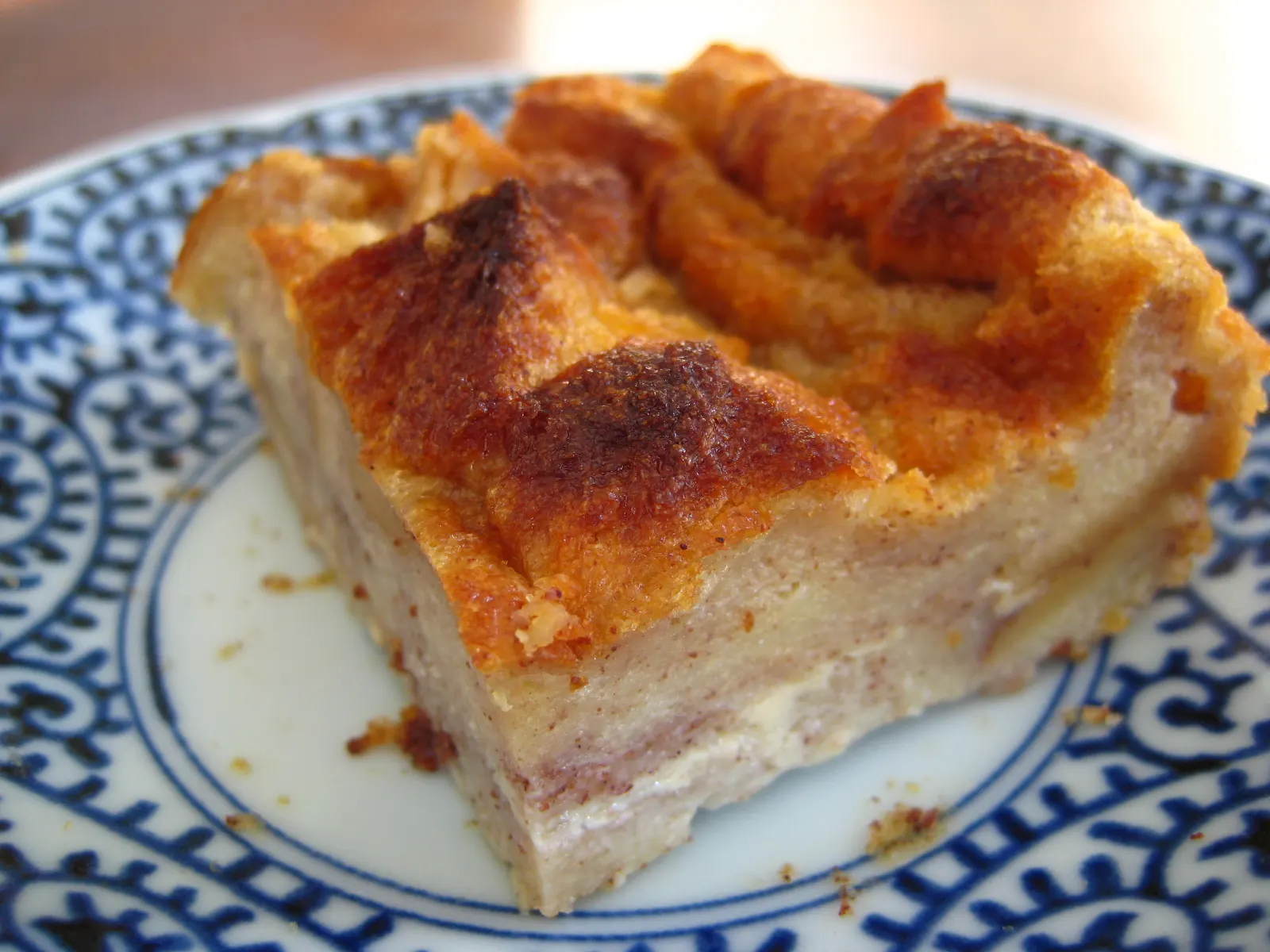
This open-license bread pudding is an illustrative texture reference. It contains ordinary bread and dried fruit; Dori’s version begins with corn bread and huckleberries.Photo by Quillaja / Wikimedia Commons · Public domain
Makes
15 servings
Dish
9 × 13 inches
Oven
300°F
Bake
60–75 min
The useful loaf is yesterday’s loaf. Dori Stowell began with extra corn muffins from a church supper, then folded in milk from a neighbor, eggs from her hens, and huckleberries picked in the forest. The result sits between breakfast casserole and dessert: maple-softened custard below, a scatter of brown sugar above, and dark fruit running through the golden crumb.
Nothing asks for a new batch of corn bread. The slightly dry edges are exactly what the custard needs. Pour slowly, allow the full soak, and bake at the source’s low 300°F until the center moves as one soft mass rather than a pool. It is thrift translated into texture.
“Use leftover corn bread or muffins to create this delicious breakfast or dessert; blueberries can stand in for huckleberries.”
Begin with the leftover
Eight cups of cubed corn bread carry the dish. Slightly dry cubes absorb custard while keeping visible edges.
Pour in passes
Move the bowl around the casserole so maple custard reaches the corners before the bread begins to drink it in.
Give it the full pause
The source’s 10–15-minute stand is where dry cubes become evenly saturated rather than wet only at the bottom.
Read the middle
A finished center trembles gently but does not slosh. The egg-dish safety check is 160°F / 71°C.
The absorption mapCrumb · berry · maple · custard
Four measures turn scraps into breakfast
The original ratio remains untouched. Success comes from distributing it evenly and giving the corn bread time to drink.
01
Eight cups corn bread
The crumb is both structure and sponge, bringing toasted corn flavor while holding four cups of dairy custard.
Cube gently and measure by volume. Use stale but sound bread—never bread with mold.02
One cup huckleberries
Tart, dark berries break through maple and brown sugar in small bright pockets.
Fresh or frozen both belong to the source; add frozen berries without thawing.03
Maple + brown sugar
Half a cup syrup sweetens the custard while a separate two tablespoons of brown sugar makes the top.
Keep the measures in their assigned places so the surface retains its caramel-like flecks.04
Five-egg milk custard
Four cups milk and five eggs set slowly around the corn bread at a low 300°F.
Whisk until no white strands remain, then verify the center rather than judging by the browned rim.
Pan + patchThe prairie breakfast palette
Yellow crumb holds the custard; wild fruit cuts through it
Leftover corn bread is the pudding’s structure. Slightly dry cubes welcome the maple-and-egg custard instead of dissolving into it.Photo by Calstanhope / Wikimedia Commons · CC BY-SA 4.0
Do not erase the cubes
Press dry peaks into the custard, but leave the bread’s shape intact. The finished spoonful should still show corn-gold layers.
Mountain huckleberries bring small flashes of tart fruit. The source explicitly permits fresh or frozen berries and names blueberries as the substitute.Photo by Julie from Idaho / Wikimedia Commons · CC BY 2.0
The pan clockCube scatter whisk pour rest bake
One soak, one long quiet bake
Assembly moves quickly; absorption and a low oven do the patient work.
0:00
Heat and grease
Set 300°F and coat the 9-by-13-inch dish so the custard releases at the edges.
+3
Build the field
Spread eight cups of corn-bread cubes, then scatter one cup huckleberries across the whole pan.
+6
Whisk one smooth custard
Combine milk, eggs, maple, the larger brown-sugar measure, cinnamon, and salt until uniform.
+8
Pour corner to corner
Distribute the custard in passes and press only the exposed dry pieces briefly beneath the surface.
+10
Sugar the top
Scatter the final two tablespoons brown sugar, then leave the pan undisturbed.
+20–25
Finish the soak
After the source’s 10–15-minute rest, the cubes should look evenly damp rather than afloat.
+80–100
Check the center
At 60–75 bake minutes, look for a soft tremble, no liquid slosh, and 160°F in the middle.
1 cup fresh or frozen huckleberries, or blueberries
4 cups milk; skim, whole fresh cow’s milk, or half-and-half
5 large eggs
1/4 cup packed brown sugar
1/2 cup maple syrup
1 teaspoon ground cinnamon
1/4 teaspoon salt
Topping
1/8 cup packed brown sugar (2 tablespoons)
For serving, optional
Whipped cream or ice cream
Directions
Heat the oven to 300°F / 150°C. Butter or spray a 9-by-13-inch casserole dish.
Spread the cubed corn bread or corn muffins in the dish. Scatter the fresh or still-frozen huckleberries evenly over and between the cubes.
In a large bowl, whisk the milk, eggs, 1/4 cup brown sugar, maple syrup, cinnamon, and salt until the egg whites disappear into a uniform custard.
Pour the custard slowly across the bread and fruit, moving around the pan so every area is moistened. Press any stubborn dry cubes briefly into the liquid without crushing them.
Sprinkle the remaining 1/8 cup brown sugar evenly over the top. Let the assembled pudding stand for 10–15 minutes so the corn bread can absorb the milk mixture.
Bake at 300°F / 150°C for 60–75 minutes. Begin checking at 60 minutes; the center should look set, tremble softly rather than slosh when the dish is nudged, and reach 160°F / 71°C for an egg dish.
Rest the pudding on a rack for 10 minutes so the custard can finish settling. Spoon into 15 portions and serve warm as it is, or add whipped cream or ice cream.
Source and research references: the queued legacy path /huckleberry-corn-bread-pudding-2501823240.html and its September 19, 2015 My Recipe Magic card for the exact title, Dori Stowell attribution, 15-serving label, ingredient list, opening directions, taxonomy, and conflicting nutrition; Dori’s complete same-day Prairie Scraps post “Free Breakfast” for the leftover-corn-muffin story, complete formula, milk options, berry substitution, pan, soak, full bake, and serving suggestions; King Arthur Baking’s test-kitchen bread pudding and stale-bread guide for independent support of custard absorption, a set-center cue, cooling rest, and the value of dry bread; Food Network Kitchen’s bread-pudding method for even coating, a deliberate soak, set custard, and warm service; Oregon State University Extension’s berry-freezing guide, which covers huckleberries with blueberries, for washing, drying, and dry-pack handling; and FDA’s egg-safety guidance for a 160°F egg-dish finish, two-hour service limit, 3–4-day cold storage, and 165°F reheating. The source ratio, substitution, pan, soak, oven, bake range, and serving ideas remain unchanged; even-pour language, visual doneness cues, temperature verification, and storage guidance are clearly separated additions.