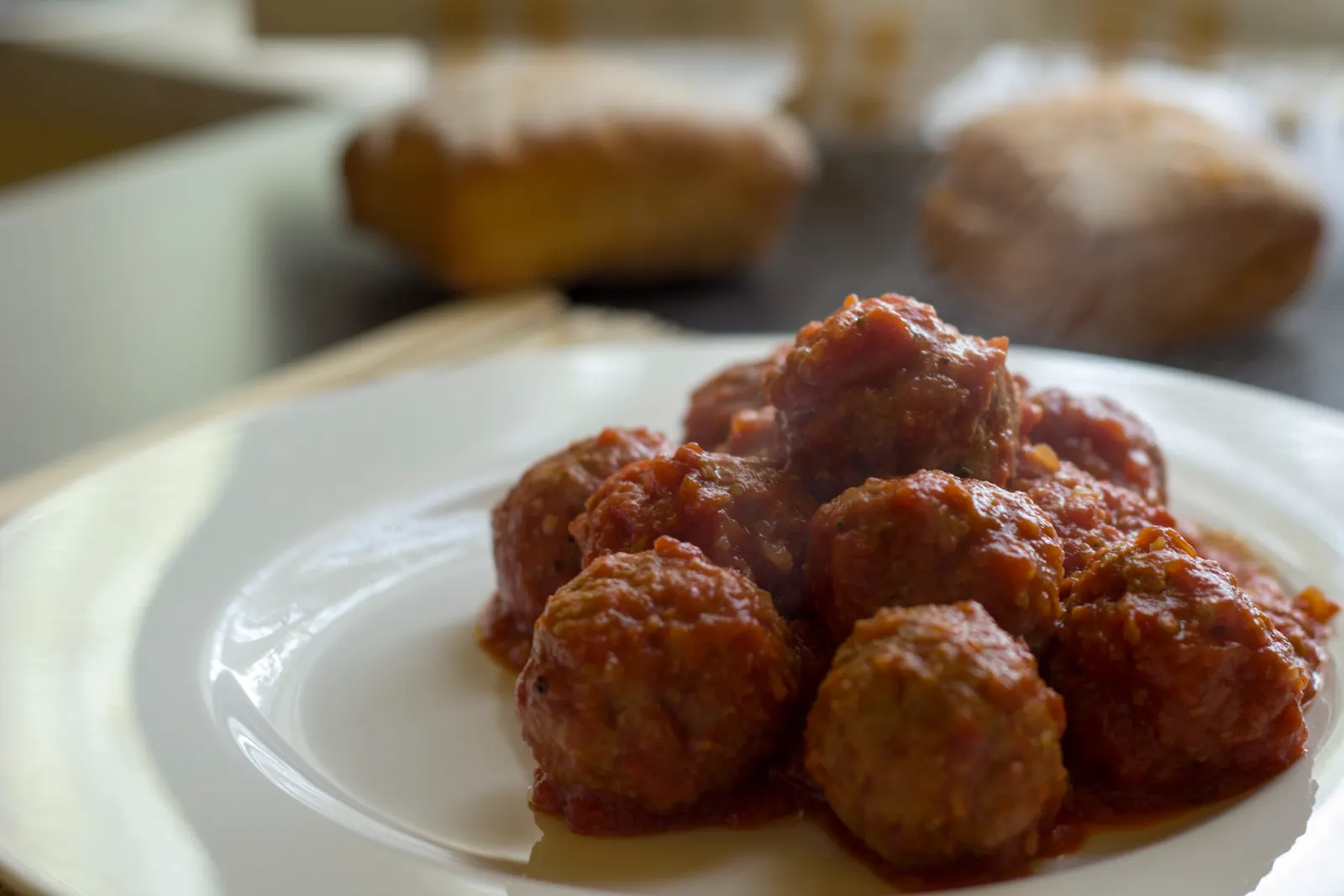
The source casserole folds fully cooked meatballs into tomato-rich rice. This illustrative plate shows the meatball-and-sauce half of that final pan, without the rice or cheese.Photo by Luca Nebuloni / Wikimedia Commons · CC BY 2.0
Serves
8
Prep
5 min
Covered bake
60–75 min
Pan
13 × 9 in
This dinner is built around a closed lid. Blair Lonergan’s pan starts with freezer meatballs and shelf-stable tomato ingredients, but the real work happens out of sight: long-grain rice sits beneath the sauce, catches the tomato juices, and softens in trapped steam while the meatballs reheat above and around it.
That simplicity makes the small physical details unusually important. A grain left dry can stay hard. A loose corner of foil can vent the moisture the rice needs. A center check can prevent a bubbling edge from declaring victory too early. Keep the source’s generous tomato formula, then treat submersion, seal, and tenderness as the three decisions that make it dependable.
“There’s no prep necessary for this Dump and Bake Italian Meatball and Rice Casserole! It’s the perfect easy dinner solution for your busy weeknights — and your family will love the cozy comfort food!”
Start the steam
Freshly boiled water gives the long-grain rice the hot start recommended for oven cooking without changing the source quantity.
Keep every grain wet
Spread the rice evenly and press stray grains below the tomato liquid before the frozen meatballs go in.
Seal the whole rim
The covered hour is a steam chamber. A lid or firmly crimped foil matters more than a decorative topping.
Test the center
Rice at the edge can soften first. Taste a grain from the middle and reseal the pan if it still has a chalky core.
The casserole equationTomato + grain + freezer + melt
Eight ingredients, each in its own phase
The original formula stays short. Its structure comes from when the ingredients enter the pan, not from adding more of them.
01
Three cups marinara
The original 2016 card’s tomato base seasons the rice while supplying most of its cooking liquid.
Use a sauce you already enjoy; there is no later seasoning stage to disguise a flat jar.02
One cup long-grain white rice
Jasmine or basmati keeps a distinct grain while absorbing the marinara, tomato juice, and measured water.
Do not swap in instant, brown, wild, or risotto rice without accepting a different liquid and timing problem.03
Twenty-six ounces frozen meatballs
Fully cooked Italian-style meatballs reheat from frozen during the covered rice bake and make the pan dinner-size.
Check the package for the words fully cooked; raw meatballs are not an equivalent shortcut.04
Two cheeses, one final five minutes
Mozzarella makes the soft blanket; Parmesan gives a salty, nutty edge after the rice is already tender.
Keep both cheeses out of the steam phase so they melt across the finished surface instead of disappearing into it.
Under the lidThe grain and tomato system
Every dry grain needs a route to hot liquid
Long-grain rice is the quiet engineering in this pan: every grain must begin below the liquid and stay under trapped steam until tender.Photo by Henningklevjer / Wikimedia Commons · CC BY-SA 2.5
The center is the test
The outer inch heats first. Taste rice from the middle before adding cheese; if it is chalky, reseal the pan and keep the steam working.
The eighty-minute laneHot water · tight foil · center check
Five minutes to close the pan, then patience
The clock is mostly covered oven time. Open once with purpose, judge the center grain, and let tenderness—not the first bubbling edge—set the finish.
0:00
Heat the oven and water
Set 375°F and bring exactly 3/4 cup water to a boil while the pan and cans come together.
0:03
Build the tomato bath
Stir marinara, undrained seasoned tomatoes, hot water, and long-grain rice directly in the 13 × 9-inch dish.
0:04
Submerge, add, seal
Level every grain below the liquid, distribute the frozen fully cooked meatballs, and crimp the cover tightly.
1:04
Test the center grain
Open away from your face. Rice from the middle should be tender without a pale, chalky core; check 165°F at center.
+10
Reseal if needed
Crunchy rice gets another 5–10 minutes under a fresh tight seal, with a small splash of boiling water only if the pan looks dry.
1:15
Melt the two-cheese finish
Once the rice is tender, uncover, add mozzarella and Parmesan, and bake about 5 minutes until molten and bubbling.
1:20
Cut the red with green
Scatter parsley over the hot pan and serve while the cheese is supple and the rice is creamy.
Four finish signalsTender · absorbed · hot · molten
Read the casserole before the cheese goes on
The five-minute uncovered melt is a finish, not a rice-cooking stage. Confirm all four signals in sequence.
01
Rice is swollen through the center
A properly cooked grain is tender from edge to core. A white hard pin in the middle means the cover goes back on.
02
Sauce clings instead of flooding
The rice has absorbed enough liquid to make a loose, spoonable casserole—not dry pilaf and not tomato soup.
03
The center reaches 165°F
A thermometer in the center verifies the casserole, not merely a meatball sitting near the hot rim.
04
Cheese melts after tenderness
The mozzarella and Parmesan go on only when the rice is done; the uncovered finish is too short to rescue hard grains.
Low-lift planningStage dry · mix hot · chill fast
Prepare the station, not the wet rice
The recipe earns its ease by being assembled at oven time. Leftovers need the same clarity: shallow containers, a short refrigerator window, and a full reheat.
Stage shelf-stable ingredients
Set out the baking dish, canned tomatoes, marinara, rice, and measuring tools. Keep the meatballs frozen until assembly.
Do not hold the raw rice in sauce
Mix immediately before baking. A long refrigerator rest changes hydration before the source clock begins.
Chill within two hours
Move leftovers into shallow covered containers rather than leaving the full hot casserole on the counter.
Use within three to four days
Reheat only the serving you need to 165°F. The maintained author does not recommend freezing the finished dish.
Dump-and-Bake Italian Meatball and Rice Casserole
Blair Lonergan’s eight-serving tomato-rice bake with fully cooked frozen meatballs, mozzarella, Parmesan, and parsley.
MeatballsRice CasseroleDump and BakeMarinaraMozzarellaWeeknight Dinner
Ingredients
Covered bake
3 cups (27 ounces) marinara sauce
1 (14.5-ounce) can basil, garlic, and oregano diced tomatoes, undrained
3/4 cup freshly boiled water
1 cup uncooked long-grain white rice, preferably jasmine or basmati
1 (26-ounce) package fully cooked Italian-style frozen meatballs; do not thaw
Melt and finish
1/2 cup (2 ounces) shredded low-moisture mozzarella
1/4 cup (1 ounce) grated Parmesan
2 tablespoons chopped fresh parsley
Directions
Heat the oven to 375°F / 190°C. Bring the measured 3/4 cup water just to a boil; this hot start is a researched reliability clarification for oven-cooked rice, while the source quantity stays unchanged.
In a 13 x 9-inch baking dish, stir together the marinara, undrained seasoned tomatoes, boiling water, and long-grain rice. Spread the rice evenly and press every visible grain below the liquid.
Add the fully cooked meatballs straight from the freezer and stir gently to distribute them without lifting rice onto a dry surface.
Cover the dish immediately and tightly with its lid or heavy-duty foil. Crimp foil firmly around every edge so the steam cannot escape.
Bake covered for 60 minutes. Open carefully away from your face and test rice from the center of the pan. If any grains are chalky or crunchy, stir them back below the liquid, add a small splash of boiling water only if the pan looks dry, reseal tightly, and continue in 5–10 minute increments. The rice must be tender and the casserole center must reach 165°F / 74°C.
When the rice is tender, uncover and scatter the mozzarella and Parmesan evenly over the pan. Return it to the oven, uncovered, for the final 5 minutes, until the cheese is fully melted and the casserole bubbles at the edges.
Finish with chopped parsley and serve hot. Refrigerate leftovers within 2 hours; reheat portions to 165°F / 74°C.
Source and research references: the earliest May 25, 2016 archived The Seasoned Mom article and recipe card for the queued title, Blair Lonergan byline, original deck, sponsored Rosina identity, eight servings, five-minute prep, 60–75-minute bake, exact eight-line formula, frozen-meatball instruction, 13 × 9-inch pan, tight cover, final cheese melt, and parsley finish; Blair’s maintained article, recipe, and author replies for the current card, jasmine-or-basmati preference, creamy rice target, low-moisture mozzarella note, center-submersion troubleshooting, later 24-ounce marinara clarification, and current automatic nutrition; USA Rice’s oven method for boiling liquid, a tight cover, and tenderness as the endpoint; Food Network Kitchen’s Big Batch Rice and Chicken and Rice Casserole for independent boiling-water, tight-foil, center-stir, and tenderness controls; and FoodSafety.gov’s temperature chart for 165°F / 74°C casserole and leftover guidance. The ingredient quantities, frozen fully cooked meatballs, pan, oven, yield, and cheese finish remain the archived source recipe; only the hot-water start, grain-position, reseal, center-temperature, storage, and allergen controls are separated research clarifications.