The orange freezer-pop memoryCitrus · vanilla · cold set
Kelli Davidson · June 2013
Dreamsicle Jelly
Kelli Davidson’s orange-and-vanilla jelly keeps its sunny five-ingredient formula while moving the untested canning variation to conservative cold storage.
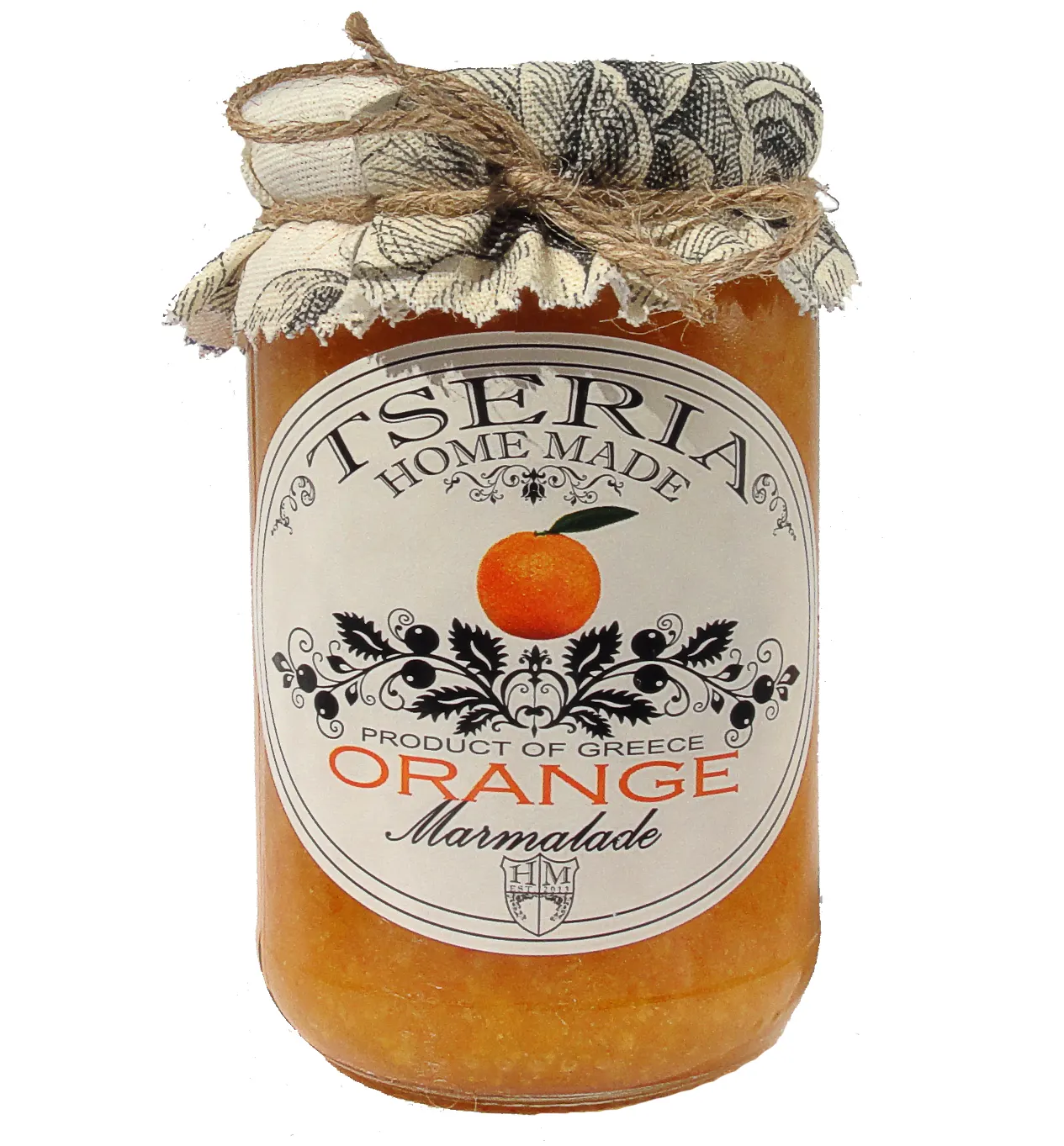
This illustrative Greek marmalade jar is opaque and peel-rich; Kelli’s strained orange jelly is meant to be smooth and translucent instead.Photo by Tseria / Wikimedia Commons · CC BY-SA 3.0
Makes
About 5–6 half-pints
Juice
4 cups, strained
Flavor
2 vanilla beans
Set
12–24 hr chilled
The cream note is an aroma, not an ingredient list. Kelli Davidson pairs strained orange juice with the seeds and pods of two vanilla beans, turning a childhood sherbet-and-vanilla memory into an amber spread. The jelly lands on toast like sunlight and makes a sharp, fragrant ribbon over cold ice cream.
Its five-line formula is unusually spare. That makes precision more important, not less: measure the juice after straining, respect the full sugar amount, use only the pectin type the source names, and wait until the jelly is thoroughly cold before deciding how it set. The one deliberate boundary is storage. Because the vanilla-and-butter variation is not a laboratory-tested canning formula, the jars stay in the refrigerator or freezer.
“The orange-and-vanilla memory of a frozen push-up, recast as jelly for toast, biscuits, yogurt, cake, and ice cream.”
The clear base
Fresh orange juice passes through cloth before it meets sugar, leaving the pulp behind for a cleaner, brighter gel.
The vanilla signal
Seeds perfume the juice and remain as fine black flecks; the split pods steep in the pan and come out before filling.
The cold-storage line
The five source ingredients stay put, but this untested flavor variation belongs in the refrigerator or freezer—not the pantry.
The set
Do not call the jelly loose or failed while it is warm. Leave it upright and chilled for 12–24 hours before judging texture.
Five source ingredientsJuice sugar bean butter pectin
Orange carries the color; vanilla carries the cream
The original ratio remains untouched. Each ingredient has one precise structural or aromatic job, and none invites a casual substitute.
01
Four cups clear orange juice
The measured juice supplies the tart-fruit half of the creamsicle memory without rind, zest, pulp, or dairy.
Measure after straining. Pressing the cloth forces fine pulp through and makes a cloudier jelly.02
Four cups granulated sugar
Equal measured cups of juice and sugar make the source’s concentrated sweet spread and support its gel structure.
Do not casually reduce the sugar when using regular pectin; sugar, acid, and pectin work as a system.03
Two whole vanilla beans
Seeds and pods create the vanilla-cream impression without adding cream, milk, or vanilla extract to the juice.
Split lengthwise, scrape the seeds into the pan, and count both pods back out before the hot fill.04
A truly small pat of butter
The source’s only dairy ingredient tamps down foam; it is not meant to turn orange jelly into a dairy preserve.
Kelli gives no weight. Keep the amount modest rather than translating “pat” into several tablespoons.
The jelly clockStrain split boil fill chill
One bright boil, then a long cold pause
The active work is short. The patient part comes after filling, when the containers stand upright and the gel finishes forming in the cold.
Before
Clean, warm, and clear a shelf
Wash the containers, keep glass warm against thermal shock, and reserve refrigerator space before the syrup starts moving.
0:00
Strain to exactly four cups
Let fresh juice drip through cloth and measure the clear liquid only after pulp and seeds are left behind.
+8
Split the vanilla
Scrape both beans into the saucepan, then add their pods, sugar, juice, and the small butter pat.
+12
Reach the rolling boil
Stir as the sugar dissolves, then use high heat and ample headroom for a boil that keeps bubbling while stirred.
+18
Choose one source branch
Boil one minute after adding regular powdered pectin, or cook the pectin-free version to the local jellying point.
+21
Pull pods and fill upright
Skim foam, distribute the vanilla flecks gently, and ladle into warm containers without turning them over.
12–24 hr
Judge it cold
Refrigeration completes the set. Freeze what will not be used within the three-week cold-storage window.
Fruit + flowerTwo perfumes in one jar
A market crate and two black beans make the whole palette
The source begins with four measured cups of freshly squeezed juice. Straining after juicing removes pulp that would cloud the finished jelly.Photo by safaritravelplus / Wikimedia Commons · CC0 1.0
Measure the clear liquid
Four cups means four cups after the juice has passed through cloth. The oranges themselves vary; the measured, strained juice is the recipe.
4 cups freshly squeezed orange juice, measured after straining
4 cups granulated sugar
2 vanilla beans, split lengthwise and scraped; seeds and pods reserved
1 small pat unsalted butter (the source does not define a weight)
1 box regular powdered fruit pectin, optional (the source does not specify a brand or package weight)
Directions
Wash 5–6 heat-safe half-pint jars or freezer containers and their lids in hot soapy water, rinse well, and keep the glass warm. This edition is for refrigerator or freezer storage; do not treat the filled containers as shelf stable.
Squeeze the oranges, then pass the juice through a jelly bag or a fine-mesh strainer lined with a double layer of cheesecloth. Let it drip rather than forcing pulp through. Measure exactly 4 cups of the clear juice.
Split each vanilla bean lengthwise. Scrape the seeds into a large nonreactive saucepan and add the emptied pods. Add the strained orange juice, all 4 cups sugar, and the small pat of butter.
Heat while stirring until the sugar dissolves, then bring the mixture to a full rolling boil over high heat. Use a pan with generous headroom and keep stirring because the sweet juice can foam and climb quickly.
For Kelli’s pectin branch, whisk in the entire box of regular powdered pectin, return the mixture to a full rolling boil that cannot be stirred down, and boil hard for exactly 1 minute while stirring constantly. Because the legacy source does not name a brand or package weight, use this branch only if the package identifies the product as regular powdered fruit pectin; do not substitute liquid or low-sugar pectin.
For Kelli’s no-pectin branch, omit the boxed pectin and continue the hard boil to the local jellying point: 8°F above the boiling point of water where you are, or until the liquid sheets from the side of a cool metal spoon. The source gives 220°F and a 3-minute hold; 220°F applies only at sea level, so use the altitude-adjusted NCHFP test instead of a universal number.
Remove the pan from the heat. Lift out both vanilla pods, skim away any foam, and stir once gently so the vanilla seeds are distributed without working new bubbles into the jelly.
Ladle the hot jelly into the warm clean containers, leaving about 1/2 inch headspace for anything that will be frozen. Wipe the rims, apply the lids, and set the containers upright on a towel or rack; do not invert or repeatedly turn them.
Let the containers stand upright and undisturbed until no longer steaming, then refrigerate promptly and within 2 hours of filling. Chill for 12–24 hours before judging the set. Keep refrigerated and use within 3 weeks, or freeze for longer storage; thaw frozen jelly in the refrigerator.
Source and research references: the queued /dreamsicle-jelly-2500694096.html identity and its June 1, 2013 My Recipe Magic card for the title, Kelli Davidson attribution, four-serving marker, description, exact five ingredient lines, opening method, and original-site link; Kelli’s complete May 13, 2012 article for the Mother’s Day story, full pectin and no-pectin branches, boil details, jar method, and serving ideas; the National Center for Home Food Preservation’s tested orange jelly with powdered pectin for the comparable 5–6 half-pint yield and evidence that formula, pectin order, jar size, and altitude process are specific; its no-pectin doneness tests for the 8°F-over-local-boiling-point rule, spoon-sheet test, and altitude corrections; its boiling-water canner guidance for keeping jars upright and undisturbed; Penn State Extension’s pectin guidance for why powdered, liquid, low-sugar, and other thickeners are not interchangeable; and Oregon State University Extension’s freezer-jam storage guidance for the conservative three-week refrigerator and one-year freezer quality windows used here. The juice, sugar, vanilla, butter, and optional pectin remain the source formula; altitude-aware doneness, upright cooling, and cold storage are explicitly separated corrections.