Load after breakfastLift at supper

10-minute assembly · 8 hours on LOW

Crock-Pot Stuffed Green Peppers

Green bell peppers filled with beef, uncooked rice, breadcrumbs, Parmesan, and onion, then slow-cooked beneath juicy diced tomatoes until tender.

Fill the peppers
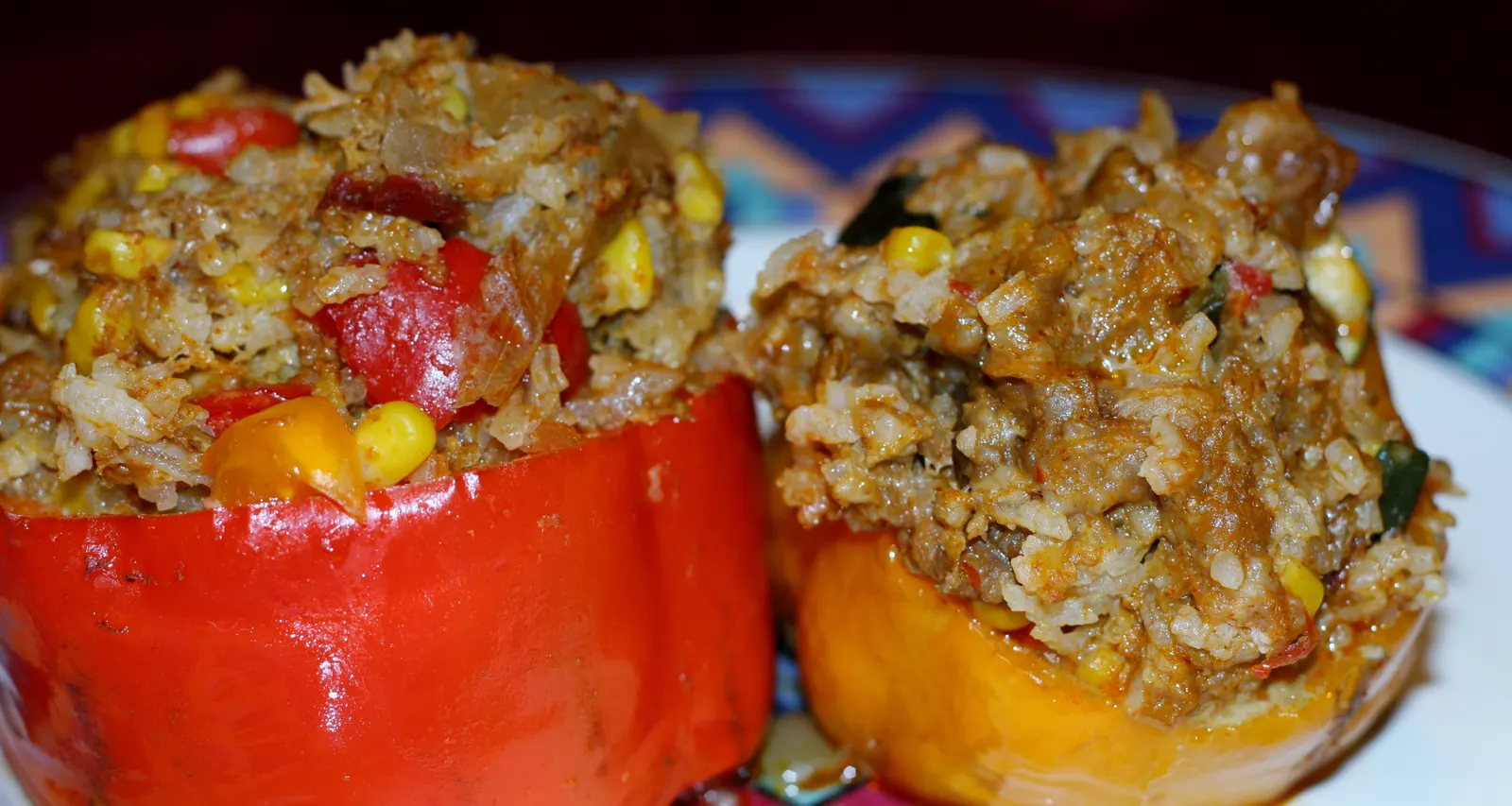
Cooked red and yellow stuffed peppers in a slow cooker, shown as a colorful serving variation.
A colorful slow-cooker variation illustrates the finished form; Heidi Kennedy’s source recipe specifically calls for green peppers and a beef-and-rice filling without corn.Photo by William Andrus · CC BY 2.0
Prep
10 min
LOW
8 hr
Makes
4 servings
Finish
160°F center

A bell pepper is unusually good slow-cooker architecture. Trimmed flat at the top and left whole at the base, it holds a compact supper of beef, raw rice, breadcrumbs, Parmesan, onion, and egg while the covered pot supplies steady, moist heat from every side.

Heidi Kennedy’s formula is deliberately spare, and this version keeps it that way. The undrained tomatoes are the entire braising liquid; the rice goes in uncooked; the cooker stays on LOW for eight hours. The added editorial work is in the finish: test the center for 160°F, taste the rice for tenderness, and let the soft peppers settle before serving.

“This recipe for Crock-Pot Stuffed Green Peppers is always a hit.”

Rice goes in raw

Use uncooked long-grain white rice; the tomato juices and closed cooker hydrate it.

Stand them upright

A snug arrangement supports the pepper walls while leaving the open tops exposed to tomato.

Check two cues

The filling must reach 160°F and the rice must be tender before the peppers leave the crock.

Inside the pepperVessel · protein · grain · braise

Four structural choices hold the supper together

Every major ingredient has a physical job as the raw filling becomes a tender, self-contained meal.

01

Green bell peppers

Four medium peppers become both the vegetable and the upright vessels for the beef-and-rice filling.

Choose peppers with broad, level bases so they stand securely, and remove membranes without cutting through the walls.
02

Extra-lean ground beef

One pound anchors the filling while releasing less fat into the tomato braise than a richer grind.

Keep it refrigerated until assembly, mix it only until even, and verify 160°F at the center of the deepest portion.
03

Uncooked long-grain rice

Three quarters of a cup absorbs seasoned moisture as the peppers steam, expanding through the meat mixture.

Use it dry and uncooked exactly as written; precooked rice would upset the source recipe’s volume and liquid balance.
04

Undrained diced tomatoes

The fourteen-ounce can supplies both the bright tomato pieces and the measured braising liquid around the peppers.

Pour in every drop of juice and spoon a little over the exposed filling before closing the lid.

Before the lid closesHollow · fill · hydrate

Keep the pepper intact and the rice thirsty

Two whole green bell peppers resting against a softly blurred garden background.
Medium green bell peppers make the edible vessels: trim the tops, remove seeds and membranes, and keep the walls intact.Photo by Janet Guynn / Alabama Extension · CC0 1.0
The source balance

Do not precook the rice or drain the tomatoes. Those two instructions belong together: dry grains need the canned juice during the eight-hour covered cook.

Uncooked long-grain white rice scattered across a wooden surface.
The rice goes into the filling uncooked, exactly as written; the sealed cooker and undrained tomatoes supply the moisture it needs.Photo by Gaurav Dhwaj Khadka · CC BY-SA 4.0

Slow clockHollow mix stand pour prove rest

Ten minutes of assembly, then one closed lid

The sequence protects the pepper shells, distributes the filling evenly, and saves the only temperature check for the finish.

  1. 0:00

    Hollow the peppers

    Trim four tops, remove seeds and membranes, and protect the walls and bases from punctures.

  2. 0:05

    Mix the filling

    Combine beef, raw rice, breadcrumbs, Parmesan, onion, garlic salt, and egg just until even.

  3. 0:08

    Fill and stand

    Divide the mixture without dense packing, then arrange the peppers upright in a 5-quart or larger crock.

  4. 0:10

    Add all the tomato juice

    Pour the undrained tomatoes around the peppers and over their open tops, then cover securely.

  5. 8:00

    Prove the center

    Look for 160°F in the beef filling, fully tender rice, and pepper walls that yield easily to a knife.

  6. +5 MIN

    Settle and serve

    A short rest steadies the soft peppers before they are lifted into bowls with tomato juices.

Doneness cuesYielding tender set savory

Read the pepper, grain, center, and juices

The thermometer settles beef safety; these tactile cues confirm that the rest of the stuffed pepper is ready too.

01

Pepper walls spoon-tender

After eight hours they should slump gently and yield without crunch while still holding the filling upright.

02

Rice grains fully softened

Taste a grain from the center: it should be plump and tender, never chalky or hard at its core.

03

Filling set but not packed

The egg, crumbs, and cheese bind the beef into a sliceable center without turning it into a compressed plug.

04

Tomato juices around the base

The liquid should taste savory and pepper-sweet; spoon it around the finished pepper instead of hiding the top.

Keeping planCold shallow covered 165°F

Move the leftovers out of the crock

Cook the raw filling promptly, cool finished peppers quickly, and use a faster appliance when they return to the table.

Assemble close to cooking

Because the filling contains raw beef and egg, keep every component chilled until the slow cooker is ready to start.

Cool in shallow containers

Move leftovers out of the deep crock and refrigerate within two hours rather than letting the whole vessel cool on the counter.

Keep for 3–4 days

Store the peppers with a little tomato liquid in covered containers so the rice does not dry out.

Reheat to 165°F

Use the oven, microwave, or stovetop for leftovers; USDA does not recommend reheating cold food in a slow cooker.

Crock-Pot Stuffed Green Peppers

Green bell peppers packed with beef, uncooked rice, breadcrumbs, Parmesan, and onion, slow-cooked in undrained diced tomatoes.

BeefSlow CookerStuffed PeppersBell PeppersRiceMake Ahead

Ingredients

Peppers and filling

  • 4 medium green bell peppers
  • 1 pound extra-lean ground beef
  • 3/4 cup uncooked long-grain white rice
  • 3/4 cup breadcrumbs
  • 1/4 cup grated Parmesan cheese
  • 1 medium yellow onion, peeled and diced
  • 1 teaspoon garlic salt
  • 1 large egg

Tomato braise

  • 1 can (14 ounces) diced tomatoes, undrained

Directions

  1. Slice the tops from the green peppers. Remove the seeds and pale inner membranes without piercing the walls, then stand the hollow peppers upright while you make the filling.
  2. In a large bowl, combine the ground beef, uncooked long-grain rice, breadcrumbs, Parmesan, diced onion, garlic salt, and egg. Mix just until the ingredients are evenly distributed.
  3. Divide the raw beef mixture evenly among the four peppers. Fill them without pressing the mixture into a hard, dense pack.
  4. Stand the stuffed peppers upright in a 5-quart or larger slow cooker. Keep the peppers close enough to support one another without forcing them against the crock.
  5. Pour the diced tomatoes and all their juice around the peppers, spooning some tomato over each open top. Fit the lid securely.
  6. Cook on LOW for 8 hours, keeping the lid closed. Near the end, test the center of the filling without touching the crock: the ground beef must reach 160°F (71°C), the rice should be tender, and the pepper walls should yield easily to a knife.
  7. If either the rice or the center of the filling is not ready, replace the lid promptly and continue on LOW, checking again in short intervals. Let the finished peppers stand for 5 minutes before lifting them into shallow bowls with some of the tomato juices.

Source and safety references: Heidi Kennedy’s Crock-Pot Ladies recipe, its independently preserved Samsung Food card, USDA slow-cooker guidance, and the USDA safe-temperature chart for ground meats and leftovers.

Image credits

Photography is used under open licenses with attribution: William Andrus, Janet Guynn / Alabama Extension, and Gaurav Dhwaj Khadka.