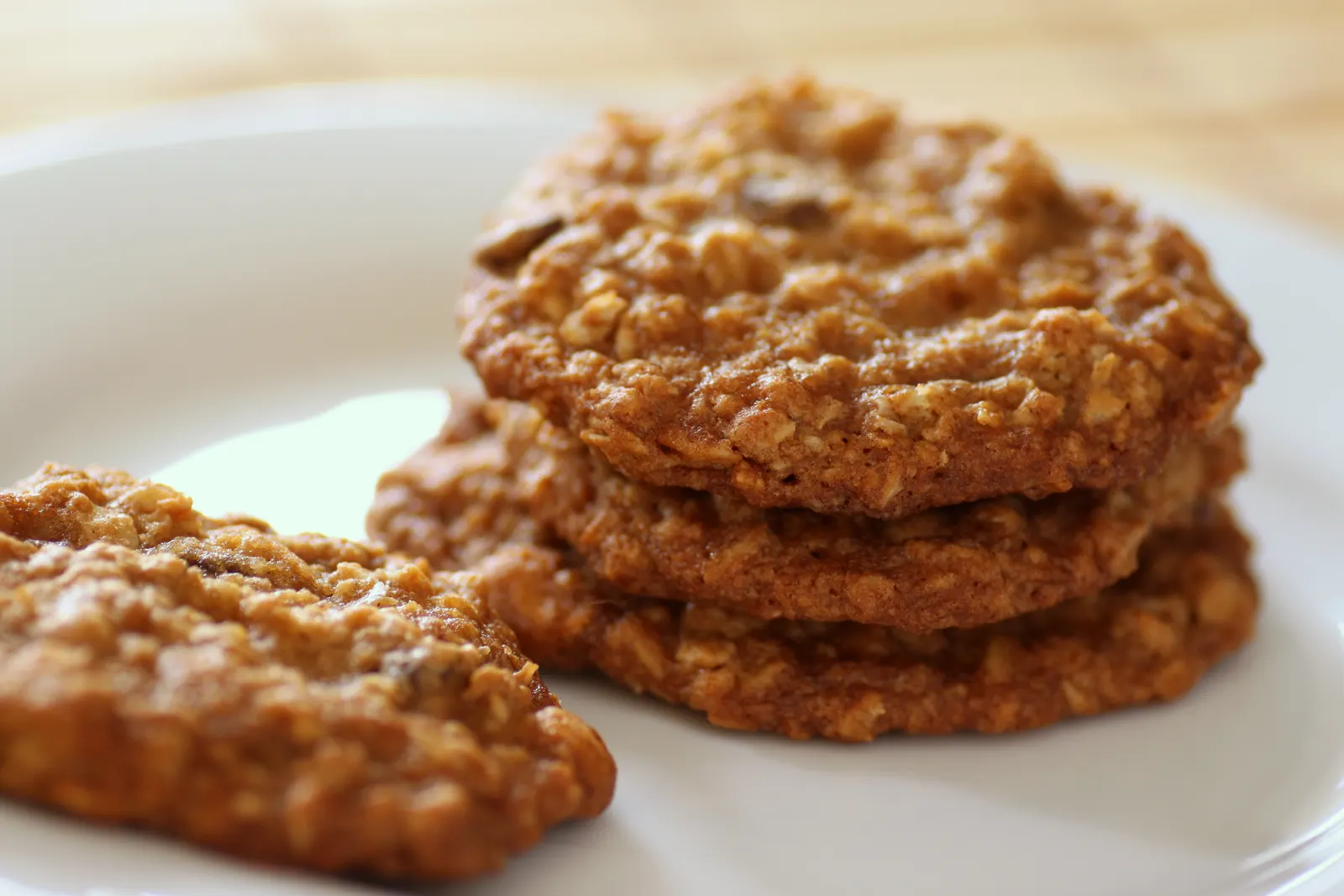
The oat-rich crumb and caramel-colored chips echo Davies’s cookies. This illustrative batch also contains chocolate chips; the source formula uses butterscotch chips only.Photo by Stacy Spensley · CC BY 2.0
Prep
15 min
Oven
350°F
Bake
10–12 min per batch
Yield
36 cookies
This cowboy cookie rides a different trail. Ellie Davies’s formula predates the now-familiar giant mix-in style: there is no coconut, no cinnamon, and no required pecan. Its signatures are quick oats and butterscotch chips, held in a notably soft dough made with both margarine and vegetable oil.
The method is as direct as the cookie jar it fills. Sift, beat until smooth, add two eggs one at a time, and stop working the flour as soon as the oats and chips are evenly carried. The decisive moment comes at the oven door: golden edges and soft centers, followed by a few minutes on the sheet, make the contrast the recipe promises.
“It’s a great cookie, one of the kids’ favorites.”
Two fats, one texture
Soft margarine brings structure while vegetable oil keeps the centers tender; the source relies on both rather than treating them as interchangeable choices.
Quick oats belong here
The smaller flakes distribute through a teaspoon-size drop cookie without demanding the longer hydration of old-fashioned rolled oats.
Gold only at the edge
Ten to twelve minutes is enough when the rim is set and golden. The soft center finishes on the hot sheet before the rack.
The formula mapSolid liquid dark pale oat caramel
Four pairings explain the whole cookie
Nothing needs to be swapped or amplified. The original ingredients already divide cleanly into structure, sweetness, chew, and pockets of butterscotch.
01
Margarine + vegetable oil
Equal half-cups divide the fat between a soft solid and a liquid, producing a broad cookie with a tender middle.
Use softened stick margarine and a neutral oil. High-water tub spreads or an untested butter swap change the way the dough sets.02
Brown + white sugar
A full cup of each gives both caramel depth and the crisp edge expected from this distinctly sweet cookie-jar recipe.
Pack the brown sugar, then beat both sugars with the fats until no greasy streaks remain around the bowl.03
Quick-cooking oats
Two cups make the cookie unmistakably oaty while their fine flakes fit the source’s small teaspoon portions.
Do not silently replace them with thicker old-fashioned oats; the dough texture and finished chew will be different.04
Butterscotch chips
One cup supplies pockets of buttery caramel flavor without the chocolate, coconut, or pecans found in many other cowboy cookies.
Fold them in with the oats at the very end so the flour is not overworked while the chips are being distributed.
The batch preflightSoft sift cool small
Prepare for spread before the first scoop
Temperature and portion size do more to protect these cookies than adding flour or chilling a dough the source never asks to chill.
Oats into the jarFine flakes · full cooling · tight lid
The small flake becomes a broad golden cookie
Cool the cookies completely before the jar is closed. This companion photograph includes peanut-butter chips alongside butterscotch, while the source uses one cup butterscotch chips alone.Photo by slgckgc · CC BY 2.0
The jar rule
Wait until every cookie is cold. Closing the lid over residual warmth traps steam exactly where a crisp golden edge should be.
Davies specifies quick-cooking oats. Their smaller flakes disappear into the dough more readily than the old-fashioned rolled oats shown here.Photo by Bodhi Peace · CC BY-SA 4.0
The one-sheet rhythmHeat sift smooth fold space gold rest
Seven stops from smooth batter to set center
A fully heated oven, cool sheet, and short pan rest keep the source’s 10–12-minute bake from becoming either a greasy spread or a hard cookie.
350°F
Heat the oven before mixing
A fully heated center rack lets the edges begin setting before the margarine-and-oil dough spreads too far.
Sift
Disperse both leaveners
Combine flour, soda, baking powder, and salt until no white or salty pockets remain.
Smooth
Bring two fats and two sugars together
Beat only until the mixture is uniform and creamy, then incorporate the eggs one at a time.
Fold
Stop at an even oat-chip dough
Add dry ingredients gradually; fold in quick oats and butterscotch chips as soon as the flour disappears.
2 in
Give teaspoon drops room
Place even portions on a cool, ungreased sheet with two inches of open metal around each one.
10–12
Pull at the golden rim
Bake one sheet at a time until the edges set and color while the centers still look soft.
3–5
Let residual heat finish the center
Hold the fragile cookies on the sheet for a few minutes, then move them to a rack to cool completely.
The cookie evidenceCohesive mounded golden releasable
Read the dough and the rim, not the clock alone
Four physical cues show whether the fats have blended, the portion can hold, and carryover heat has done its work.
01
Creamy, streak-free fat mixture
Margarine, oil, and both sugars should read as one smooth mass, not a fluffy butter cream and not a separated slick.
02
Thick dough with visible fine oats
A rounded teaspoon should hold its mound. If the dough is already puddling, check the margarine temperature and the pan temperature.
03
Set, golden perimeter
The edge takes color first while the middle remains soft and lighter. That contrast is the intended moment to leave the oven.
04
Cookie that releases after a pause
A few minutes of carryover cooking strengthens the base. Move it too soon and a soft center can fold over the spatula.
The cookie-jar planRack seal vary freeze
Cool first, then protect the softer center
Storage is simple once steam is gone. The author’s nut variation and frozen portions remain optional, clearly separated from the core batch.
Cool every batch completely
Warm cookies trapped under a lid release steam and soften the crisp edge. Give the rack time before filling the container.
Store airtight for up to five days
A sealed tin or container protects the tender middle. A decorative jar is best only when its lid closes snugly.
Keep the author’s nut idea optional
Davies sometimes adds about one-half cup chopped walnuts or pecans. Add them only as a declared variation, with tree-nut allergen and nutrition changes understood.
Freeze portions only as a researched option
Scoop onto a tray, freeze firm, and bag for up to six weeks; bake from frozen with an extra minute or two, expecting slightly less spread.
Cowboy Oatmeal Cookies
Ellie Davies’s quick-oat drop cookies with butterscotch chips, margarine, vegetable oil, and golden edges around soft centers.
Set a rack in the center of the oven and preheat to 350°F (175°C). Keep two light-colored baking sheets ungreased, as the source directs, and let each sheet cool completely before it receives another batch.
Sift the flour, baking soda, baking powder, and salt together into a medium bowl. Whisk once after sifting so the two leaveners are distributed evenly, then set the bowl aside.
In a large bowl, beat the packed brown sugar, granulated sugar, softened margarine, and vegetable oil until smooth and uniform. Scrape the sides and bottom; this mixture should look creamy and cohesive rather than fluffy like an all-butter dough.
Beat in the eggs one at a time, mixing until the first disappears before adding the second. Scrape the bowl again so no slick bands of oil or egg remain.
Add the flour mixture gradually on low speed and stop when the dough is just combined. Fold in the quick-cooking oats and butterscotch chips only until they are evenly dispersed; extra mixing after the flour enters makes a tougher cookie.
Drop rounded teaspoonfuls of dough onto a cool, ungreased baking sheet, leaving 2 inches between portions. Keep the portions similar in size so all 36 cookies can reach the same doneness window.
Bake one sheet at a time for 10–12 minutes, until the edges are golden and set while the centers still look soft. Start checking at 10 minutes; do not wait for the whole top to brown.
Leave the cookies on the hot baking sheet for 3–5 minutes, honoring the source’s “few minutes” of set-up time. Transfer with a thin spatula to a wire rack and cool completely before storing airtight.
Source and technique references: Ellie Davies’s maintained Allrecipes card for the byline, description, 36-cookie yield, exact 11 ingredients, 350°F oven, 10–12-minute bake, golden-edge cue, current update date, and nutrition panel; the August 31, 2005 archived Allrecipes copy for the earliest verified record, original 15-minute prep and 40-minute ready time, teaspoon portions, and wording of the method; King Arthur Baking’s test-kitchen cowboy cookies for a soft-center cross-check, five-minute sheet rest, five-day airtight storage, and frozen-dough guidance; its Baker’s Hotline on fully preheated ovens and cool baking sheets; and the FDA’s raw flour, raw egg, dough, and cleanup guidance. No source proportion, fat, oat type, chip type, yield, oven temperature, or bake range was changed; added pan, texture, storage, freezing, and safety cues are explicitly researched guidance.