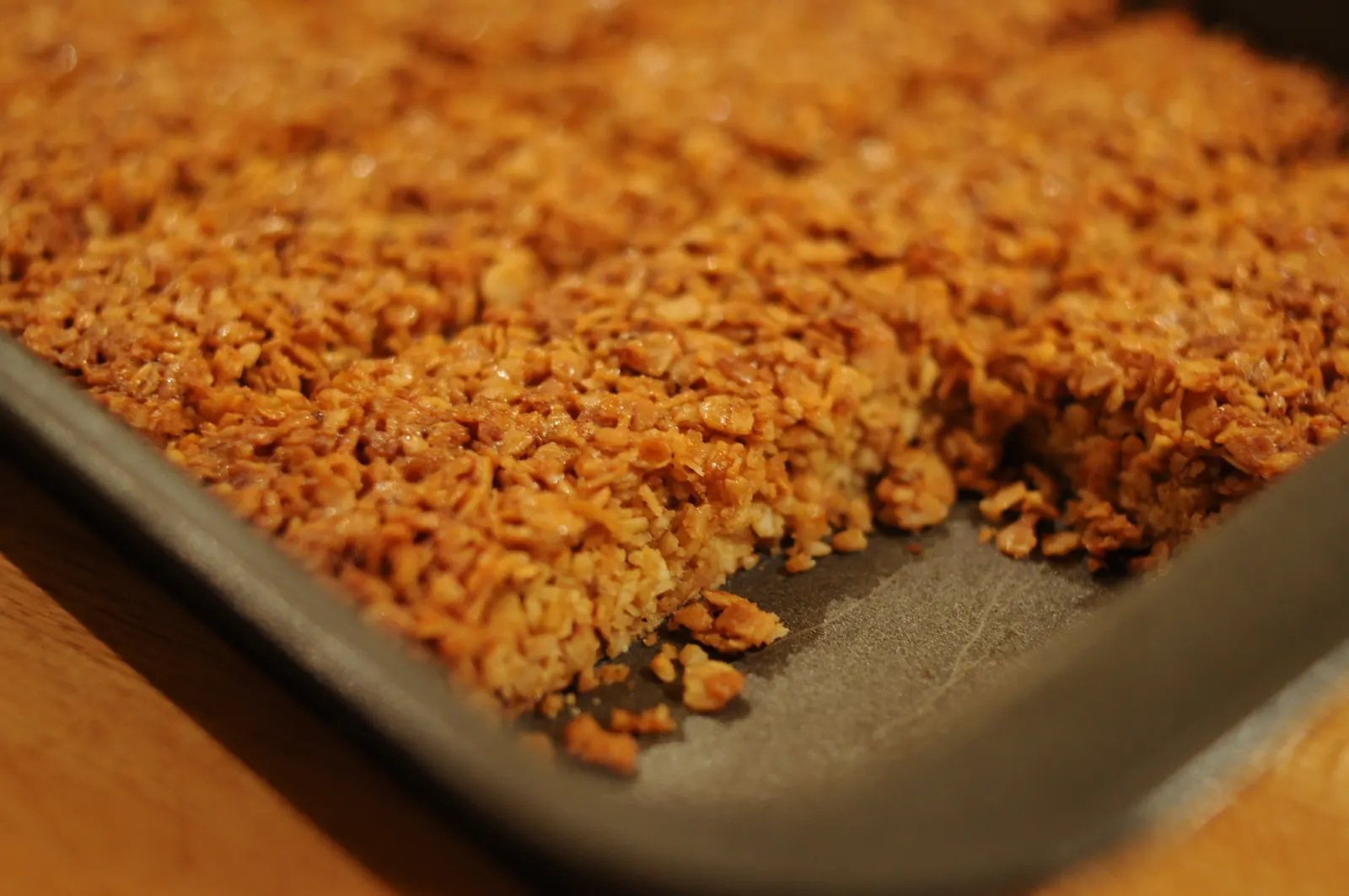
This British flapjack tray is an illustrative view of a pressed oat bar. It uses a different butter-and-syrup formula and has no frosting; Chelsea’s softer copycat is bound with milk and egg.Photo by sk8geek / Wikimedia Commons · CC BY-SA 2.0
Makes
12 bars
Pan
8-inch square
Oven
350°F
Source clock
25 min
This is oatmeal made portable, not granola made crunchy. Chelsea’s square keeps old-fashioned flakes visible, then grounds a second measure into flour so the soft middle still cuts. Brown sugar and cinnamon build the familiar breakfast profile; a narrow frosting stripe brings the molasses impression of the packaged inspiration without pouring molasses into either bowl.
Its most useful instruction is also the least glamorous: trust the batter. Once milk and egg meet the grain, the mass is thick, wet, and awkward to spread. An even press in a parchment-lined eight-inch pan turns that unruly mixture into a gently lifted slab with pale-brown edges. Cool it fully, and the same oats that fought the spatula hold a clean square.
“A Nature Valley copycat: soft-baked cinnamon and brown sugar oatmeal bars for an easy on-the-go breakfast.”
Keep both oat textures
Rolled oats stay visibly chewy while a half-cup ground into flour fills the crumb around them.
Expect a stubborn batter
The source calls the mixture very thick and wet. Press it level; do not repair its intended texture with more flour or milk.
Watch lift and edge color
The center should rise slightly as the edges take on light brown color. Stop before the soft middle turns dry.
Cool before the stripe
A warm slab melts the butter-based frosting. Let it cool, cut cleanly, then pipe thin lines over the individual bars.
The grain mapFlake · flour · sugar · spice
Two oat textures draw one soft square
The archived formula stays intact. Texture comes from the division between visible rolled oats and finely ground oats—not from extra fat or a commercial frosting shortcut.
01
Rolled oats + oat flour
One and one-half cups keep their flake; another half-cup is ground fine enough to support the soft interior without erasing its oat identity.
Grind plain oats only until floury, then measure the half-cup needed for the formula.02
White whole-wheat flour
Three-quarters cup gives the square enough wheat structure to lift and cut while keeping the copycat’s whole-grain direction.
All-purpose flour is the author’s explicit substitute; neither option makes the recipe gluten-free.03
Brown sugar in two places
The bars take a half-cup plus two tablespoons, while one-third cup gives the frosting its molasses-like note without liquid molasses.
Pack each measure consistently. The source’s lower-sugar variation is optional and deliberately less copycat-like.04
One teaspoon cinnamon
The warm spice marks the batter clearly without masking vanilla, brown sugar, and the cereal flavor of the oats.
Use the full source teaspoon first; extra cinnamon is a preference, not a missing ingredient.
Bowl + barkThe quiet breakfast palette
Rolled oats make the body; cinnamon makes the memory
Rolled oats stay visible while a second portion is ground into flour, giving one batter both chew and a finer supporting crumb.Photo by Bodhi Peace / Wikimedia Commons · CC BY-SA 4.0
One grain, two scales
Keep 1½ cups whole for chew. Grind and measure another ½ cup for the close, tender crumb around them.
The source begins with one teaspoon ground cinnamon and explicitly leaves room for more. The bark shown here is illustrative of the spice before grinding.Photo by Fumikas Sagisavas / Wikimedia Commons · CC0 1.0
The source clockSling stir fork fold press bake
Twenty-five minutes to the cooling rack
The published total stops when the first bake mark arrives. Cooling, cutting, and piping are real but passive finishing time.
0:00
Heat and sling the pan
Set 350°F and cross the 8-inch pan with parchment overhang so the cooled slab can lift without breaking.
+3
Distribute every dry note
Stir two oat textures, wheat flour, both leaveners, salt, cinnamon, and brown sugar until no pocket remains.
+5
Fork the wet trio
Beat vanilla, milk, and egg in a small bowl until the egg is uniform before it reaches the oats.
+7
Fold into the thick stage
Stop once the dry patches disappear. The sticky, heavy mixture is the intended checkpoint.
+9
Press corner to corner
Level the batter with a flexible spatula; thin corners dry before a deep center can set.
+10
Bake the visual range
Start the 15–18-minute window and pull when the center is gently inflated and the edges are lightly brown.
25:00
Begin the cooling wait
The source clock ends at the first bake mark. Full cooling, cutting, and piping happen afterward.
3/4 cup white whole-wheat flour, or all-purpose flour
1 teaspoon baking soda
1/4 teaspoon baking powder
1/4 teaspoon salt
1 teaspoon ground cinnamon, or more to taste
1/2 cup plus 2 tablespoons packed brown sugar
2 teaspoons vanilla extract
1/2 cup unsweetened almond milk, or another milk
1 large egg
Brown-sugar frosting
1/4 cup unsalted butter, softened but not melted
1/3 cup packed brown sugar
1 to 2 tablespoons milk
1/4 teaspoon vanilla extract
1 cup plus 2 tablespoons powdered sugar
Directions
Heat the oven to 350°F / 175°C. Line an 8-inch square pan with a parchment sling, leaving enough overhang to lift the baked slab cleanly.
In a large bowl, stir together the rolled oats, oat flour, white whole-wheat flour, baking soda, baking powder, salt, cinnamon, and brown sugar until the leaveners and spice are evenly distributed.
In a small bowl, combine the vanilla, milk, and egg. Beat lightly with a fork until no separate streaks of egg remain.
Add the wet mixture to the dry mixture and fold only until everything is moistened. The batter should be unusually thick, wet, and sticky; do not loosen it with extra milk or dry it with extra flour.
Transfer the mixture to the prepared pan. Use a flexible spatula to press it firmly into the corners and level it into an even layer so the center and edges bake at a similar rate.
Bake for 15–18 minutes, preserving the source range, until the center looks slightly inflated and the edges are lightly browned. The middle should look set rather than wet, but the slab is meant to remain soft.
While the slab cools, beat the softened butter, brown sugar, vanilla, powdered sugar, and 1 tablespoon milk until completely combined. Add only enough of the remaining milk to make a frosting that can be piped in thin lines.
Let the bars cool completely. Lift the slab out by the parchment, set it on a board, and cut into 12 bars; cut nine larger squares instead if preferred.
Spoon the frosting into a resealable plastic bag or piping bag, snip a very small corner, and pipe over the cooled bars. Store airtight so the oats do not dry out; refrigerate the frosted bars for conservative dairy handling.
Source and research references: the queued legacy path /cinnamon-brown-sugar-oatmeal-bars-2501400725.html and its April 4, 2014 My Recipe Magic card for the ID, title, Chelsea Lords attribution, 12-bar label, ingredient list, opening method, taxonomy, and nutrition; the first archived Chelsea’s Messy Apron article and complete recipe card for the description, 9–12-piece range, 10/15/25-minute clock, exact formula, parchment warning, full 15–18-minute bake, thick-batter cue, sugar and cinnamon options, frosting method, cooling, cutting, piping, and airtight storage; Nature Valley’s current product description and ingredient statement for the soft-and-chewy whole-oat, cinnamon, and brown-sugar copycat target—not for changes to Chelsea’s formula; King Arthur Baking’s test-kitchen oatmeal cream pie bars, chewy granola bars, and parchment-sling guide for independent support of even spreading, edge color, full cooling, clean lifting and cutting, airtight storage, and freezing comparable oat bars unfrosted; FDA’s raw-flour safety guidance; and University of Minnesota Extension’s frosting safety discussion for why an uncooked dairy frosting needs verified sugar concentration and water activity before it can be treated as shelf stable. The source ingredients, pan, mixing order, bake range, doneness cues, yield, and finishing method remain unchanged; even-press language, a no-raw-tasting correction, conservative refrigeration, and the unfrosted freezer option are explicitly separated guidance.