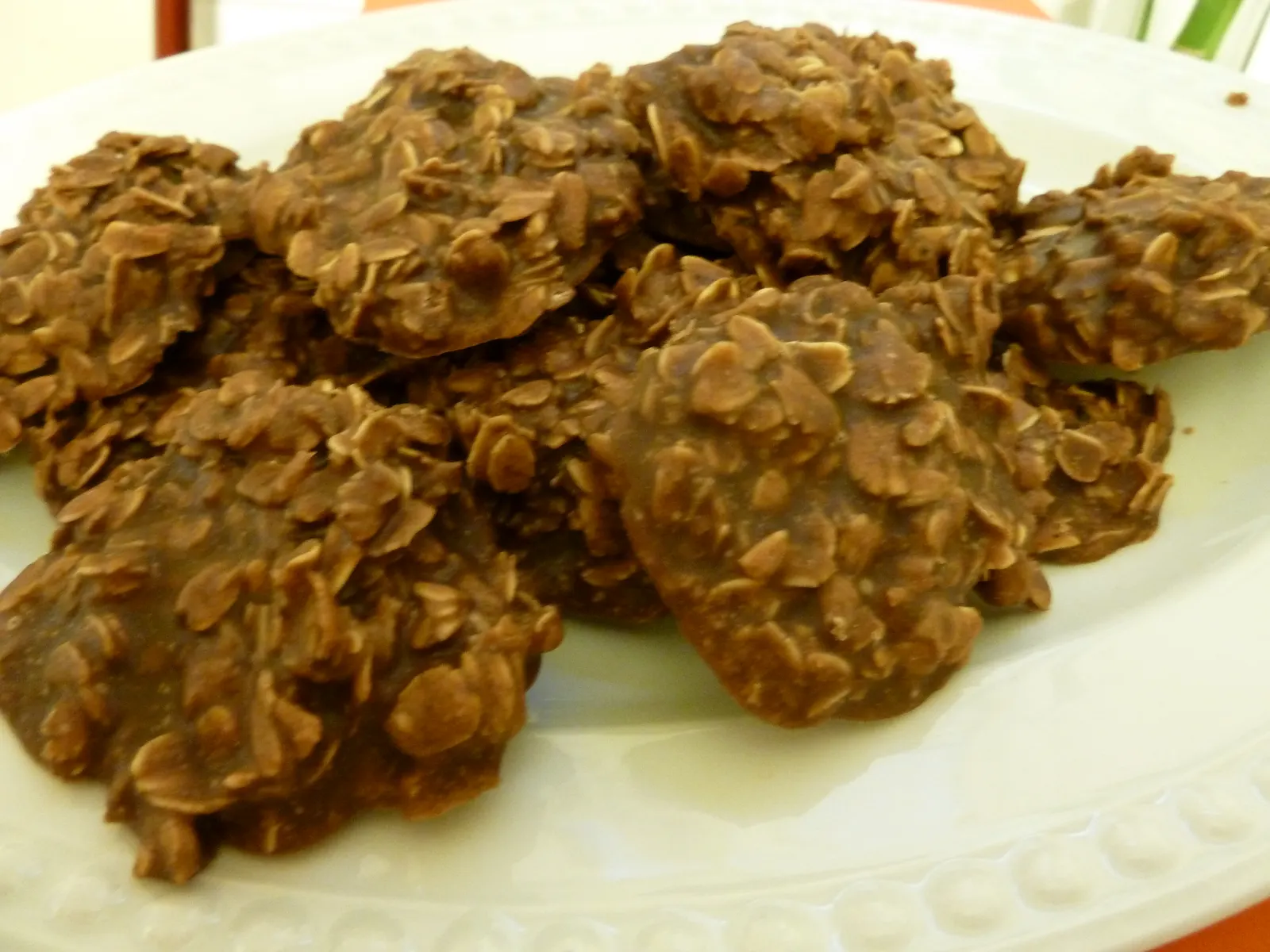
Jaydoo’s chocolate, peanut-butter, and oatmeal no-bake cookies show the rough, oat-studded finish this stovetop method should produce.Photo by Jaydoo / Wikimedia Commons · CC BY-SA 3.0
Makes
24 cookies
Active
15 minutes
Boil
1 full minute
Set
About 30 min
No oven does not mean no cooking. These pantry cookies hinge on one minute at a true rolling boil: long enough to concentrate the cocoa syrup so it sets, short enough to keep the finished drops chewy instead of chalky.
The family nickname in the queued title—“Gorilla Poops”—belongs to the cookie’s rough silhouette and a long American tradition of giving chocolate-oat no-bakes comic names. Underneath the joke is a compact piece of candy logic. Sugar and milk establish the set; peanut butter softens and enriches it; quick oats catch the hot syrup before it cools.
“A fast family chocolate-peanut butter cookie made entirely on the stovetop and known by a whole collection of playful names.”
Stage first
The cold ingredients and lined landing zone are ready before heat reaches the saucepan.
Time the boil
The minute begins only when bubbles cover the surface and keep rising through the stir.
Scoop promptly
The glossy oat mixture moves from fluid to set as it cools, so portioning cannot wait.
Pantry architectureAbsorb enrich deepen set
Four systems in one small saucepan
The archived source proportions stay intact. Reliability comes from sequencing and a readable endpoint, not from adding more ingredients.
01
Quick oats
Two cups absorb the hot syrup and give every drop its visible, nubbly structure.
Keep the source’s quick oats here. Their smaller flakes hydrate faster than old-fashioned rolled oats.02
Creamy peanut butter
Three-quarters cup supplies richness, body, and the nutty finish beneath the cocoa.
A conventional homogenized jar is the predictable choice; separated natural peanut butter can shift the oil balance.03
Cocoa powder
Two tablespoons deepen the milk-and-sugar syrup without turning the cookie into a chocolate bar.
Break up dry lumps before heating so the saucepan becomes smooth before the rolling boil.04
Sugar + milk
This is the setting system: enough water boils away for the cooled syrup to hold oats and peanut butter together.
The one-minute endpoint matters more than aggressive heat. Medium heat gives the sugar time to dissolve evenly.
Stovetop rhythmLine dissolve roll melt fold drop
Fifteen active minutes, one minute that counts
Everything after the boil happens off heat and at speed. A prepared counter is as important as the saucepan.
0:00
Build the landing zone
Line the surface and measure every ingredient that enters after the boil.
HEAT
Dissolve before timing
Sugar, butter, cocoa, and milk turn smooth over medium heat while the bottom is scraped.
1:00
Hold the rolling boil
Start only at bubbles across the surface; stir for one minute, or read 215–220°F.
OFF
Make it glossy
Salt, vanilla, and peanut butter melt into the syrup away from the burner.
FAST
Fold and portion
Quick oats go in all at once, then twenty-four rounded tablespoons move to the paper.
30 MIN
Let the syrup set
The shine fades, the bottoms release cleanly, and the centers stay softly chewy.
Flake + powderStructure meets depth
Oats hold the shape; cocoa writes the shadow
The source specifies quick oats. Their smaller, thinner flakes absorb the hot cocoa syrup quickly and keep the drops cohesive.Photo by Bodhi Peace / Wikimedia Commons · CC BY-SA 4.0
The whole recipe turns at the boil
Too brief and the drops stay tacky. Too long and the sugar tightens around the oats. One full minute keeps the middle ground.
Line two baking sheets or a clear counter area with parchment paper, waxed paper, or foil. Measure the salt, vanilla, peanut butter, and quick oats before turning on the heat; the mixture must be finished and portioned promptly once the syrup is ready.
Combine the sugar, butter, cocoa powder, and milk in a medium heavy-bottomed saucepan. Set it over medium heat and stir, scraping the bottom and corners, until the butter melts and the mixture is smooth.
Continue stirring until bubbles rise across the entire surface and the mixture reaches a full rolling boil that does not disappear when stirred. Start a timer only now and boil for 1 full minute, stirring steadily. For a thermometer cue, aim for 215–220°F.
Remove the pan from the heat immediately. Add the salt, vanilla, and creamy peanut butter; stir until the peanut butter is completely melted and the cocoa mixture looks glossy and uniform.
Add all of the quick oats and fold briskly until every flake is coated. The mixture should thicken but remain scoopable. Do not return it to the heat.
Working before the mixture begins to set in the pan, drop 24 rounded tablespoon portions onto the prepared surface. Leave the mounds craggy, or neaten them lightly with the scoop without compressing the oats.
Let the cookies stand undisturbed at room temperature for about 30 minutes, until the surfaces lose their wet shine and each cookie lifts cleanly while remaining chewy. Cool completely before stacking or sealing in a container.
Source and technique references: the July 2019 exact-slug snapshot for the queued identity, recipe 144, 24-cookie yield, 15-minute active time, proportions, and six-step source method; the maintained Six Sisters’ Stuff page for Steph Loaiza’s byline, storage range, quick-oat preference, current nutrition, and preserved family nickname; Food Network Kitchen for the full-minute cocoa-syrup boil, fast off-heat mixing, and 30-minute set; and King Arthur Baking for the 215–220°F endpoint, back-of-spoon body, temperature-sensitive room set, three-day airtight storage, and freezing guidance. The source’s eight ingredients and proportions are unchanged; the one-minute rolling-boil clarification is evidence-backed and explicitly documented.