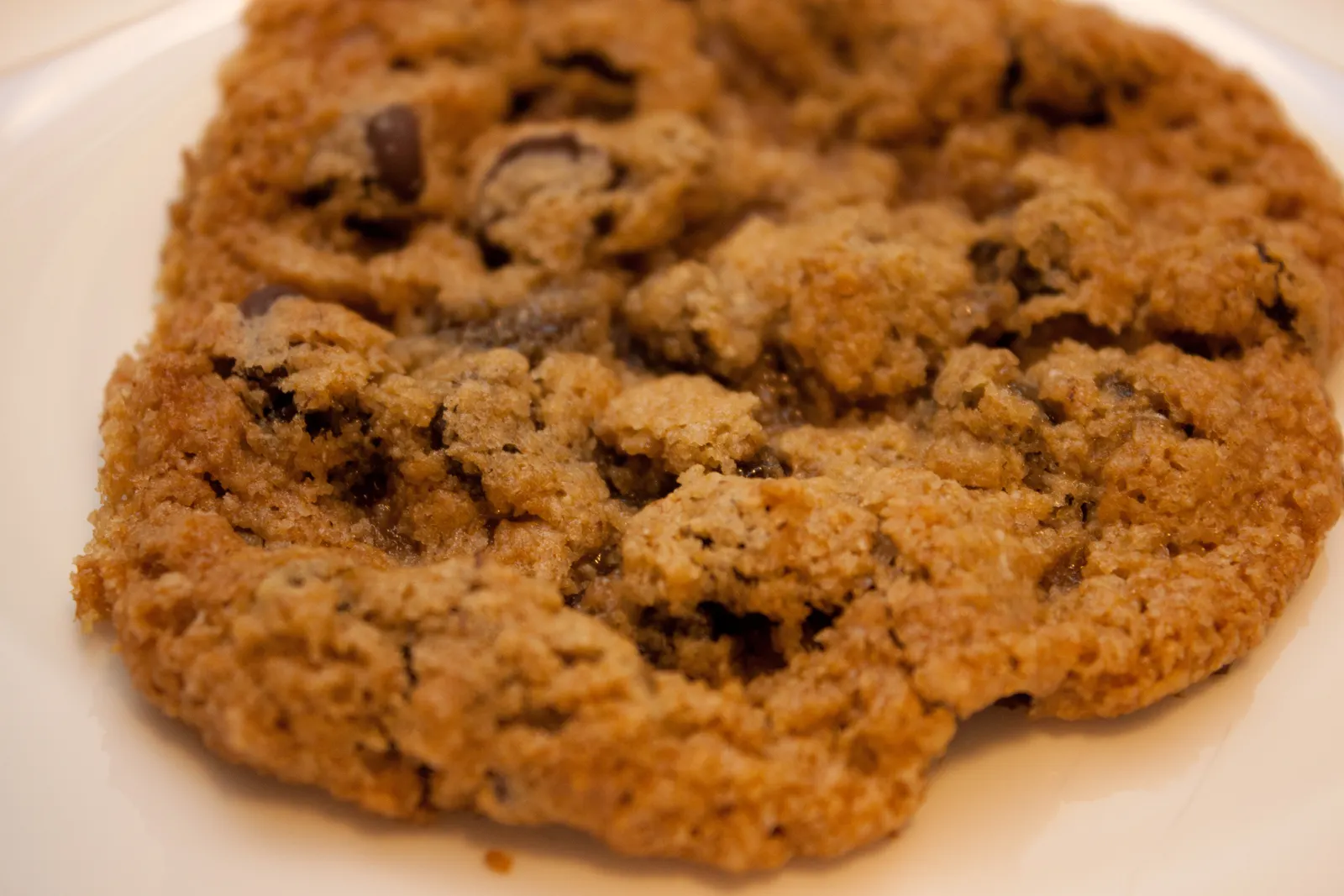
This is not banana bread pretending to be a cookie. Trish Rosenquist’s formula leans fully into the soft drop-cookie form: two ripe bananas are beaten with butter and two sugars, no egg enters the bowl, and a tablespoon of cornstarch helps the flour hold all that fruit moisture.

The small disciplines matter more than embellishment. Mix the dry bowl evenly. Stop stirring as soon as it disappears. Give the dough its full half-hour in the refrigerator, then pull each tray when the tops have only started to turn gold. The cookie’s last structural change happens not in the oven, but on the cooling sheet.

“These Easy Chocolate Chip Banana Cookies are sure to become a new favorite – so soft and delicious, they’re impossible to resist!”

Ripen

Use genuinely ripe, soft bananas; the source keeps their honest measure at two whole fruit.

Restrain

Once flour enters, stir only until combined, fold in the chips, and stop.

Set

A pale-gold top and complete cooling on the sheet protect the intended soft center.

The formula mapFruit · sugar · starch · chocolate

Every measured ingredient stays exactly where the author put it; the handling gives the batch its shape.

01

Two ripe bananas

They replace the egg, supply the defining flavor, and make this dough much softer than a standard chocolate-chip-cookie dough.

Use the source measure as written. Do not quietly convert variable whole fruit into a made-up volume.
02

Brown + white sugar

A full cup of brown sugar carries molasses depth while one-quarter cup of granulated sugar keeps the sweetness from reading flat.

Beat both with the softened butter and bananas until the mixture looks lighter before adding vanilla.
03

Cornstarch

One tablespoon joins the flour in binding the bananas’ moisture and supports a tender, softly set crumb.

Whisk it into the dry bowl first so it cannot remain in chalky pockets.
04

Semisweet chips

One and one-half cups keeps chocolate present in nearly every bite without replacing the banana character.

Fold them in at the end, when the flour has only just disappeared.

The five-minute setupSoft butter · ripe fruit · ready sheets

Set the cold pause before mixing

Prepare the conditions first so a warm, banana-rich dough never has to wait on the counter.

The tactile proofEven · fluffy · chilled · pale-gold · set

Five readings from whisk to lift

A variable fruit measure and a fast oven clock make observable cues more useful than false precision.

01

The dry bowl is uniform

No bright cornstarch streaks or small baking-soda clumps remain in the flour.

02

The banana bowl turns fluffy

Soft butter, fruit, and both sugars look lighter and aerated rather than slick or separated.

03

The chilled dough holds a scoop

After 30 minutes, a portion keeps a mound on the sheet instead of immediately flowing outward.

04

The top loses its wet shine

At 9–10 minutes the surface is just beginning to turn pale gold; a dark brown top has gone too far for this style.

05

The sheet completes the bake

The soft cookie firms as the hot metal cools. Leave it undisturbed until it can lift without bending apart.

The cookie switchboardCold · pan · clock · patience

Four corrections without rewriting the dough

Keep the original ratios intact and respond only to what the bowl, sheet, and first cookie show you.

If the first scoop spreads at once

Return the bowl to the cold

The butter has softened. Give the dough more refrigerator time rather than changing the source with extra flour.

If your sheet is dark

Watch the underside early

Dark metal transfers heat aggressively. Use parchment and begin checking before the top reaches the far end of the source clock.

If the top is wet at nine

Use the final minute

Stay within the 9–10-minute range and look for lost shine plus the first light-gold color, not a firm center.

If a cookie bends on lifting

Put it back down

The author calls for complete cooling on the sheet. The hot cookie is not ready for a rack or storage container.

Image credits

Photography is used under open licenses with attribution: Joey Doll / Wikimedia Commons, Martin Thoma / Wikimedia Commons, and Editor at Large / Wikimedia Commons.