The four-layer chocolate cakeCocoa · mousse · poured frosting
One recipe, three chocolate textures
Chocolate Cake with Chocolate Mousse Filling
Lauren Allen’s towering chocolate cake splits two tender rounds into four, fills every seam with chilled chocolate mousse, then seals the stack beneath a warm-set cocoa frosting.
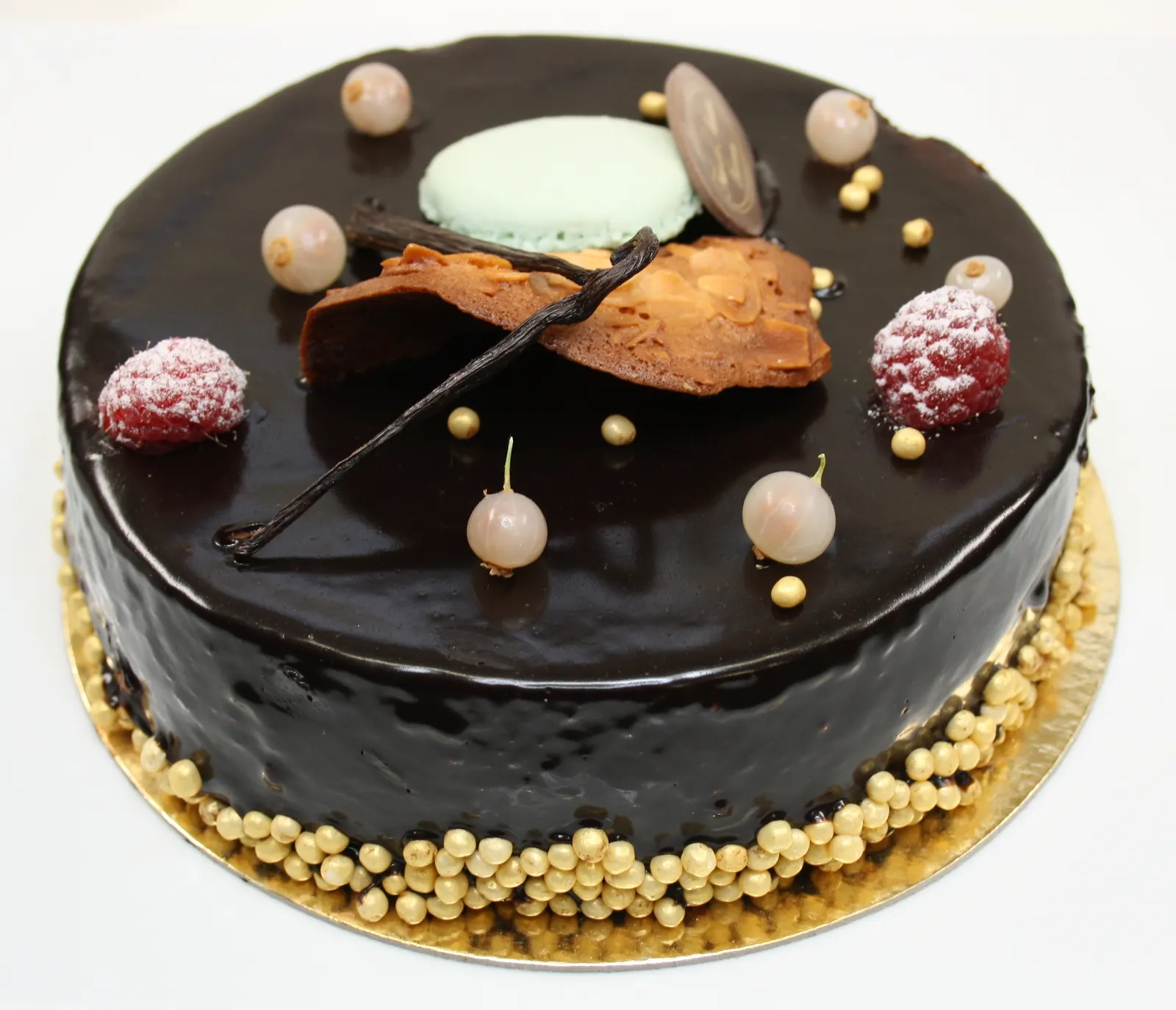
A polished chocolate mousse cake illustrates the glossy celebration finish. Allen’s recipe is a four-layer chocolate cake under poured cocoa frosting and contains no fruit or macaron garnish.Photo by Lionel Allorge · CC BY-SA 3.0
Layers
4
Oven
350°F
Bake
30–35 min
Yield
10 servings
This is chocolate cake built as a sequence of contrasts. Lauren Allen’s two tender cocoa rounds become four thin layers; an eggless whipped-cream mousse fills the seams; a boiled cocoa frosting lands last, warm enough to flow but cool enough to leave the airy center intact.
The 2014 formula is generous and direct: pantry cake, five-ingredient mousse, four-ingredient frosting. Its difficulty comes from temperature rather than pastry-school technique. Cool the cakes before the knife, cool the chocolate before the cream, then cool the assembled stack before the final pour. Each pause protects the next texture.
“A delicious, moist chocolate cake with layers of dark chocolate mousse filling and a warm chocolate frosting poured on top!”
The thin batter
Boiling water makes the chocolate batter unusually fluid. That is a feature of the Hershey formula, not a cue to add flour.
The cool junction
Melted chocolate must stay fluid while losing its heat; only then can it enter whipped cream without collapsing the air.
The cold stack
Thirty minutes in the refrigerator firms three mousse seams before the pourable cocoa frosting reaches the cake.
The cocoa architectureCrumb air sheen
Chocolate moves through three different systems
The ingredient list repeats chocolate deliberately, but water, cream, and butter make each appearance behave differently.
01
Unsweetened cocoa
Three separate measures carry the flavor through crumb, mousse, and frosting so no layer reads as an afterthought.
Break up the dry cocoa before mixing and make the mousse portion into a smooth slurry with hot water before it meets melted chocolate.02
Boiling water
One full cup loosens the cake batter dramatically and helps hydrate the cocoa in the source’s Hershey-based formula.
Stir it in by hand at the end and expect a thin pour. Adding flour to “correct” the texture changes the cake.03
Semisweet chips
A cup and a half supplies the mousse’s chocolate body without introducing eggs or gelatin.
Melt gently, combine with the cocoa slurry, and cool to room temperature while keeping the mixture fluid.04
Cold heavy cream
Two whipped cups provide every pocket of air in the filling and enough volume for three seams plus a thin outer coat.
Stop at stiff peaks before the cream turns grainy, then fold with broad strokes rather than beating in the chocolate.
The layer-cake preflightPans cream racks shelf
Prepare a cold route for a tall cake
A little staging prevents warm components and improvised landing places from undoing the mousse.
Dark matter, light structurePowder dissolved whipped poured
One cocoa tin, three distinct textures
Cocoa appears three times: in the cake, dissolved into the mousse, and boiled with milk and butter for the final frosting.Photo by Blair · CC BY-SA 2.0
The room-temperature hinge
The melted chocolate base has to cool without hardening. That narrow window keeps the whipped cream lofty and the mousse streak-free.
The original cake needs no garnish, but the texture of shaved chocolate echoes the moment melted semisweet chips turn whipped cream into mousse.Photo by Mack Male · CC BY-SA 2.0
The two-hour rhythmBeat bake wait fold chill pour
The clock alternates action and cooling
The author’s maintained planning time is useful, but the visible state of each component decides when the next move is safe.
2 min
Beat the cocoa batter
Mix eggs, milk, oil, and vanilla into the dry ingredients, then stir in boiling water without trying to thicken the pour.
30–35
Bake two deep rounds
A center tester should emerge clean or with a few moist crumbs; wet batter means the layers are not ready to split.
Cool
Wait twice
Cake rounds cool completely on racks while the melted chocolate base falls to room temperature without hardening.
Fold
Keep the mousse aerated
Whip cream and sugar to firm peaks, then turn in the cool chocolate only until the pale streaks disappear.
30 min
Set the four-layer stack
Mousse fills three seams and coats the outside lightly; cold makes the tall structure steady enough to glaze.
15–20
Cool the frosting to pourable
Stir the boiled cocoa frosting as it loses heat, then pour slowly before it stiffens but after it can no longer melt mousse.
The texture readsFluid baked cool peaked flowing
Five cues protect the tower
The cake gives clear evidence at every stage; use it instead of forcing warm components together to stay on schedule.
01
Fluid batter, even pans
The cake mixture runs rather than scoops. Divide it evenly so both baked rounds offer the same height for torting.
02
Clean tester, springing center
The layers should spring lightly and show no liquid batter on a center tester; a few damp crumbs are acceptable.
03
Chocolate fluid but not warm
The mousse base should fall from the spatula in a ribbon at room temperature. Heat deflates cream; a solid mass cannot fold evenly.
04
Stiff peaks without grain
The whisk leaves peaks that stand, but the cream remains smooth. Stop before it looks curdled or begins separating.
05
Frosting flows, mousse stays still
The final frosting should move under the spatula in a slow sheet while the chilled mousse coat remains visibly firm underneath.
The celebration planWrap thaw fill chill serve
Freeze the rounds, not the mousse
Advance work belongs to the sturdy cake layers. The cream-filled finished cake stays cold and is best close to serving.
Rounds up to 3 months
Cool the unsplit cakes completely, double-wrap, and freeze. Thaw while wrapped before leveling or splitting.
Finish on serving day
The author allows make-ahead components, but the unstabilized whipped-cream mousse has its best volume and cleanest cut when assembled fresh.
Refrigerate up to 3 days
Cover the finished cake and hold it at 40°F or below. Cut directly from the refrigerator for the sharpest four-layer profile.
Two hours on the table
Whipped-cream filling is perishable. Return the cake to the refrigerator within two hours, sooner in very warm conditions.
Chocolate Cake with Chocolate Mousse Filling
Lauren Allen’s original 10-serving four-layer chocolate cake with eggless chocolate mousse and a warm-set cocoa frosting.
Set a rack in the center of the oven and preheat to 350°F (177°C). Grease and flour two 9-inch round cake pans; line the bottoms with parchment rounds so the tender cakes release cleanly.
In a large bowl, stir together the granulated sugar, flour, cocoa powder, baking powder, baking soda, and salt until the cocoa is evenly distributed and no dry pockets remain.
Add the eggs, milk, vegetable oil, and vanilla. Beat on medium speed for 2 minutes. Stir in the boiling water by hand; the batter will be very thin, as the source intends. Divide evenly between the prepared pans.
Bake for 30–35 minutes, until a tester inserted in the center comes out clean or with only a few moist crumbs. Cool in the pans for 10 minutes, then turn the rounds onto wire racks and let them cool completely before splitting.
For the mousse, stir the 4 tablespoons cocoa into the 1/2 cup hot water until smooth. Melt the semisweet chips gently in a double boiler or in short microwave bursts, stirring until smooth. Stir in the cocoa mixture, then let this chocolate base cool to room temperature; it must remain fluid but should not feel warm enough to melt whipped cream.
In a clean large bowl, whip the cold heavy cream with 2 tablespoons sugar to very stiff peaks, stopping before it looks grainy. Add the cooled chocolate base and fold gently with a flexible spatula until no pale streaks remain. Refrigerate while the cakes finish cooling.
Use a long serrated knife to split each completely cooled cake round horizontally, making four thin 9-inch layers. Set the first layer on a cake plate and spread it with mousse. Repeat with the next two cake layers, then place the final layer on top. Spread the remaining mousse thinly over the top and sides and refrigerate for 30 minutes to firm the stack.
While the assembled cake chills, make the frosting. Combine the 6 tablespoons milk, 3 tablespoons cocoa, and butter in a medium saucepan and bring to a boil, stirring. Remove from the heat, add the confectioners’ sugar, and beat until smooth and free of lumps.
Let the frosting cool for 15–20 minutes, stirring occasionally, until it is still pourable but no longer hot enough to loosen the chilled mousse. Pour it very slowly over the top and guide it across the top and down the sides with an offset spatula.
Refrigerate until the frosting is set and the cake is ready to serve. Cut while chilled with a long clean knife, wiping the blade between slices so all four layers remain distinct.
Source and technique references: Lauren Allen’s earliest complete archived Tastes Better From Scratch page for the May 28, 2014 publication, author, 10-serving yield, exact cake, mousse, and frosting formulas, original method, and description; the maintained author recipe for its transparent revision note, component timing, room-temperature chocolate, longer frosting cool, make-ahead options, and later formula differences; Hershey’s “Perfectly Chocolate” cake for confirming the original 11-item cake ratio, thin batter, two 9-inch pans, 30–35-minute bake, and complete cooling; King Arthur Baking’s test-kitchen mousse cake for even batter division, firm-peak caution, a 30-minute pre-frosting chill, cold storage, and a three-day finished-cake window; and FoodSafety.gov’s refrigerated-food chart for discarding cream held above 40°F for more than two hours. The original quantities and yield are preserved; only cooling, folding, assembly, and safe-holding cues are clarified.