
Chicken + dumplingsPot pie logic

Pour twice · stir neither

Chicken and Biscuit Bake

A creamy chicken-and-vegetable casserole with a soft biscuit-mix layer, assembled in deliberate pours and baked until golden and set.

Bake the casserole
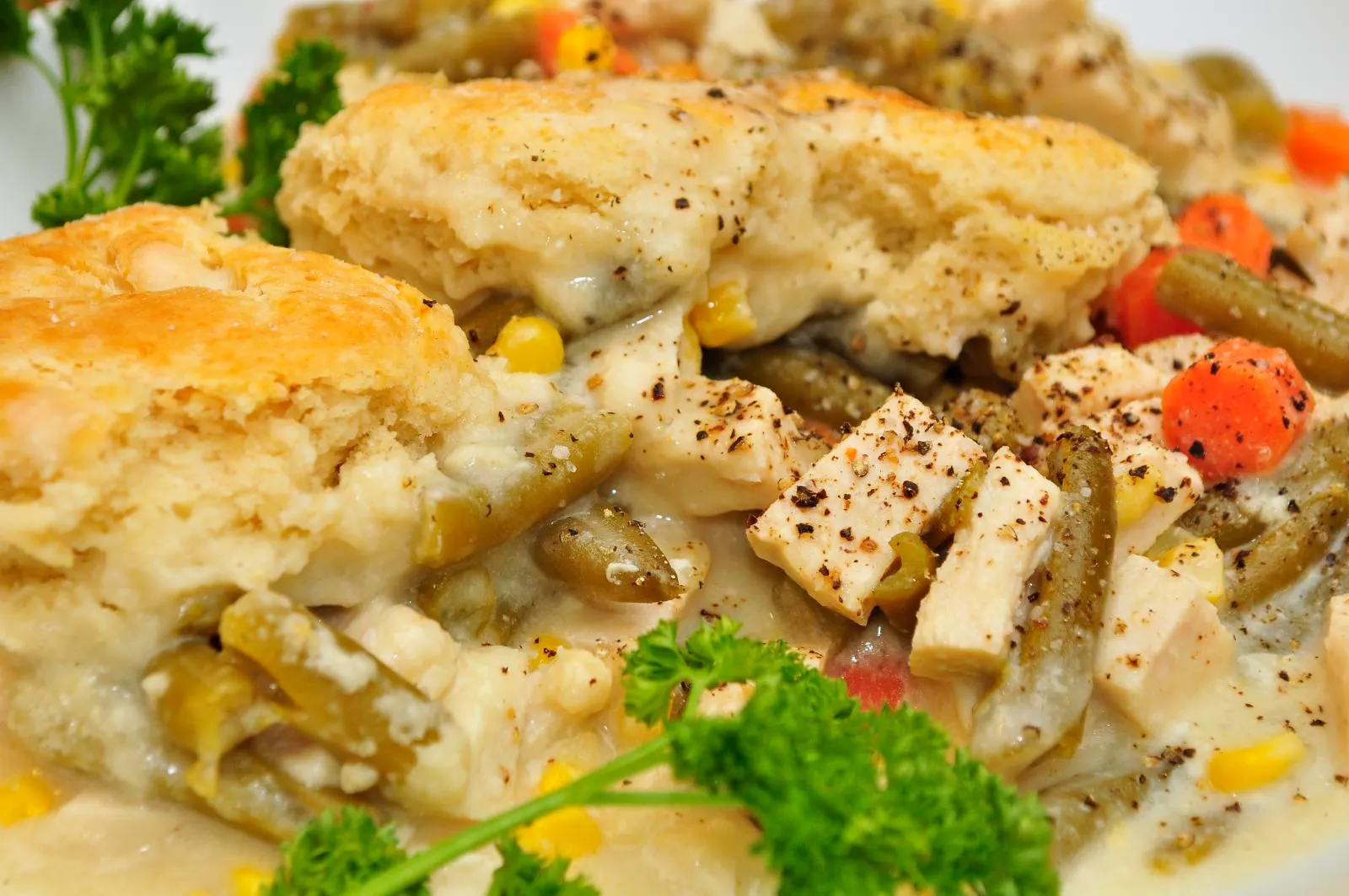
Biscuit-topped chicken and vegetables in creamy gravy.
An illustrative biscuit-topped chicken supper shows the destination: creamy filling, distinct vegetables, and a fully baked golden top. Angela’s source uses a poured Bisquick layer rather than separate biscuits.Photo by jeffreyw · CC BY 2.0
Bake
40–45 min
Rest
5 min
Serves
6 servings
Dish
9 × 13 inch

This casserole begins with a contradiction: pour in everything that looks as though it should be stirred, then leave it alone. Butter, cooked chicken, and vegetables make the base. A loose baking-mix batter covers them. Creamy chicken stock follows. The oven, not the spoon, resolves those layers into something between chicken and dumplings and pot pie.

Angela Steveson’s method is valuable because it keeps its strange-looking moment in full view. Before baking, the dish appears too wet. After forty to forty-five minutes, the biscuit layer rises and sets while the stock and condensed soup become gravy below. The five-minute rest is part of the architecture: it lets the hot interior settle enough to serve.

“The perfect combination of chicken and dumplings and chicken pot pie come together in one casserole bake. Comfort food at its finest.”

Butter first

Melted butter coats the dish before cooked chicken and thawed vegetables form the base.

Two deliberate pours

Biscuit batter goes in first, creamy stock goes in second, and neither layer is stirred.

Three finish cues

A lightly browned top, bubbling edges, and a 165°F center matter more than the clock alone.

The comfort trioChicken mix vegetables

Three workhorse ingredients carry the casserole

The recipe stays pantry-simple, but each quantity has a structural job as well as a flavor job.

01

Cooked chicken

Three cups make the casserole a real supper rather than a biscuit pudding with a few savory pieces.

Shred or cube it evenly and keep it in a loose layer so the two pours can travel around it.
02

Baking mix

Bisquick supplies flour, leavening, fat, and salt in one measured layer that sets inside the gravy.

Mix with milk only until no dry pockets remain. A few lumps are normal, and canned biscuits are not an equivalent swap.
03

Mixed vegetables

One and a half cups bring color, sweetness, and pot-pie character without adding another pan.

Thaw them for the source’s 30 minutes so excess ice does not dilute the set.

Mise before layeringThaw warm measure separate

Set up the two pours before butter reaches the dish

Once assembly begins, the only useful movement is forward. The separate bowls keep the order unambiguous.

The casserole clockNo stirring between lines

Layer, pour, pour again, then trust the oven

The source gives one strong timing range. Visual, texture, and temperature cues decide the exact finish.

  1. −0:30

    Thaw the vegetables

    Spread the frozen mix out so ice can release before the oven heats.

  2. 0:00

    Build the buttered base

    Coat the dish, pour in melted butter, then layer cooked chicken and vegetables.

  3. 0:06

    Pour biscuit batter

    Combine baking mix and milk gently, pour it across the base, and do not stir.

  4. 0:09

    Pour creamy stock

    Whisk warm fortified stock with condensed soup and pour it over the batter without mixing.

  5. 0:50

    Read the center

    Look for a light-golden set top and bubbling edge, then require 165°F in the middle.

  6. +5 min

    Let the layers settle

    A short rest turns a boiling casserole into portions that hold together on the spoon.

Open the centerGolden top creamy middle

A set lid over a spoonable chicken supper

A round chicken pot pie opened to show chicken, peas, carrots, and corn.
This illustrative open pie makes the casserole’s useful contrast visible: a set top over moist chicken and mixed vegetables. The source bake has no pastry shell.Photo by MonicaVereanaWilliams · CC BY-SA 4.0
The non-negotiable

Do not stir either pour. The loose layers are the method, not a problem waiting for a spoon.

An individual chicken pot pie with a browned biscuit-like top and creamy vegetables at the rim.
A browned top and bubbling edge are useful visual cues. Angela’s 9-by-13-inch casserole should also look set before it leaves the oven.Photo by Elsie Hui · CC BY 2.0

Doneness stackBrown set bubble probe

Four readings say the center is ready

The timer starts the check; the casserole itself gives the final answer.

01

Lightly browned

The top should have warm golden patches, not a pale wet center or a dark dry rim.

02

Set through the middle

Nudge the dish gently: the center may be tender, but it should no longer move like raw batter.

03

Bubbling at the edge

Active gravy around the perimeter confirms that the lower layers are hot, but it does not replace a center reading.

04

165°F in several spots

Probe the center of this mixed dish, avoiding the glass. Check more than one place before serving.

Keeping planPrep assemble cool reheat

Prepare the parts early, but keep the layers late

Convenience comes from cooked chicken and measured components, not from letting wet biscuit batter wait.

Prepare components ahead

Cook and shred the chicken, thaw the vegetables, and measure the dry and liquid ingredients separately.

Assemble just before baking

Do not hold the completed raw biscuit-and-gravy layers overnight; the baking mix would hydrate before the oven can set it.

Cool in shallow portions

Move leftovers out of the deep casserole within 2 hours so they pass through the warm zone quickly.

Reheat to 165°F

Warm only what you need. An oven preserves more top texture than a microwave, but the safe center temperature stays the same.

Chicken and biscuit bake

Angela Steveson’s six-serving chicken, mixed-vegetable, and Bisquick casserole with two deliberate no-stir pours.

ChickenCasseroleBiscuitsMixed VegetablesComfort FoodOne-Dish Dinner

Ingredients

Chicken and vegetable base

  • Nonstick cooking spray
  • 1/4 cup butter, melted
  • 3 cups cooked chicken, shredded or cubed
  • 1 1/2 cups frozen mixed vegetables, thawed for about 30 minutes

Biscuit layer and gravy

  • 2 cups Bisquick baking mix
  • 1 1/2 cups milk
  • 1 1/2 cups low-sodium chicken stock or broth
  • 1 chicken bouillon cube (see note before increasing)
  • 1 standard can condensed cream of chicken soup
  • 1 teaspoon black pepper

Directions

  1. About 30 minutes before assembling, spread the frozen mixed vegetables in a shallow bowl to thaw. Heat the oven to 350°F (175°C). Lightly coat a 9-by-13-inch casserole dish with nonstick spray.
  2. Warm the chicken stock in a small saucepan over medium-low heat. Add 1 bouillon cube and stir until dissolved, then keep the fortified stock warm. Do not add a second cube by default; see the source note below.
  3. Pour the melted butter into the prepared casserole dish. Scatter the cooked chicken evenly over the butter, then distribute the thawed vegetables over the chicken. Do not stir the layers together.
  4. In a mixing bowl, combine the Bisquick and milk with a fork or whisk. Stop when no dry pockets remain; a few small lumps are expected.
  5. Pour the biscuit mixture slowly and evenly over the chicken and vegetables. Do not mix. Sprinkle the black pepper across the surface.
  6. In a clean bowl, whisk the condensed cream of chicken soup with the warm fortified stock until blended.
  7. Pour the soup mixture slowly over the biscuit layer. Do not mix. The dish will look unusually loose and soupy at this stage; that is the source method, not a signal to add more baking mix.
  8. Bake uncovered for 40 to 45 minutes, until the top is lightly browned, the center looks set rather than liquid, and the edges are bubbling. Check the center of the casserole in several places with an instant-read thermometer; it should reach 165°F (74°C).
  9. Rest the casserole for 5 minutes before serving. The pause lets the hot filling settle and makes each portion easier to lift cleanly.

Source and research references: the queued My Recipe Magic card for the September 29, 2013 title, author, six-serving yield, exact syndicated quantities, and nutrition mismatch; Angela Steveson’s archived November 7, 2012 Joyously Domestic post for the full layer order, 9-by-13-inch timing, set-and-brown cues, five-minute rest, and warning against canned-biscuit substitution; Betty Crocker Kitchens and King Arthur Baking for corroborating baking-mix technique; and University of Minnesota Extension for 165°F mixed-dish reheating and shallow-container cooling guidance.

Image credits

Photography is used under open licenses with attribution: jeffreyw, MonicaVereanaWilliams, and Elsie Hui.