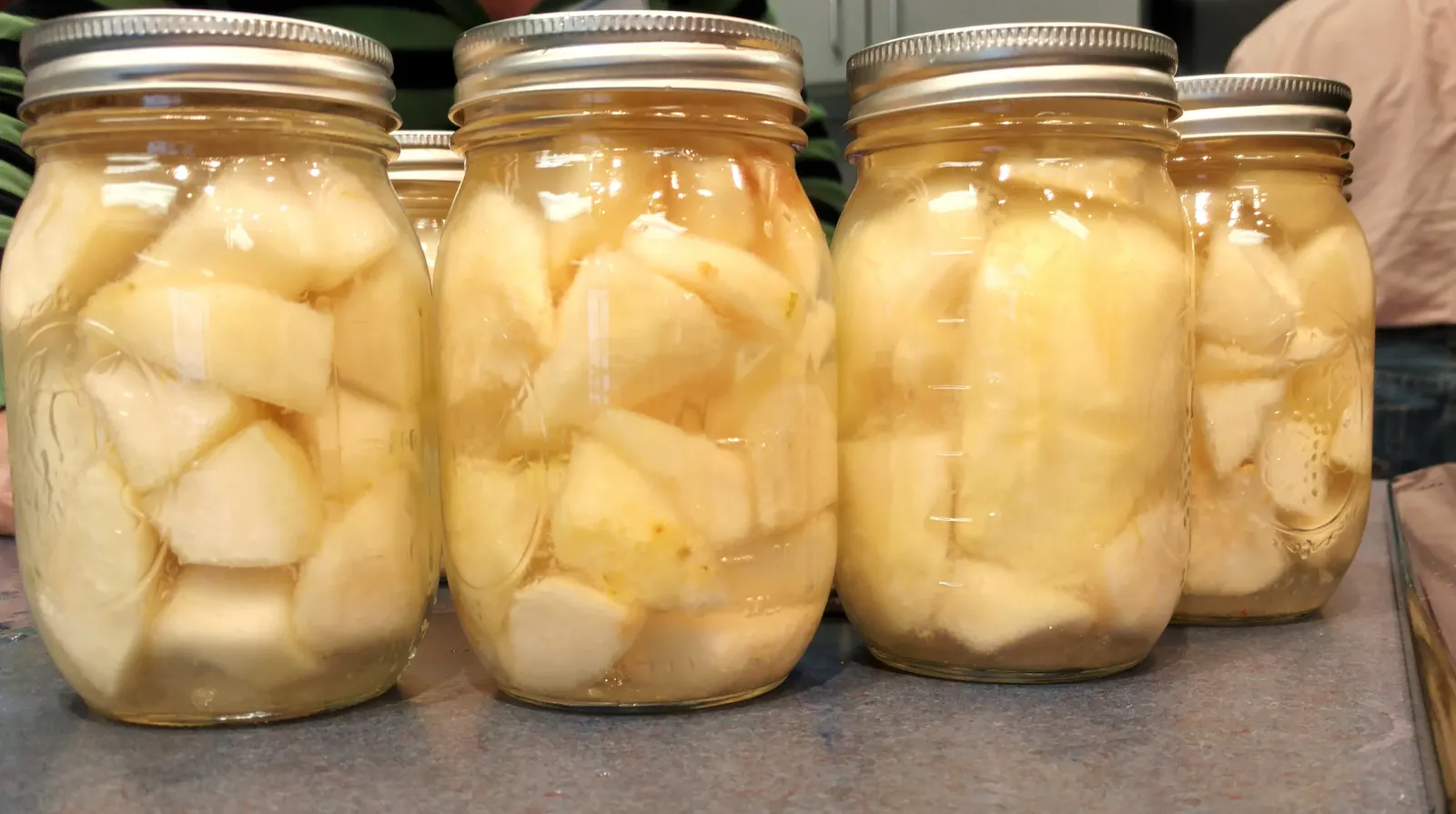
A handful of red candy turns the preserving kettle theatrical. Rachel Paxton’s pears begin as a practical way to hold onto a free harvest, then take a bright detour: cinnamon Red Hots melt into the packing liquid and tint every jar from the outside in.
The formula is charmingly direct—pears, candy, water, and Fruit Fresh—but shelf-stable fruit depends on precision after the candy dissolves. Hot fruit, measured headspace, a continuous boil, elevation-aware timing, and a patient cool are the difference between a pretty jar and a properly processed one.
“Adding red hots to canned pears gives fresh pears a nice cinnamon twist.”
The fruit
Thirty small, ripe-but-firm common pears hold their shape better than soft fruit and fill roughly three to four quart jars.
The color
Red Hots dissolve into the five cups of water; the candy supplies the cinnamon heat, sugar, and scarlet tint.
The safety clock
Quart jars need the tested pear hot-pack time: 25 minutes at 0–1,000 feet, with longer processing above that elevation.
The preserving setFruit heat color clarity
Four ingredients, each with a job
Nothing new enters the 2013 formula. The useful upgrade is knowing what each item controls—and what it cannot replace.
01
Firm common pears
The source starts with 30 small pears. Bartlett and other common pears can follow the standard tested pear process.
Choose fragrant fruit that still resists pressure. Asian pears require a different, acidified canning method.02
Cinnamon Red Hots
Two cups make the covering liquid sweet, hot-cinnamon scented, and gradually pink-red around the pale fruit.
Dissolve every candy before the pears enter so no hard pieces collect in one jar.03
Five cups water
Water carries the melted candy and supplies enough hot liquid for roughly four quart jars, depending on pack density.
Keep the 1/2-inch headspace measured after bubbles are released; add liquid only to restore that line.04
Fruit Fresh
One tablespoon goes into the holding bath and one into the cinnamon liquid, matching Paxton’s original directions.
Because anti-browning products change, follow the current package amount for the holding bath when it differs.
Altitude firstPrepare pack process cool
The jar clock starts before the burner
Canning rewards staging. Once the pears are peeled, every bowl, jar, lid, and tool should already be in position.
Before
Know the elevation
Choose the correct quart-jar processing interval first, then heat the canner and keep clean jars hot.
Prep
Peel into protection
Halve and core each pear, moving it immediately into Fruit Fresh water so the cut surface stays pale.
0:00
Dissolve the red syrup
Stir candy into five cups water until completely smooth; add the second tablespoon of Fruit Fresh.
0:05
Hot-pack the fruit
Boil drained pears in the cinnamon liquid for five minutes, then pack cut-side down with 1/2 inch headspace.
0:15
Process at a full boil
Start the 25–40 minute altitude clock only after the covered canner returns to a vigorous boil.
After
Wait before judging
Rest five minutes in the open canner, then cool upright and untouched for 12–24 hours before testing seals.
For hot-packed quart jars, use 25 minutes only at 0–1,000 feet. The tested interval lengthens to 30, 35, or 40 minutes as elevation rises.
Common pears such as Bartlett can be canned by the standard pear process. Asian pears need a separate tested, acidified method.Photo by Rhododendrites / Wikimedia Commons · CC BY-SA 4.0
The finish cuesShape space boil seal
Read four things before the shelf
The timer is essential, but it is not the only checkpoint. Fruit, headspace, canner, and lid each give a visible answer.
01
Pears remain intact
The halves are hot through after five minutes but still firm enough to pack cut-side down without collapsing.
02
A clean half-inch
Fruit and liquid both sit 1/2 inch below the rim after trapped air is released and the level is rechecked.
03
A continuous boil
Water covers the lids by 1–2 inches and boils for every minute of the altitude-adjusted interval.
04
A true vacuum seal
After 12–24 hours the lid curves inward and does not spring when pressed; the screw band is no longer needed.
The holding planStage cool test store
Let the seal prove itself
The work is not finished when the jars leave the water. Cooling and seal testing are part of the process, not cleanup.
Before peeling
Set out every tool, determine elevation, heat the canner, and mix the holding bath. Cut pears darken quickly.
After processing
Leave jars upright and alone for 12–24 hours. Pressing lids or tightening bands while hot can interfere with sealing.
If one fails
Refrigerate and use it promptly, or reprocess within 24 hours with a new lid and the complete processing time.
On the shelf
Date sealed jars and store without bands in a cool, dark, dry place. Aim to use them within one year for best quality.
Canned cinnamon pears
Ripe-but-firm pear halves hot-packed in a red cinnamon-candy liquid and processed in a boiling-water canner with altitude-aware timing.
30 small ripe but firm common pears, such as Bartlett (not Asian pears)
Cool water, enough to hold the prepared pears
1 tablespoon Fruit Fresh, or the package amount for an anti-browning bath
Cinnamon-candy liquid
2 cups cinnamon Red Hots candies
5 cups water
1 tablespoon Fruit Fresh
Directions
Before starting, read the boiling-water canner and lid manufacturers’ directions and determine your elevation. Set a rack in the canner, add enough water to cover filled jars by 1–2 inches, and begin heating it. Wash the jars, lids, and bands; keep the clean jars hot until filling and prepare lids as their manufacturer directs.
Fill a large bowl with cool water and mix in 1 tablespoon Fruit Fresh, or use the package amount specified for an anti-browning bath. Working one pear at a time, trim the ends, peel, halve lengthwise, and scoop out the core with a melon baller or metal measuring spoon. Hold the prepared halves in the bath while the rest are cut.
Combine 2 cups cinnamon Red Hots and 5 cups water in a large nonreactive saucepan. Heat gently, stirring until the candies dissolve completely. Stir in the remaining 1 tablespoon Fruit Fresh and bring the liquid to a boil.
Drain the pear halves. Add them to the cinnamon liquid, cover, and return to a gentle boil. Cook for 5 minutes so the fruit is heated through, stirring carefully enough to expose every piece to the hot liquid without breaking it.
Working with one hot jar at a time, pack the hot pear halves cut-side down, leaving 1/2 inch headspace. Ladle in boiling cinnamon liquid to keep that 1/2-inch space. Slide a plastic bubble remover around the inside edge, release trapped air, and adjust the liquid level if needed.
Wipe each jar rim clean, center a prepared flat lid, and apply the band fingertip-tight. Lower the jar onto the canner rack and repeat until the fruit and liquid are packed. Keep jars upright and separated.
Cover the canner, make sure boiling water stands 1–2 inches above the jar tops, and return it to a vigorous boil. Process quart jars for 25 minutes at 0–1,000 feet, 30 minutes at 1,001–3,000 feet, 35 minutes at 3,001–6,000 feet, or 40 minutes above 6,000 feet. Start timing only when the full boil resumes; keep the water boiling for the entire interval.
When processing is complete, turn off the heat, remove the canner lid, and wait 5 minutes. Lift each jar straight up without tilting and set it on a towel or rack with space around it.
Let the jars cool undisturbed for 12–24 hours; do not press the lids or retighten the bands. Remove the bands and test every seal. Refrigerate and use an unsealed jar promptly, or fit a new lid and reprocess within 24 hours using the full process time.
Wipe sealed jars clean, label and date them, and store without the bands in a clean, cool, dark, dry place. For best quality, use within 1 year and discard any jar that leaks, bulges, spurts, smells off, or shows other spoilage.
Source and technique references: the December 12, 2013 My Recipe Magic card for the exact legacy identity, Creative Homemaking attribution, original description, 30 pears, 2 cups cinnamon Red Hots, 5 cups water, and 2 tablespoons Fruit Fresh; Rachel Paxton’s maintained Creative Homemaking page for the two-part Fruit Fresh use, small-pear context, 3–4 quart yield, trimming, peeling, melon-baller coring, candy dissolution, and cut-side-down pack; the National Center for Home Food Preservation’s USDA-adapted pear procedure for ripe common pears, five-minute hot pack, 1/2-inch headspace, quart-jar processing times, and the separate warning for Asian pears; Oregon State University Extension for fruit selection, weight-per-quart, hot-pack handling, altitude adjustments, and quality guidance; and NCHFP seal guidance for the five-minute canner rest, 12–24-hour undisturbed cool, band removal, and failed-seal options. The only substantive method changes are the tested five-minute hot pack and safe quart-jar process time.