The all-brown-sugar pieBrown butter · toasted pecans · deep dish
No corn syrup · one bowl · complete cool
Brown Butter Brown Sugar Pecan Pie
Trish Rosenquist’s deep-dish pecan pie lets brown sugar do all the sweetening, folds in toasted nuts, and bakes until the custard rises golden before settling into a clean slice.
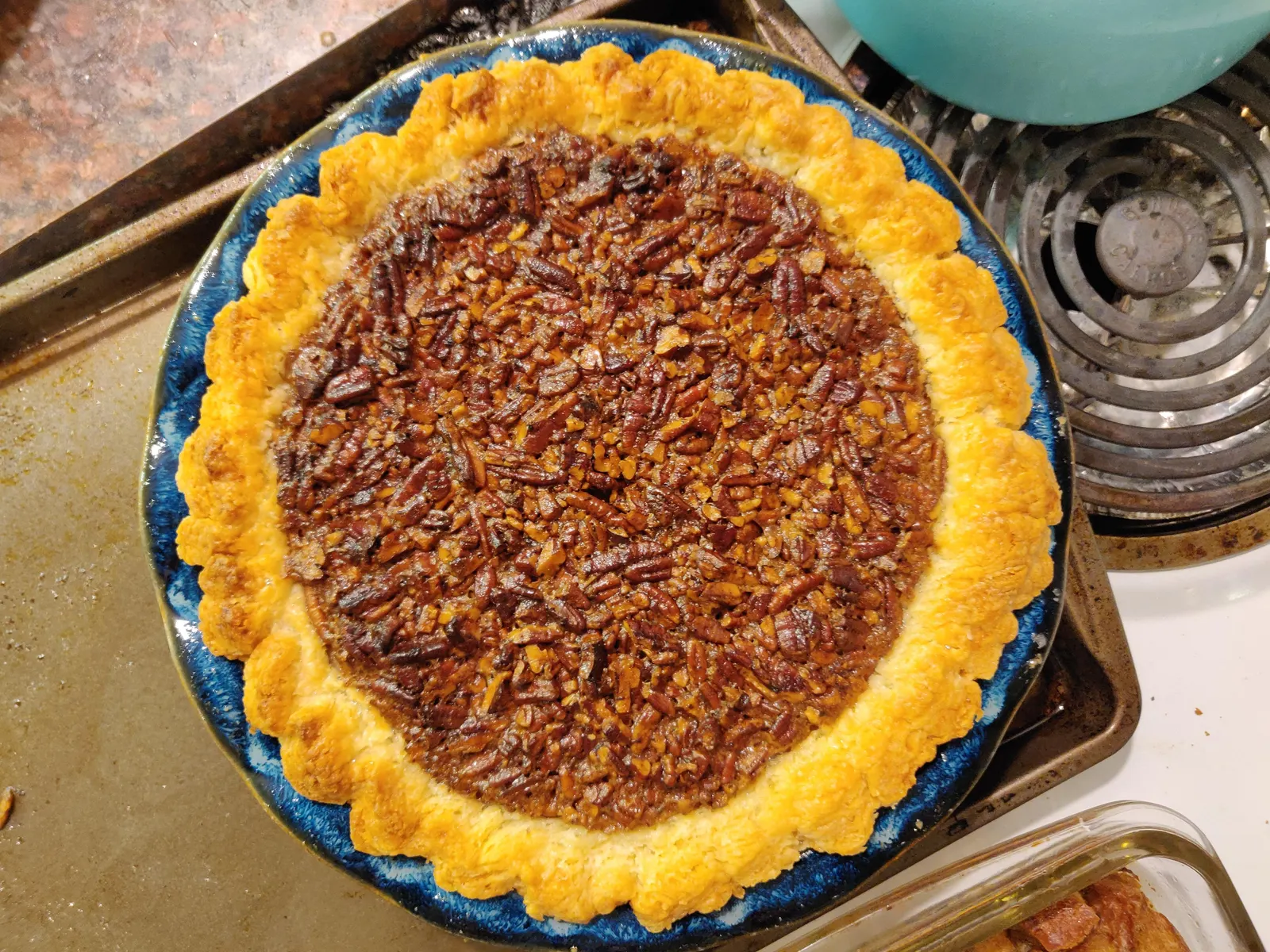
The source bakes its deep-dish pie on a sheet pan until the brown-sugar custard is puffed and golden. This homemade pecan pie illustrates that full-pan finish.Photo by Mshuang2 · CC0 1.0
Sweetener
Brown sugar only
Oven
325°F
Bake
45–55 min
Yield
8 servings
This pie chooses brown sugar and commits. Trish Rosenquist’s 2015 filling skips corn syrup and granulated sugar entirely, leaning instead on packed brown sugar, four eggs, and a modest quarter-cup of milk. Browned butter deepens the caramel line; chopped toasted pecans interrupt it with a crisp edge.
The work is short, but two pauses carry the structure. Ten minutes cools the brown butter before it meets the eggs. A much longer rack cool follows the oven, allowing the puffed filling to settle into the deep-dish shell. Rush either one and a straightforward holiday pie becomes harder than it needs to be.
“This Brown Butter Brown Sugar Pecan Pie is the perfect addition to your holiday table. It is so easy you may want to make one for yourself and one for a friend.”
The dark note
Butter stops at dark gold, not black. Every toasted milk solid goes into the filling, where it echoes the pecans.
The sugar body
Two and one-third cups packed brown sugar supply both sweetness and the molasses-rich structure; no corn syrup enters.
The patient cut
The filling leaves the oven puffed, then sinks as it cools. A complete rack cool is what turns the hot custard into a clean slice.
The filling architectureMolasses toast egg crunch
Four ingredients build the dark custard
The original ratio stays exactly where Rosenquist put it. Better results come from recognizing what each ingredient controls.
01
Brown sugar
The only sugar in the filling gives the pie its deep caramel flavor and dense custard body.
Pack the cup firmly and break up every hard lump while whisking with the eggs; there is no corn syrup to dissolve it later.02
Brown butter
Half a cup of butter gains toasted milk solids before it joins the custard, reinforcing the nuts without adding another flavoring.
Use a light-colored pan, stir the bottom, and pour at dark gold. The hot pan can carry perfect butter into bitterness after the burner is off.03
Room-temperature eggs
Four eggs set the high-volume brown-sugar filling and help it rise before settling on the rack.
Cool the butter for ten minutes and stream it in while whisking so the eggs warm gradually rather than forming streaks.04
Toasted pecans
One chopped cup distributes nutty crunch through every wedge instead of arranging a decorative but harder-to-cut top.
Toast gently until fragrant, cool, then chop. Oil-rich pecans can move from aromatic to scorched quickly at high heat.
The deep-dish preflightShell sheet bowl nuts
Prepare the landing places before butter foams
Browning and tempering leave little room to search for equipment. Four checks turn the ten-minute prep into an orderly sequence.
Brown into goldToasted milk solids · fully cooled slice
Color begins in the saucepan and resolves on the rack
Brown butter is ready when the milk solids turn dark gold and smell nutty. Move it out of the hot pan immediately so “slightly browned” does not become bitter.Photo by H. Alexander Talbot · CC BY 2.0
The carried heat
Brown butter does not stop cooking because the burner is off. Pouring it into a waiting bowl preserves the dark-gold milk solids the filling needs.
A fully cooled pecan pie cuts without a syrupy wake. The photographed restaurant slice is illustrative; Rosenquist’s filling uses only brown sugar, with no corn syrup.Photo by Quinn Dombrowski · CC BY-SA 2.0
The fifty-five-minute arcHeat brown cool whisk puff settle
The pie crosses six visible thresholds
The source clock stays intact, while aroma, motion, and shape make each transition easier to read.
325°F
Heat the center rack
A moderate oven gives the deep custard time to set before the pastry rim becomes too dark.
Dark gold
Brown, then leave the pan
Swirl and stir until the sputter fades and the milk solids color; pour immediately into a heatproof bowl.
10 min
Cool the butter fluid
The source pauses here. Butter should still pour, but it should no longer be hot enough to shock the eggs.
Slow stream
Build one glossy custard
Whisk eggs, sugar, milk, vanilla, and salt smooth, then drizzle in every drop of brown butter while whisking.
45–55
Bake to puffed and golden
Look for set outer filling and a center that trembles together instead of moving in liquid waves.
Cool
Let the rise become the slice
The pie settles on the rack. Wait until it is completely cool before a knife enters the custard.
The four texture checksGolden glossy unified settled
Read the custard from saucepan to slice
A good pie offers evidence before the knife arrives. These cues are more reliable than extending the bake for an arbitrary darker color.
01
Nutty aroma, golden sediment
Brown butter should smell toasted and show dark-gold milk solids. Black specks and an acrid smell mean it has burned.
02
A lump-free glossy pour
The mixed filling should fall from the whisk in a continuous ribbon with no compacted brown-sugar pebbles or egg streaks.
03
A center moving as one
At the end of the bake, the middle may tremble gently when the sheet moves, but it should not ripple under the pecans like liquid.
04
A settled, level cut
The domed hot filling sinks while cooling. A room-temperature wedge should stand cleanly while remaining soft and custardy.
The keeping planBake cool cover thaw
Cool now; serve on holiday time
Pecan pie rewards an early start. The long cool and cold storage give the filling time to become more sliceable, not less fresh.
Bake one day ahead
Cool completely, cover, and refrigerate. Bring the pie toward room temperature before serving if you prefer a softer custard.
Serve after the full cool
Whipped cream or vanilla ice cream suits the source’s holiday table, but neither belongs on a still-hot, unset slice.
Refrigerate 3–4 days
FoodSafety.gov classifies baked pecan pie as refrigerated food. Keep it covered at 40°F or colder.
Freeze 1–2 months
Wrap the completely cooled pie tightly for best quality, then thaw it overnight in the refrigerator before unwrapping.
Brown Butter Brown Sugar Pecan Pie
Trish Rosenquist’s eight-serving, corn-syrup-free deep-dish pie with toasted pecans and a brown-butter custard.
2 1/3 cups (about 500 grams) firmly packed brown sugar
4 large eggs, at room temperature
1/4 cup (60 milliliters) milk
2 teaspoons vanilla extract
1/2 teaspoon fine salt
1 cup (about 113 grams) chopped toasted pecans
1 unbaked 9-inch deep-dish pie crust
Directions
Set a rack in the center of the oven and preheat to 325°F (163°C). Place the unbaked deep-dish pie shell on a rimmed baking sheet so the filled pie can move safely in and out of the oven.
Melt the butter in a small light-colored saucepan over medium heat. Continue cooking, swirling and stirring across the bottom, until the sputtering eases, the milk solids turn dark golden brown, and the butter smells nutty. Do not wait for black flecks.
Immediately pour the brown butter, including the toasted milk solids, into a heatproof bowl to stop the cooking. Let it cool for the source’s full 10 minutes; it should remain fluid but no longer be fiercely hot.
In a large bowl, whisk the firmly packed brown sugar, room-temperature eggs, milk, vanilla, and salt until smooth. Break up every compacted sugar lump before the butter goes in.
While whisking continuously, drizzle in the cooled brown butter a little at a time. Continue until the filling is glossy and completely uniform, then fold in the chopped toasted pecans.
Pour the filling into the unbaked deep-dish crust and level the nuts without pressing them down. Keep the pie on its baking sheet and transfer the sheet to the center rack.
Bake for 45–55 minutes, following the original 2015 window, until the filling is puffed and golden, the outer portion looks set, and the center moves as one gentle piece rather than rippling like liquid. Shield the crust edge if it darkens before the filling is ready.
Transfer the pie, still in its plate, to a wire rack. It will sink and settle as it cools; that is expected. Cool completely before slicing so the egg-and-brown-sugar custard can finish setting.
Source and technique references: the exact My Recipe Magic card for legacy ID 2501868177 for the title, Trish Rosenquist byline, eight-serving yield, syndicated description, ingredients, and primary link; Rosenquist’s November 19, 2015 primary snapshot for the complete formula, 10/45/55-minute card, method, original doneness cues, and publication record; the maintained Mom On Timeout page for its transparent original-publication note, later 10-serving/50–60-minute display, corn-syrup-free context, chopped-pecan rationale, and freezing instructions; King Arthur Baking on brown-butter color, stirring, carryover heat, and immediate transfer and its test-kitchen pecan pie for low nut-toasting heat, puffed and fairly set doneness, complete cooling, and expected settling; and FoodSafety.gov’s cold-storage chart for 3–4 refrigerated days and 1–2 frozen months. The 2015 proportions, eight-serving yield, oven temperature, and 45–55-minute bake are preserved; added guidance clarifies browning, tempering, doneness, cooling, and safe keeping.