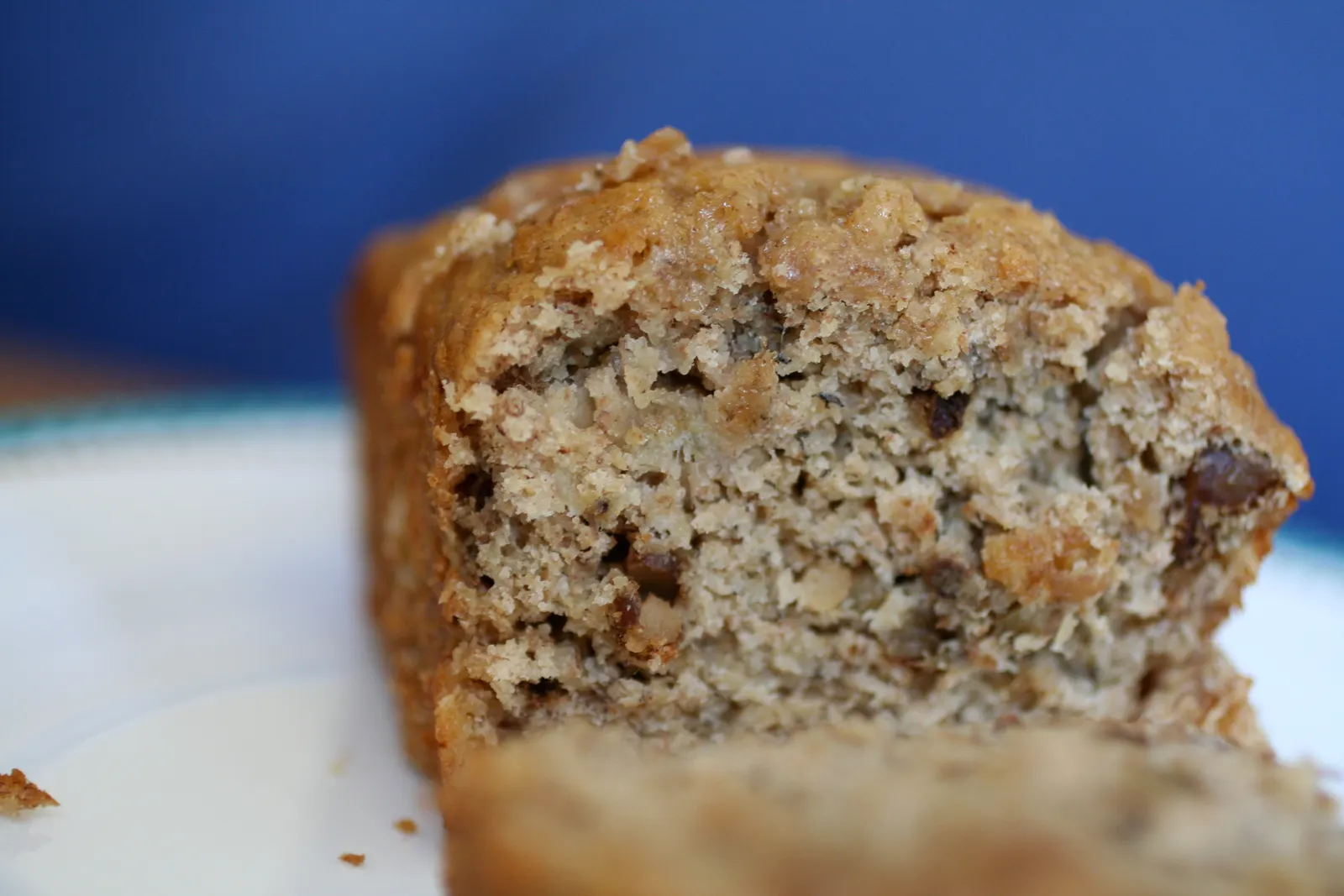
This walnut banana bread illustrates the tender banana-and-nut crumb. Jess’s source recipe spreads the batter in a sheet pan and finishes it with brown butter frosting.Photo by Whitney · CC BY 2.0
Makes
24 large bars
Pan
15 × 10 inches
Oven
375°F
Bake
20–25 minutes
Banana bread usually asks for patience and a loaf knife. Jess’s 2012 bars trade the deep pan for a broad jelly-roll sheet: the batter reaches doneness in 20 to 25 minutes, every portion gets an edge of warm frosting, and one bake yields two dozen generous squares.
Sour cream keeps the banana crumb close and tender. The optional walnuts make small interruptions in that softness. Then the top changes the register completely: ordinary butter cooks until its milk solids taste toasted, meets powdered sugar and milk, and becomes a thin cap that sets over the still-warm cake.
“They are outrageously addicting and will become one of my go-to banana recipes from here on out.”
A sheet, not a loaf
The same banana-bread comfort is spread thin enough to bake fast and cut for a crowd.
Sour cream in the crumb
A full cup brings moisture and acidity without adding another flavor to the banana.
Brown butter on warm cake
The glaze catches both toasted milk solids and residual pan heat before it sets.
The shallow-pan setupSoften measure coat stage
Four moves before the mixer starts
The bake moves quickly once flour meets banana. A measured mash and a ready frosting station protect both crumb and glaze.
What holds the barFruit dairy nut toasted sugar
One soft sheet, four kinds of structure
Banana and sour cream control tenderness; walnuts are optional architecture; the frosting makes the warm surface its own layer.
01
1 3/4 cups ripe banana
The measured mash gives the bars their aroma, sweetness, and dense tenderness; the fruit count is only an estimate.
Measure after mashing. Three unusually large bananas can overshoot the source amount and leave the center gummy.02
One cup sour cream
This is the softening engine: dairy richness and acidity support a close, moist crumb across the shallow sheet.
Blend it fully with the butter, sugar, and eggs before the flour arrives so the batter needs less mixing later.03
Optional walnuts
Half a cup interrupts the soft crumb with small toasted-bitter pockets, but the source clearly lets the banana stand alone.
Chop evenly and fold only at the end. If serving a nut-free crowd, omit rather than substitute another mix-in.04
Four-cup brown butter frosting
Powdered sugar turns the nutty melted butter into a thin, fast-setting cap that belongs between glaze and frosting.
Keep the source quantity, then use only drops of extra milk if the warm mixture refuses to spread.
Freckles to hazelnutThe two colors that matter
Ripe fruit first, toasted milk solids last
Brown freckles signal soft, aromatic fruit—the stage that gives this thin banana cake its strongest flavor and easiest mash.Photo by Martin Thoma · CC0 1.0
The brown-butter window
The foam can hide the change. Stir the sediment from the pan floor, watch it turn hazelnut brown, and leave the heat before it crosses into bitter black.
Brown butter is two visual cues at once: clear amber fat and milk solids toasted brown, never black.Photo by H. Alexander Talbot · CC BY 2.0
The 45-minute pathCream blend spread bake brown glaze cool
From creamy batter to a set amber cap
The source method is compact. These seven stations make its handoffs visible without changing a single ingredient ratio.
Cream
Build one smooth wet base
Beat sugar, sour cream, soft butter, and eggs until creamy rather than leaving visible butter islands.
Fruit
Blend in banana and vanilla
Distribute the measured mash evenly so no corner of the thin slab becomes wetter than another.
1m
Mix the dry ingredients briefly
Stop as soon as the flour, soda, and salt disappear; fold optional walnuts with the final turns.
20–25m
Bake the shallow sheet
Look for an even gold surface, light spring at center, and no wet batter on a paring knife.
Brown
Follow the milk solids
Swirl and stir over medium heat until the sputter fades and the pale solids turn a fragrant hazelnut brown.
Warm
Whisk and spread at once
Make the frosting between glaze and buttercream, then use the slab’s residual warmth to carry it edge to edge.
Cool
Let the cap set before cutting
Once both crumb and frosting are fully cool, divide the broad pan into 24 clean portions.
Read the sheetLevel spring hazelnut ribbon
Four cues beat one blind timer
A shallow cake and hot sugar frosting move fast. Surface, aroma, and flow tell you when to advance.
01
Batter reaches every corner
The shallow layer should be level from center to rim; ridges become dry high spots in a fast bake.
02
Center springs without a wet mark
Golden color begins the check, but a paring knife should show moist crumbs at most—never glossy batter.
03
Butter solids are hazelnut, not black
The fat turns clear amber as the sediment browns. A nutty aroma means stop; acrid smoke means start again.
04
Frosting ribbons but does not run
It should fall slowly from the whisk and hold a thin coat on warm cake without pooling at the pan edge.
Banana bread bars with brown butter frosting
A 15-by-10-inch sour-cream banana sheet, optionally folded with walnuts, baked golden and covered warm with a nutty brown butter glaze.
1 3/4 cups mashed ripe bananas, from about 3 or 4 bananas
2 teaspoons vanilla extract
2 cups all-purpose flour
1 teaspoon baking soda
3/4 teaspoon fine salt
1/2 cup chopped walnuts, optional
Brown butter frosting
1/2 cup unsalted butter
4 cups powdered sugar
1 1/2 teaspoons vanilla extract
3 tablespoons milk, plus a few drops only if needed for consistency
Directions
Heat the oven to 375°F (190°C). Grease and flour a 15-by-10-inch jelly-roll pan, making sure the corners and low sides are coated.
In a large bowl, beat the granulated sugar, sour cream, softened butter, and eggs until creamy and evenly blended.
Add the mashed ripe bananas and 2 teaspoons vanilla. Blend until the fruit is distributed and the mixture looks uniform.
Add the flour, baking soda, and salt. Mix for about 1 minute, stopping as soon as no dry pockets remain. Fold in the walnuts, if using.
Spread the batter evenly into the prepared pan, including the corners. Bake for 20 to 25 minutes, until golden brown, the center springs back lightly, and a paring knife inserted in the center shows no wet batter.
While the bars bake, melt the frosting butter in a light-colored saucepan over medium heat. Continue cooking, swirling and stirring the milk solids from the bottom, until the sputtering quiets, the solids turn hazelnut brown, and the butter smells nutty. Remove from the heat immediately.
Whisk the powdered sugar, 1 1/2 teaspoons vanilla, and 3 tablespoons milk into the hot brown butter until smooth. The mixture should be thicker than a glaze but looser than conventional frosting; if it will not spread, add milk only a few drops at a time.
Let the baked slab stand just until warm rather than fiercely hot, then spread the frosting edge to edge before it begins to set. Cool completely in the pan, cut into 24 large bars, and serve.
Source and technique references: Jess’s January 30, 2012 Life’s Simple Measures recipe for the complete ingredient formula, 375°F oven, 15-by-10-inch jelly-roll pan, 20-to-25-minute bake, warm frosting method, and two-dozen yield; Christy Denney’s maintained Banana Bars recipe, which Jess credits, for independent confirmation of the same sour-cream batter, shallow-pan method, warm brown-butter frosting, and airtight storage; King Arthur Baking’s brown butter guide for a light pan, medium heat, moving the milk solids, the hazelnut-to-mahogany color range, and the narrow stop-before-black window; King Arthur’s cake doneness guide for spring-back and paring-knife checks; and Utah State University Extension’s banana quick-bread guidance for avoiding overmixing and home storage table for fresh and frozen bakery products. The queued legacy record is ID 2500642153; no source proportion was changed.