The leftover bakeFine pasta · cheddar roux · fifteen-minute rest
Four ounces · one quart · two cheddars
Angel Hair Pasta and Cheese
Merrilou Johnson’s thrifty baked pasta folds fine noodles into a mild-cheddar sauce, caps them with sharp cheddar, and rests the bubbling casserole before serving.
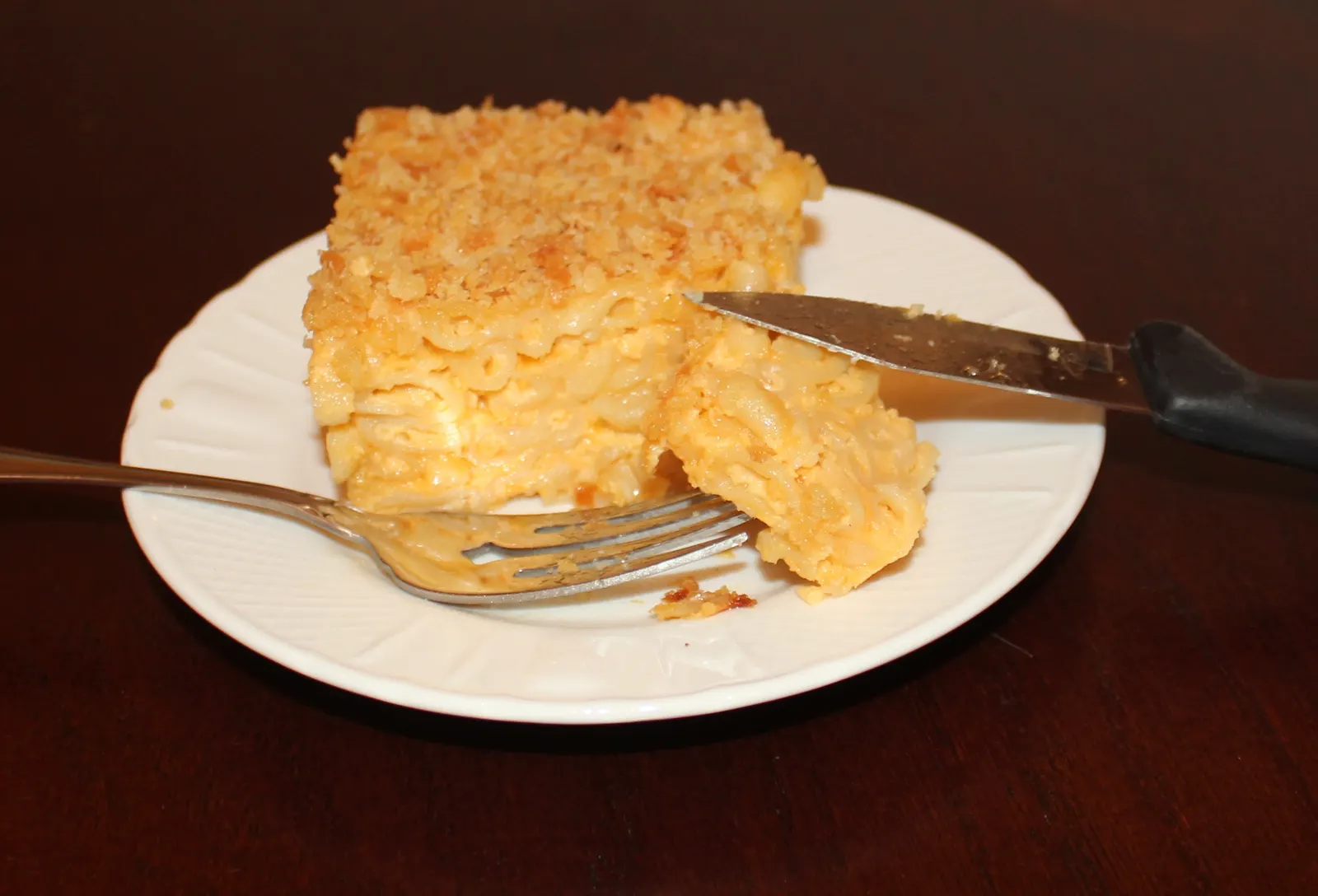
This baked macaroni and cheese illustrates the compact, creamy finish and golden top; Merrilou Johnson’s recipe uses fine angel hair and no crumb topping.Photo by Scott Veg · CC BY 2.0
Pasta
4 oz source quantity
Bake
375°F · 20 min
Rest
15 min
Yield
4 servings
The clever part begins before the recipe does. Merrilou Johnson looks at the fine noodles left after spaghetti night and sees a smaller, faster macaroni and cheese. Butter and flour give the milk a backbone, mild cheddar supplies the soft center, and sharp cheddar marks the top.
Angel hair changes the usual casserole rhythm. Its strands have already been cooked once and can move from tender to tired quickly, so the sauce is finished before they enter it. The spoon should fold, not mash. The oven’s job is simply to heat the quart dish through and wake bubbles across the cheddar cap.
“Extra spaghetti noodles become a family-requested baked macaroni and cheese, built around about four ounces of leftover angel hair pasta.”
One pasta, two lives
The fine strands begin as leftovers, then return to heat inside a flour-thickened cheddar sauce. Firm pasta survives that second cook best.
Cheddar changes jobs
Mild cheddar melts into the sauce off heat; sharp cheddar stays separate so the oven can turn it into the bubbling top.
Rest is part of cooking
Fifteen untouched minutes let the sauce settle around the thin noodles and turn a loose scoop into a cleaner portion.
The small-pan architectureStrand roux melt cap
Four parts decide whether fine pasta stays creamy
The 2013 proportions stay intact. Control comes from assigning each ingredient its original job and keeping the fine noodles out of unnecessary heat.
01
Angel hair pasta
Four ounces of fine strands make this a leftover rescue rather than a full-pan macaroni bake.
The source does not resolve whether its weight is dry or cooked. Keep the stated quantity and avoid pretending the two measurements are interchangeable.02
Butter and flour
Equal two-tablespoon measures form the roux that gives two cups of milk enough body to cling.
Cook the smooth paste for the source’s full minute, but keep it pale; this sauce wants thickening power, not toasted flavor.03
Mild cheddar
One and a half cups melt into the warm milk base, making the interior creamy and softly flavored.
Take the saucepan off the burner first and stir until no shreds remain before adding the fragile pasta.04
Sharp cheddar
The final half cup is reserved for the surface, where its stronger flavor meets direct oven heat.
Scatter it evenly and stop the bake when it begins bubbling; deep browning is not the source cue.
The leftover preflightFirm separate measured ready
Set the whole quart dish before melting butter
The sauce moves quickly once milk begins to thicken. A short mise keeps cheese off direct heat and delicate pasta out of the scramble.
Thin strand thick sauceTwo textures · one small casserole
Capelli d’angelo is the defining fine strand. When starting from dry pasta, stop at firm so the noodles can survive a second cook in the oven.Photo by Popo le Chien · CC BY-SA 4.0
The missing unit
The source says four ounces and also says leftovers. Because cooked and dry pasta do not weigh the same, the ledger preserves the number and names the ambiguity instead of inventing a conversion.
Freshly grating cheese keeps the shreds loose and quick to melt. The photograph shows an illustrative grating cheese; the source formula specifically calls for mild and sharp cheddar.Photo by Didriks · CC BY 2.0
The forty-nine-minute arcRoux thicken melt fold bubble rest
The sauce and bake pass six clear thresholds
Most of the active work happens in one saucepan. The last fifteen minutes are deliberately inactive and still belong to the method.
1 min
Cook the pale roux
Melt butter, whisk in flour and seasoning, then stir until the paste is smooth and lightly foamy but not brown.
~3 min
Wake the milk’s body
Whisk in milk and stir steadily until it begins to thicken and a spoon leaves a fleeting track on the pan.
Off heat
Melt the mild cheddar
Move the saucepan away from the burner before adding cheese; stir until the sauce is smooth.
Fold
Coat without crushing
Lift and turn the angel hair through the sauce so fine strands stay distinct rather than compressing into paste.
20 min
Bake to the first bubbles
Sharp cheddar should melt across the top and begin bubbling at the edge. The source asks for no darker target.
15 min
Let the casserole gather
Rest the pan untouched so the sauce settles and every serving brings both tender strands and the sharper top.
The creamy-casserole checksSmooth track melted bubbling
Read the pan before chasing the clock
The source gives short timings and one decisive finish cue. These four visual readings make each stage easier to recognize.
01
A smooth, pale paste
Before milk, the roux should be lump-free and foamy. Brown flecks mean the heat or timing has gone beyond the source method.
02
A brief spoon track
After roughly three minutes, the milk should begin closing slowly behind the spoon rather than looking as thin as when poured.
03
No visible cheese shreds
Mild cheddar should disappear into the off-heat sauce before pasta goes in; unmelted ropes make coating uneven.
04
Bubbles at the top edge
The source finish is active heat, not a hard crust. Stop when the sharp-cheddar cap starts to bubble.
The keeping planFirm rest shallow reheat
Treat this as a leftover recipe twice
Cooked pasta enters as yesterday’s ingredient and can leave as tomorrow’s portion, provided both transitions stay cold and prompt.
Use firm leftovers
This bake is a second life for cooked pasta. Noodles that already feel mushy cannot recover structure in the oven.
Serve after fifteen minutes
The casserole remains warm while its sauce settles. Cutting that rest short produces a looser first scoop.
Chill within two hours
Move leftovers to shallow containers and refrigerate at 40°F or below instead of leaving the warm baking dish on the table.
Use within four days
Reheat only what you need to 165°F. Covering the portion and adding a small splash of milk can limit drying.
Angel Hair Pasta and Cheese
Merrilou Johnson’s four-serving leftover-pasta bake with a pale cheddar roux, a sharp-cheddar cap, and a full fifteen-minute rest.
4 ounces angel hair pasta, cooked and drained; see note on the source’s weight ambiguity
2 tablespoons unsalted butter
2 tablespoons all-purpose flour
1 teaspoon fine salt
1/4 teaspoon ground black pepper
2 cups milk
1 1/2 cups shredded mild cheddar cheese
1/2 cup shredded sharp cheddar cheese
For the dish
Nonstick cooking spray
Directions
Have the cooked, well-drained angel hair ready. Merrilou’s recipe is written for leftovers. If starting with dry pasta, cook the source’s 4-ounce quantity only until firm according to the package directions, drain it, and set it aside; do not let the fine strands turn soft before they reach the oven.
Set a rack in the center of the oven and preheat to 375°F (190°C). Lightly coat a 1-quart baking dish with nonstick cooking spray.
Melt the butter in a medium saucepan over medium heat. Add the flour, salt, and pepper and whisk until completely smooth, then stir constantly with a wooden spoon for 1 minute. The paste should look cohesive and lightly foamy, without taking on brown color.
Pour in the milk in a steady stream while whisking. Continue stirring over medium heat for about 3 minutes, as the source directs, until the milk begins to thicken and the spoon leaves a brief track across the bottom of the pan.
Take the pan off the burner. Immediately add the mild cheddar and stir until the sauce is smooth and the shreds have melted. Fold in the cooked angel hair gently, lifting and turning so the fine strands are coated without being crushed.
Transfer the pasta and sauce to the prepared 1-quart dish. Spread it level without packing it down, then scatter the sharp cheddar evenly across the top.
Bake uncovered for 20 minutes, or until the cheese on top is starting to bubble around the edges and the center is hot. Do not extend the bake merely to force deep browning; the source’s finish is bubbling cheese.
Remove the dish from the oven and let it rest for the source’s full 15 minutes. The sauce will settle around the thin strands and portions will hold together more cleanly. Serve warm.
Source and technique references: Merrilou Johnson’s July 21, 2013 My Recipe Magic card for legacy ID 2500771758, the title, byline, four-serving yield, description, exact formula, saucepan method, 375°F bake, bubbling-cheese cue, 15-minute rest, taxonomy, and reported nutrition; King Arthur Baking’s Garlic-Herb Mac & Cheese for independent support for firm pasta, a thickened milk base, off-heat cheese melting, and a bubbly baked finish; University of Minnesota Extension for classifying cooked pasta and casseroles as perishable, two-hour control, shallow cooling, 40°F refrigeration, and 165°F reheating; and FoodSafety.gov for the four-day leftover limit. The ingredient ratios, cheese roles, oven temperature, bake, and rest remain unchanged; the added guidance clarifies technique, doneness, cooling, and reheating.