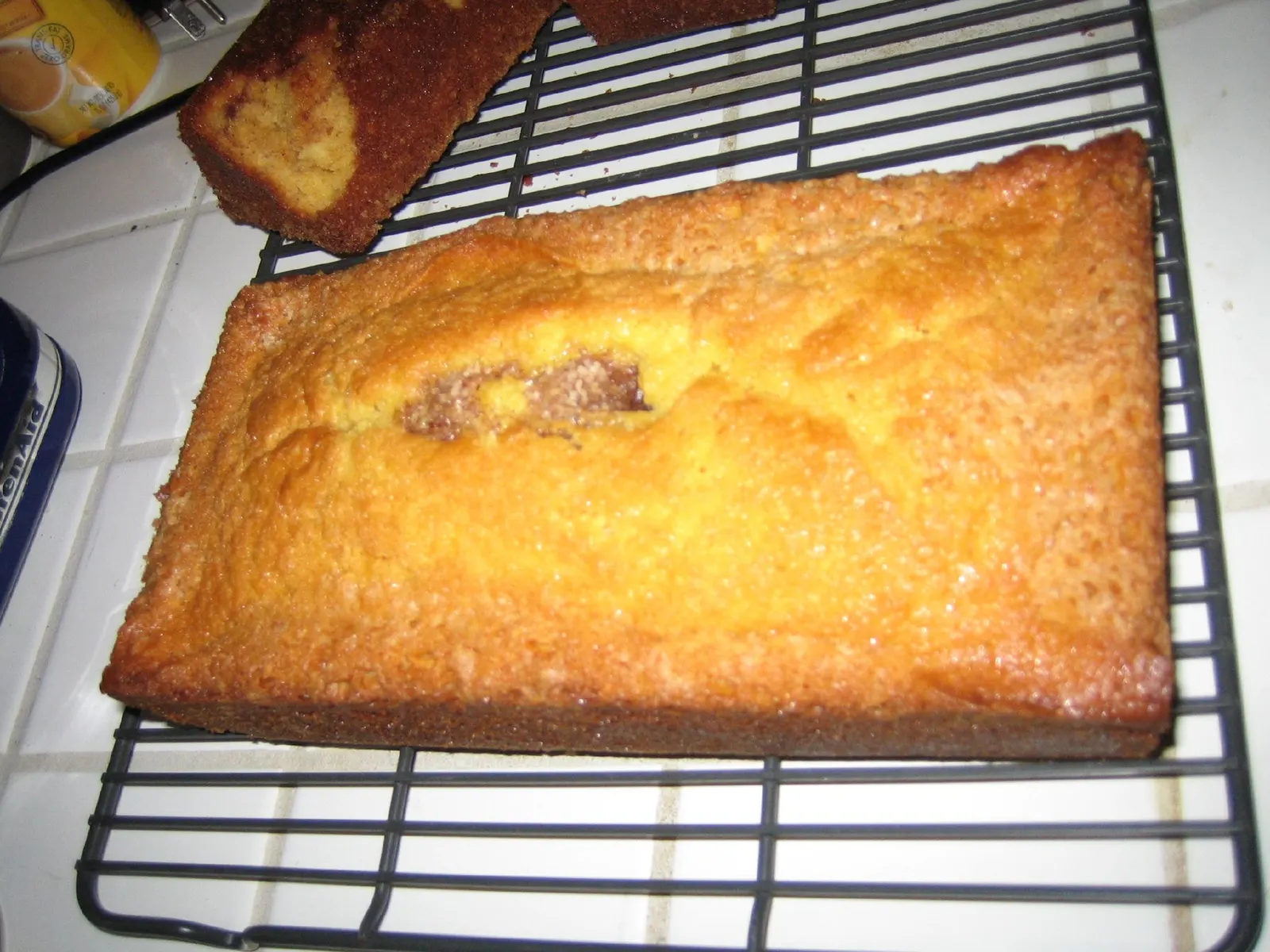
The same-day friendship loafButter · buttermilk · cinnamon ribbon
October 2012 · two shareable loaves
The Amazing Amish Cinnamon Bread Alternative
Melissa Whitcher’s starter-free cinnamon bread creams butter and sugar, leavens a buttermilk batter with baking soda, and layers a crackly cinnamon ribbon through two shareable loaves.
This photographed friendship bread shows the same cinnamon-sugar crown and shareable loaf shape. Melissa’s shortcut formula is different: it uses buttermilk and baking soda instead of a maintained starter.Photo by Glenn G / Wikimedia Commons · CC BY-SA 2.0
Prep
10 min
Bake
45–50 min
Oven
350°F
Makes
2 loaves
This is friendship bread with the calendar removed. Melissa Whitcher keeps the generous two-loaf spirit and the cinnamon-sugar middle, but replaces the maintained starter with buttermilk and baking soda. The batter can move from pantry to oven in ten minutes.
It behaves more like coffee cake than kneaded bread: softened butter is creamed with sugar, eggs bind the base, and a thick cultured-dairy batter is layered in two pans. The work is not waiting for fermentation; it is dividing fairly, swirling lightly, and letting the deepest center—not the fast-browning sugar crown—call the bake.
“Cinnamon bread (makes 2 loaves).”
Starter-free by design
Buttermilk supplies the acid for baking soda, giving this shortcut its same-day lift.
Divide in quarters
One-quarter of the full batter lands in each pan before the middle cinnamon layer; the other half caps both.
Swirl with restraint
A few shallow curves make a ribbon. Too much knife work dissolves the contrast into one sweet batter.
Test both centers
Two pans can finish minutes apart. A set crown and a center skewer without wet batter release each loaf.
The shortcut architectureCream acid lift layer
Six batter ingredients and one deliberate ribbon
The early linked copies agree on this spare formula. No vanilla, pudding mix, nuts, raisins, or glaze is needed to make its two tall, cinnamon-marked loaves.
It replaces the long starter ritual with immediate acidity and moisture, setting up the baking soda for a tall quick-bread rise.
The source also permits 2 cups milk plus 2 tablespoons vinegar or lemon juice; let that mixture stand while the pans and dry bowl are prepared.Read the ingredient story →02
Softened butter, not melted
Creamed fat holds fine air pockets before the chemical leavener joins in, while its richness gives the loaf a cake-like crumb.
It should yield to a fingertip but still hold its shape. Oily or melted butter cannot trap air the same way.03
Baking soda in the flour
Two teaspoons balance the cultured dairy across a large, two-loaf batter. Even dispersal prevents bitter spots and uneven lift.
Whisk until no small white clump of soda remains before the dry bowl meets the wet mixture.04
A two-stage cinnamon sugar
Three-quarters builds the hidden middle stripe; the final quarter creates a fragrant, crackly crown over both pans.
Divide by sight only after the mixture looks evenly tan, then spread edge to edge so every slice catches the ribbon.
Bark + cultured milkThe perfume and the lift
Cinnamon draws the stripe; buttermilk raises the crumb
Two teaspoons of ground cinnamon scent the full two-loaf batch; it is mixed with sugar and layered rather than beaten into the batter.Photo by Fumikas Sagisavas / Wikimedia Commons · CC0 1.0
Keep the name honest
“Alternative” is the useful word: this is a same-day quick bread inspired by friendship bread, not a maintained-starter formula or a claim of documented Amish origin.
Buttermilk is at right, leaving a visible coating on the glass. Its acidity works with baking soda while its moisture keeps this sweet batter tender.Photo by Ukko-wc / Wikimedia Commons · CC BY-SA 3.0
The two-pan clockCream mix layer swirl test cool
Twelve active minutes, then two centers to watch
The source’s one-hour total ends with the bake. A 20-minute pan rest and a complete rack cool are essential finishing time beyond that published clock.
0:00
Heat and grease
Bring the oven to 350°F and coat two 9-by-5-inch pans thoroughly.
+2
Map the dry bowl
Whisk 4 cups flour with 2 teaspoons baking soda until the leavener disappears evenly.
+4
Cream and bind
Work softened butter with 2 cups sugar, then beat in the eggs one at a time.
+7
Add acid and flour
Mix in buttermilk and the dry bowl on low, stopping once no flour pocket remains.
+10
Layer both pans
Batter, three-quarters of the cinnamon sugar, batter again, then the reserved top layer.
+12
Curve and bake
Draw a few shallow knife paths and begin the source’s 45–50-minute window.
0:57
Read each center
Release a loaf only when its crown is set and its deepest tester shows no wet batter.
1:17+
Turn out and finish
After 20 minutes in the pans, move the loaves to a rack and cool completely before slicing.
Four visual checksCreamed moist distinct set
Read the bowl, stripe, and crown in sequence
The timer is useful, but these cues reveal whether the fat is ready, the batter is fully mixed, and each loaf has actually set.
01
Creamed, not oily
The butter-sugar base is smooth and lighter in texture, with no pool of melted fat around the bowl.
02
Thick, evenly moist batter
The spatula finds no dry pocket at the bottom, but the mixture has not been beaten past uniformity.
03
A stripe, not a paste
Cinnamon sugar remains visible across the middle and crown after only a few deliberate knife curves.
04
Set crown, clean center
The top is deeply golden and stable while a thin center probe carries crumbs at most, never glossy batter.
The sharing planCool wrap gift freeze
One loaf for now, one loaf for later
The batch is naturally divisible. Protect the crackly top by waiting for complete cooling before any airtight layer goes on.
For today
Give both loaves the full 20-minute pan rest and complete rack cool. Warm slices compress and steam their own crust.
For the next few days
Wrap each cooled loaf airtight and keep at room temperature for 3–4 days; cut only what you plan to serve.
For sharing
Wrap one whole cool loaf in parchment, then an airtight outer layer. The two-loaf yield is the recipe’s built-in gift.
For the freezer
Wrap airtight and freeze up to 2–3 months. Thaw while wrapped so moisture collects outside the cinnamon crown.
The Amazing Amish Cinnamon Bread Alternative
Melissa Whitcher’s starter-free, two-loaf buttermilk quick bread with a layered cinnamon-sugar ribbon and crackly crown.
2 cups buttermilk, or 2 cups milk mixed with 2 tablespoons vinegar or lemon juice
4 cups all-purpose flour
2 teaspoons baking soda
Cinnamon-sugar ribbon
2/3 cup granulated sugar
2 teaspoons ground cinnamon
Directions
Heat the oven to 350°F / 175°C. Grease two 9-by-5-inch loaf pans thoroughly. If using the milk-and-acid alternative, stir the milk with the vinegar or lemon juice now and let it stand while the batter begins.
Whisk the flour and baking soda together in a medium bowl until the leavener is evenly dispersed; set aside.
In a large bowl, cream the softened butter with 2 cups sugar until smooth and lighter in texture. Beat in the eggs one at a time, scraping the bowl after each addition.
Add the buttermilk and flour mixture to the butter mixture. Mix on low, scraping the bottom and sides, only until the batter is evenly moistened and no dry flour pocket remains.
In a small bowl, stir the remaining 2/3 cup sugar with the cinnamon until the color is even.
Divide half of the batter between the two prepared pans—about one-quarter of the full batter in each. Level it gently, then divide three-quarters of the cinnamon sugar over those two layers.
Divide the remaining batter between the pans and spread it to the edges without compacting it. Top both loaves with the remaining cinnamon sugar, then draw a butter knife through each pan in a few shallow curves to marble the layers without fully blending them.
Bake for 45 to 50 minutes. Begin checking at 45 minutes: the crowns should be set and deeply golden, and a thin skewer inserted through the deepest center should come out without wet batter. Check both pans independently and give either loaf more time if needed.
Cool the loaves in their pans for 20 minutes. Loosen the edges, turn the loaves onto a wire rack, and let them cool completely before slicing or wrapping.
Source and research references: the queued legacy path and Melissa Whitcher’s unavailable October 2012 Redfly Creations URL for the exact title and source identity; the March 2013 Outer Banks Cookbook transcription, Sarah’s directly linked April 2013 bake record, and the June 2015 Tou Korek transcription for independent agreement on the eight ingredient lines, two-loaf yield, layering, 350°F oven, 45–50-minute bake, and 20-minute pan cool; Manila Spoon’s maintained same-formula recipe for the 9-by-5-inch pans, ten-minute prep, gentle mixing, airtight 3–4-day counter storage, and 2–3-month freezer guidance; Darien Gee’s friendship-bread history for the shared-starter tradition and uncertain origin of the familiar name; King Arthur Baking for thick quick-bread tester guidance and complete cooling; and FDA for raw-flour, raw-egg, and cleanup safety. The source proportions and identity remain unchanged; added details clarify mixing, division, doneness, cooling, storage, and labeling.