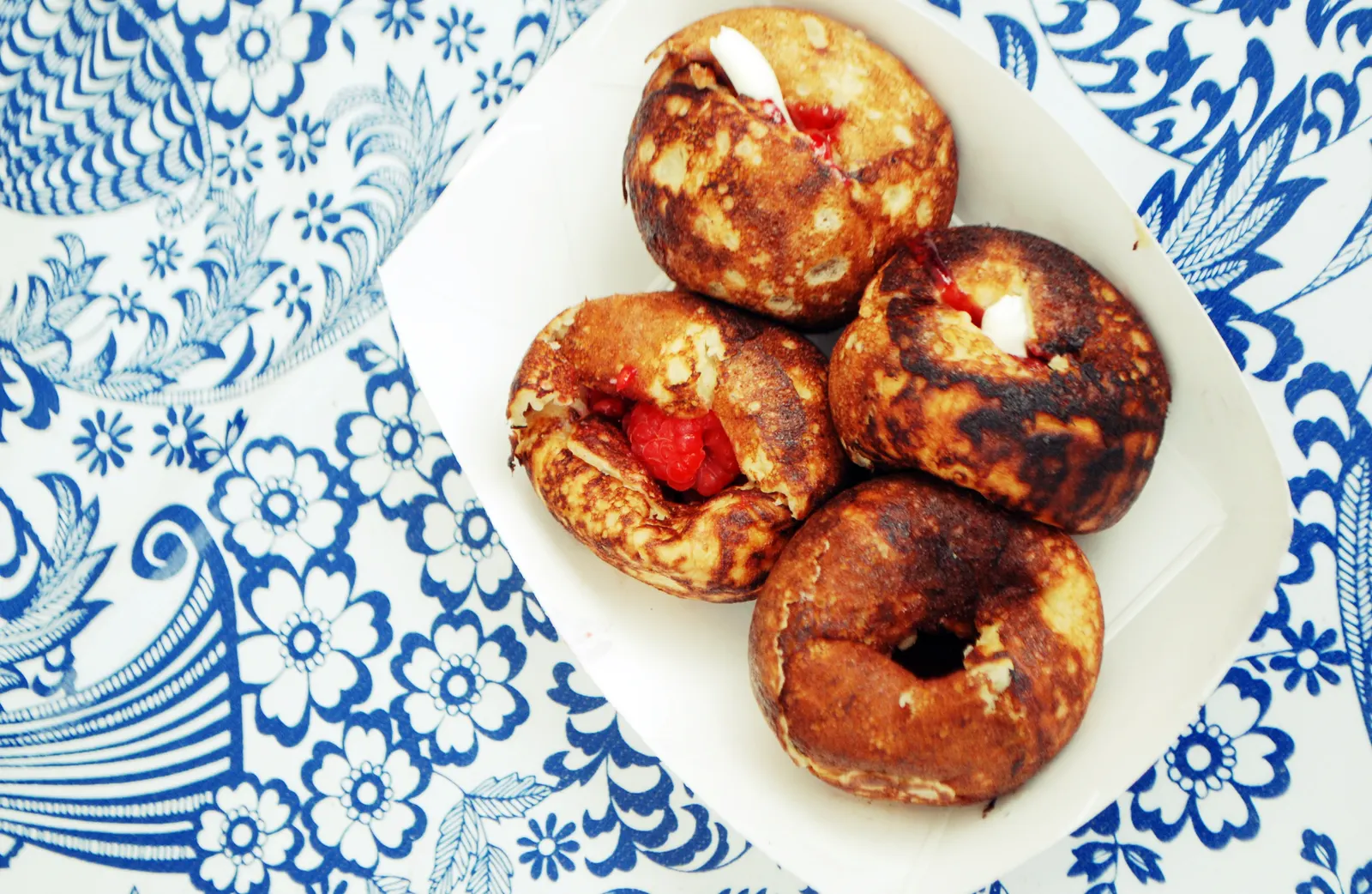
The Danish turning panSoft peak · cold apple · brown shell
Twenty-four little rounds
Aebleskivers (Evil Skeevers)
Kelli Davidson’s 24-piece family recipe folds soft-peak egg whites into a lightly sweet milk batter, encloses cold cooked apple, and turns each aebleskiver until round and brown.
The family nickname sounds mischievous; the batter is restrained. Kelli Davidson’s queued card uses only a tablespoon of sugar across two cups each of flour and milk. The pleasure comes from a cold apple center, buttered cast iron, and the moment a slim skewer turns a half-set pancake into a sphere.
The recipe travelled through Kelli’s Danish family, from her grandmother to cousins Dorothy and Dee and into her mother’s handwritten book. Advent was its natural season. Today VisitDenmark still describes æbleskiver with jam and icing sugar as a December-market ritual; this Danish-American edition keeps the older apple-filled form that gives the pastry its name.
“My dad was Danish and his mother used to make these for him, mostly during Advent, but really as often as dad asked. They are also called Danish pancakes.”
Air
Soft-peak whites fold into just-mixed batter, carrying the light center without extra sweetness.
Heat
Medium begins the batch; medium-low is the correction when butter or the first shell colors too fast.
Turn
A slim skewer slips under the set edge without crushing the sphere or dragging away much batter.
The four-piece logicFruit air lift butter
A quiet batter with an apple hidden inside
No spice is added and no filling is improvised. The legacy formula gets its character from one cooked fruit measure, separated eggs, and the geometry of the pan.
01
Cooked apple
One measured cup puts a tender fruit center inside every round without changing the barely sweet batter.
Measure after cooking, as the source insists, and chill before filling so the apple stays where it is placed.02
Separated eggs
Yolks enrich the milk base while separately whipped whites provide the soft, buoyant crumb.
Stop at soft peaks. Dry, stiff whites are harder to fold evenly and surrender more of their air.03
Baking powder
One teaspoon supports the egg-white lift in this sweet-milk batter; it is the leavener named twice in the ingredient lists.
Do not follow the stray “baking soda” word in the compact direction. There is no acidic dairy in the source formula.04
Butter
Half a stick enriches the batter; a fresh brushed film in every well promotes release and an even brown shell.
Watch the pan butter. If it races from foam to brown, lower the burner before adding the next batch.
The batch rhythmChill whip fold brush fill rotate
The turn happens fast
Preparation can be calm; once batter reaches hot iron, each well follows the same compact clock.
Ahead
Cook, measure, chill
Bring finely chopped apple just to tender, cool it completely, then measure the source’s one finished cup.
0:00
Build two mixtures
Combine flour, sugar, salt, and baking powder; separately whisk yolks, milk, and melted butter.
0:04
Whip to a soft bend
Beat the whites for the source’s 2–3 minutes, stopping when each lifted peak folds at its tip.
0:07
Mix once, fold once
Moisten the flour without chasing every lump, then preserve the air with broad folding strokes.
0:10
Butter every curve
Warm the pan evenly and brush about 1/4 teaspoon butter from the floor up the sides of each well.
0:11
Batter, apple, batter
Layer a scant tablespoon, a scant teaspoon of cold apple, and a second scant tablespoon quickly.
0:13
Turn the set shell
After 70–90 seconds, release and rotate each round; give the second side about another minute.
Warm
Dust and pass
Serve each batch promptly, then butter the wells again and tune the heat before refilling.
Iron + appleThe vessel and the hidden center
Seven curves outside, one cold spoonful within
A seven-well aebleskiver pan from the National Museum of Denmark. Its heavy iron stores heat while the curved wells build the spherical shape.Photo by Kåre Thor Olsen / Wikimedia Commons · CC BY-SA 3.0
The pan is part of the method
Its wells set curved shells from below. Even heat and a brushed film of butter matter more than forcing the burner high.
The recipe’s short timings work only beside physical cues. Read the foam, batter, shell, and center in sequence.
01
A peak with a bow
The whipped white rises from the whisk but bends at the top; it looks glossy, not dry or clumped.
02
A lightly lumpy batter
The flour is fully moistened without becoming sleek from overmixing, and no large white streaks remain.
03
A shell that releases
The lower curve is brown enough to lift cleanly when a skewer traces the edge; pale batter still clings.
04
A set, tender center
The round is golden all around, the apple remains enclosed, and the surrounding crumb shows no wet batter.
The serving planCold center fresh batter warm plate
Prepare the apple, never park the foam
The useful make-ahead move belongs to the filling. Everything after the whites are folded should move toward the pan and table.
Chill only the filling
Cold apple is an advantage; freshly mixed aerated batter is not. Cook the batter as soon as it is folded.
Serve pan to plate
The thin buttered shell is at its best immediately. Dust only the pieces headed to the table.
Cool promptly
Refrigerate leftovers within two hours in a covered container and use them within 3–4 days.
Reheat thoroughly
Warm refrigerated pieces to 165°F, ideally in dry heat that can revive the shell. The source offers no freezer method.
Aebleskivers (Evil Skeevers)
The 24-piece family formula from the queued card: lightly sweet milk batter, soft-peak whites, cold cooked apple, a buttered turning pan, and optional powdered sugar.
AebleskiverDanishPancakesAppleChristmasAdventCast Iron
Ingredients
Apple center
1 cup finely chopped cooked apple, measured after cooking and chilled
Soft-peak batter
2 cups all-purpose flour
1 tablespoon granulated sugar
1 teaspoon fine salt
1 teaspoon baking powder
2 large eggs, separated
2 cups milk
1/2 stick (4 tablespoons) butter, melted and cooled slightly
For the pan and finish
Additional butter, about 1/4 teaspoon per well for each batch
Powdered sugar, for dusting, optional
Directions
Have the apple ready before mixing the batter. If starting with raw apple, cook finely chopped pieces gently just until tender, without adding ingredients to the source formula. Cool completely, then measure 1 packed cup and refrigerate until cold.
Sift or whisk the flour, granulated sugar, salt, and baking powder in a medium bowl. The source ingredient lists name baking powder; use it here rather than the “baking soda” typo in the syndicated direction line.
In a second bowl, beat the egg yolks with the milk. Whisk in the melted, slightly cooled half-stick of butter.
With clean beaters, whip the egg whites for 2–3 minutes, stopping at soft peaks: when the whisk lifts, the peak should rise and then bend over rather than stand dry and rigid.
Pour the yolk-milk mixture into the dry ingredients and stir only until the flour is moistened; a few small lumps are preferable to overmixing. Fold the soft-peak whites through gently until no large white streaks remain.
Set the aebleskiver pan over medium heat. When it is evenly warm, place about 1/4 teaspoon butter in each well and brush the butter up the curved sides. If the butter darkens before the batter goes in, lower the heat toward medium-low.
Working briskly, spoon 1 scant tablespoon batter into each well. Set 1 scant teaspoon cold cooked apple in the center, then cover with another scant tablespoon batter.
Cook for 70–90 seconds, until the lower shell is brown and releases when nudged. Turn each aebleskiver with a skewer, knitting needle, toothpick, or fork, then cook the second side for about 1 minute. Rotate as needed so the outside browns evenly and the center has no wet batter; an egg-batter center should reach 160°F (71°C) when checked.
Lift the aebleskivers from the pan, dust with powdered sugar if wanted, and serve warm. Re-butter the wells and adjust the burner as needed before repeating with the remaining batter and cold apple.
Source and technique references: the May 19, 2013 My Recipe Magic card for legacy ID 2500672921, exact title, Kelli Davidson byline, 24-piece yield, ingredient list, compact method, and published nutrition; Kelli and Holli’s December 10, 2012 Kelli’s Kitchen post for the complete family provenance, cooked-apple measure, soft-peak timing, fill amounts, 70–90-second turn, cold-filling cue, low-to-medium heat correction, and documented ganache variation; King Arthur Baking’s test-kitchen version for corroborating the apple-filled identity, baking-powder sweet-milk batter, just-moistened mixing, light pan grease, scant-tablespoon layering, and warm service; VisitDenmark for contemporary December-market service with jam and icing sugar; the FDA’s egg-safety guidance for clean handling, 160°F cooking, two-hour refrigeration, 3–4-day storage, and 165°F reheating; and the Wikimedia Commons description pages preserved in the credits for authorship and licenses. The formula is unchanged; the corrected leavener word, apple readiness, heat diagnosis, doneness, and storage cues are explicit clarification.